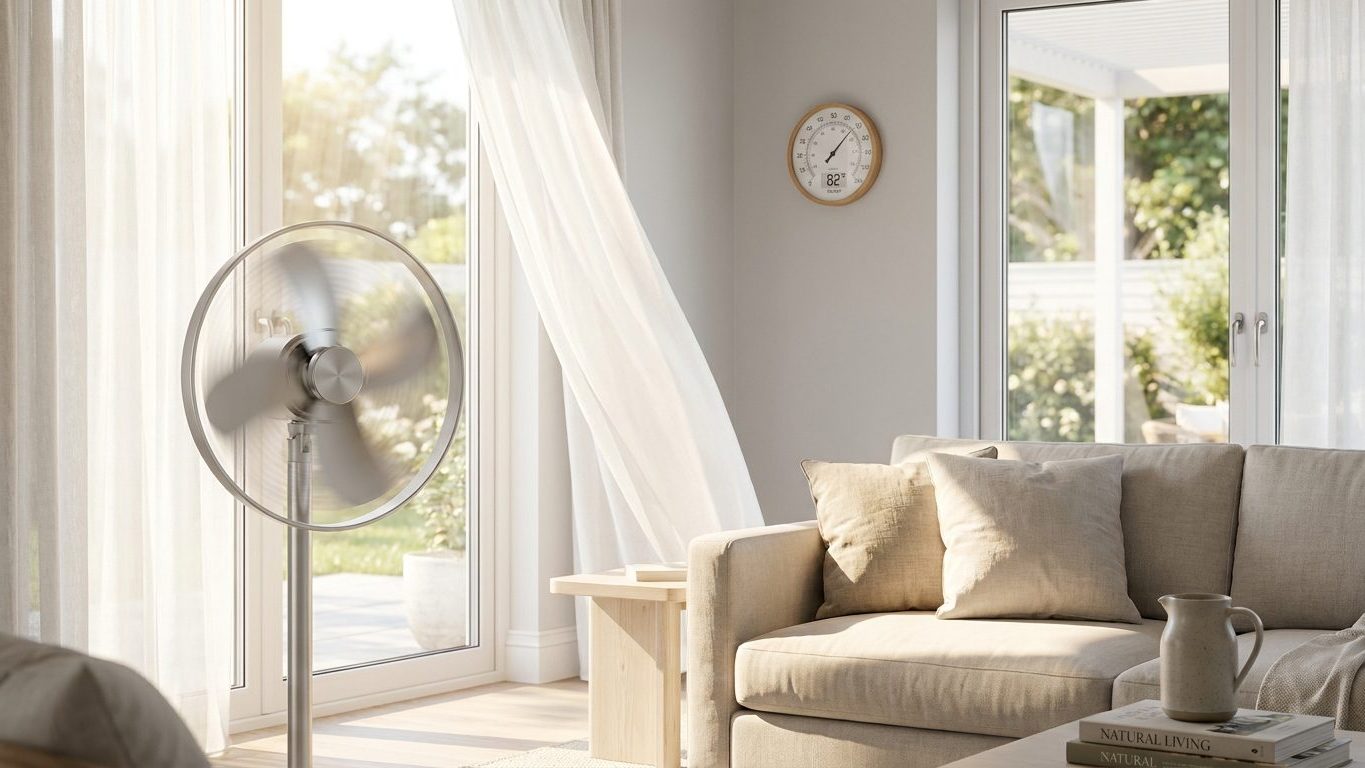

The honest answer is: fans, night ventilation, evaporative cooling, whole-house fans, and shading can all take the edge off summer heat without a compressor ever kicking on. None of them removes heat from a house the way an air conditioner does. Each one works only under a specific condition, and checking that condition first saves you from running equipment that does nothing.
Cooling that does not run a compressor
An air conditioner works by moving heat out of the house through a refrigeration cycle: refrigerant absorbs heat indoors, compresses, and releases that heat outside. Everything in this family works differently. Moving air across your skin speeds up evaporation from sweat, which feels cooler even though the room temperature hasn’t changed. Exchanging indoor air for outdoor air only helps when the outdoor air is actually cooler. Evaporating water into a dry airstream pulls heat out of that air as the water changes state. Keeping direct sun off glass stops a house from absorbing heat it would otherwise have to shed.
None of these methods lowers a thermometer reading in the room the way refrigeration does. A fan moves air, it doesn’t cool it, the room can read the same 82 degrees before and after you turn the fan on. Night ventilation only banks cool air if the night genuinely drops below your indoor temperature. Evaporative cooling depends on how dry the incoming air already is. These are conditions to check, not guarantees.
How many households already lean on these low-tech approaches instead of, or alongside, mechanical cooling? The U.S. Energy Information Administration’s Residential Energy Consumption Survey (RECS 2020) gives a useful national picture: 89% of U.S. homes use some form of air-conditioning equipment, 67% run a central system, and 26% use an individual unit like a window or portable air conditioner. But those national numbers hide enormous regional variation, and the gaps show how much climate and housing stock shape what people actually install.
Alaska is the clearest example. Only 7% of Alaska homes have any air conditioning at all, and 46% rely on ceiling fans instead. Compare that to Arizona, where 94% of homes have air conditioning and 86% run a central system, or Connecticut, where 90% of homes are cooled but only 34% have central air, meaning a large share depend on window or portable units. These figures describe what’s installed, which follows what was affordable and necessary when the housing stock was built. They aren’t a recommendation for what you should install in your own house.
Each one has a condition
Every method here has one thing in common: it only delivers real comfort under a specific circumstance. Skip the condition, and the method does little more than move air around or let heat back in. The table below lays out what each one actually does and what has to be true for it to work.
| Method | What it actually does | Condition it needs |
|---|---|---|
| Fan (ceiling or portable) | Increases airflow across skin, speeding evaporative cooling of sweat | Only helps a person who is in the room, it does nothing for an empty house, so it should run where people actually are |
| Night ventilation | Exchanges warm indoor air for outdoor air, cooling the house’s mass overnight | Works only when nighttime outdoor air is cooler than the air already inside the house, compare the two, don’t assume |
| Evaporative cooler | Passes air through water, which absorbs heat as it evaporates and lowers the air temperature | Needs dry air moving through it; in humid air, water evaporates far more slowly and the effect is diminished |
| Whole-house fan | Pulls large volumes of outdoor air through the house and pushes hot attic/indoor air out | Requires windows open somewhere in the house so it’s pulling in outdoor air, not just depressurizing sealed rooms |
| Shading (awnings, shutters, trees, exterior screens) | Blocks solar radiation before it ever reaches the glass | Only effective when the shading is outside the glass, interior blinds and curtains block light after the heat has already entered the room |
The whole-house fan and any large exhaust fan deserve one extra note. A powerful fan pulling air out of a closed-up house can depressurize it enough to draw combustion byproducts back down a natural-draft flue from a furnace or water heater. It’s not a reason to avoid these fans, but it is a reason to run them with windows open as intended and to have working carbon monoxide detection in the house. If you want the full mechanism behind that risk, see this site’s guide to carbon monoxide and combustion safety.
Notice that none of these conditions are about how hot it is outside in an absolute sense. They’re about a comparison: outdoor air versus indoor air, dry air versus humid air, sun versus shade. That comparison is something you can observe in your own house without needing a weather report to tell you what to do.
What to do first
Given five methods and five conditions, the order you tackle them in matters more than trying all of them at once. Start cheap and certain, move toward equipment last.
- Shade the windows that get afternoon sun. This comes first because it prevents heat from entering in the first place, rather than trying to remove it afterward. A window with direct exterior shading takes in dramatically less solar heat than the same window left bare, and the fix (an awning, exterior shade, or even a strategically placed shrub) keeps working every day without anyone touching it.
- Close the house during the day, open it when outside is cooler. Once the sun’s heat is blocked at the glass, the next lever is deciding when air moves in and out. Closing windows and shades during the hottest hours keeps that heat from following the sun in through open air paths; opening the house once outdoor air reads cooler than indoor air lets the accumulated heat leave. This only works if you’re actually comparing the two temperatures, not opening on a schedule out of habit.
- Run fans only where people are. With the house’s heat gain and heat exchange handled, fans address the last variable: how a given room feels to the person in it. A fan in an empty guest room does nothing for anyone and costs electricity for no comfort. Point moving air at occupied rooms and turn it off, or aim it elsewhere, when no one’s there.
- Only then consider equipment. If shading, timed ventilation, and targeted fans still leave the house too warm to live in, that’s the point to look at a whole-house fan, an evaporative cooler, or, if none of the above are enough for your circumstances, mechanical air conditioning. Equipment is the most expensive and most complex answer on this list, which is exactly why it belongs last, not first.
This order isn’t arbitrary. Each step removes or reduces a source of heat before the next step tries to manage what’s left. Skip straight to fans or equipment without shading the windows first, and you’re asking a fan or a cooler to fight heat that never needed to get into the house at all.
And the part that helps everything
Every method works better in a house that holds onto cool air and keeps hot air out through its walls, attic, and floors, and works worse in a house that leaks air freely in both directions. That’s the role of insulation and air sealing, and it’s worth being precise about what that role actually covers.
The U.S. Environmental Protection Agency’s ENERGY STAR program puts a number on it: “EPA estimates that homeowners can save an average of 15% on heating and cooling costs (or an average of 11% on total energy costs) by air sealing their homes and adding insulation in attics, floors over crawl spaces, and accessible basement rim joists.” That’s an average drawn from modeling of a typical existing home, and it names three specific locations: attics, floors over crawl spaces, and basement rim joists. It doesn’t extend to window performance or exterior shading, which are separate improvements with their own separate benefits.
The honest way to put these two facts together: a well-insulated, well-sealed house makes shading, night ventilation, fans, and evaporative cooling all perform closer to their potential, because the cool air you bring in overnight or the shade you create at the window actually stays where you put it. A leaky, poorly insulated house undoes a lot of that work, cool night air escapes through gaps almost as fast as it comes in, and heat that shading kept off the glass can still creep in through an unsealed attic hatch or an underinsulated rim joist. If you haven’t looked at your attic, crawl space floor, or rim joists yet, this site’s insulation guides under the energy and heating-cooling section walk through where those gaps typically show up and how homeowners address them.
Common questions
Does a ceiling fan actually lower the temperature in a room?
No. A fan moves air across your skin, which speeds evaporation and makes you feel cooler, but it doesn’t change the air temperature reading in the room. That’s why fans should run only in occupied rooms, an empty room gains nothing from moving air.
How do I know if night ventilation will help my house?
Compare the outdoor temperature to the indoor temperature at night. If outdoor air reads cooler than what’s inside, opening windows lets that cooler air replace the warm air the house built up during the day. If nights don’t drop below the indoor temperature, opening windows just lets warm air back in.
Is a whole-house fan safe to run with the windows closed?
It’s not the intended use. A whole-house fan needs open windows somewhere to pull in outdoor air; running it against a closed-up house can depressurize the space enough to pull combustion byproducts back down a natural-draft flue. Keep windows open when it’s running and make sure carbon monoxide detection is in place.
Does insulation help with summer heat the same way it helps in winter?
Yes, in the sense that the same air sealing and insulation in attics, floors over crawl spaces, and basement rim joists that keeps heat in during winter also keeps heat out during summer, which is why ENERGY STAR’s savings estimate covers both heating and cooling costs together. It doesn’t, however, cover window upgrades or exterior shading, those are separate measures with their own effect on heat gain.
Guides by state
- The Whole-House Fan: Emptying the House of Hot Air
- Attic Fans: What They Do, and Why They Are Not Whole-House Fans
- Ceiling Fans: What They Cool, and the Switch Nobody Uses
- Evaporative Coolers: Cooling With Water, and Where It Fails
- Cooling a House With Night Air, and the Hour That Decides It
- Keeping the Heat Out: Shade, Glass and the Cooling You Never Have to Buy