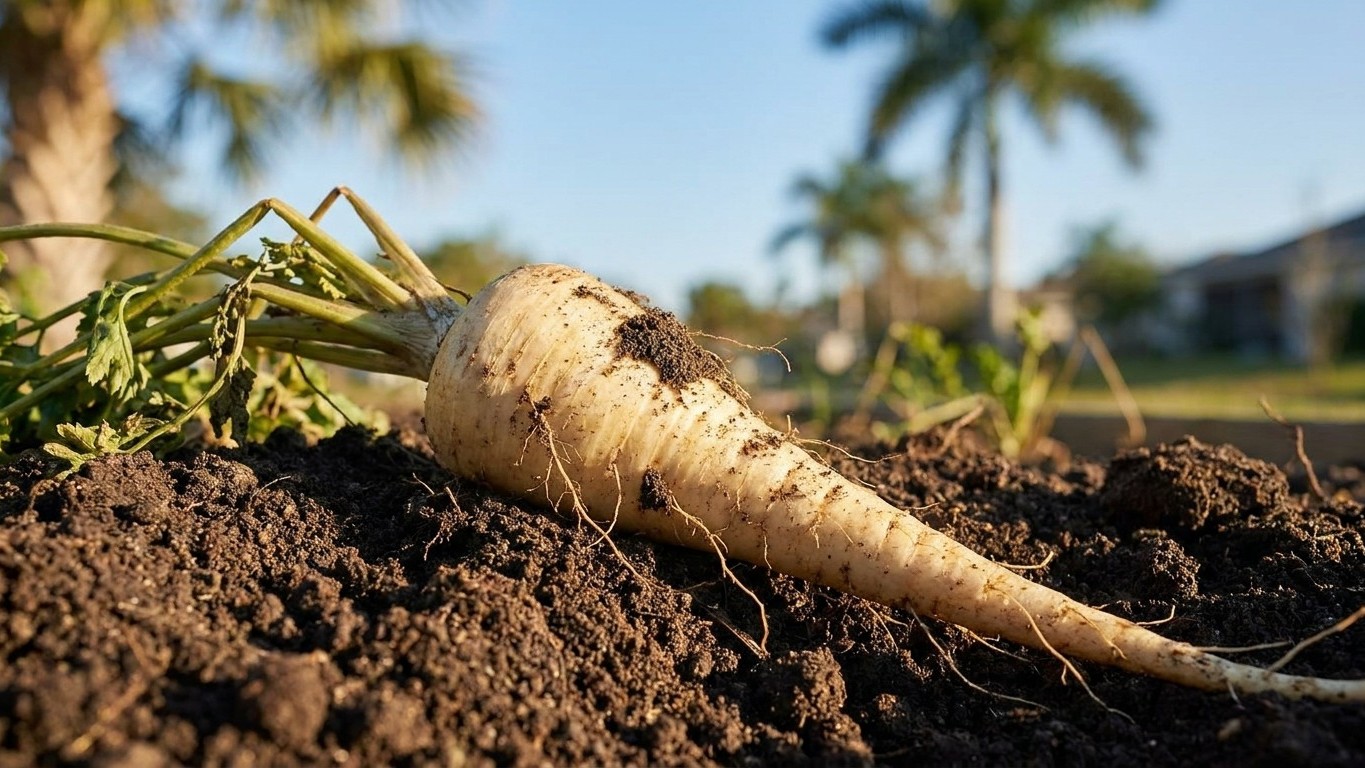

Lift parsnips in North Dakota after frost has worked on them for several weeks, which usually means late October into early November, and before the ground locks up solid. Cold soil makes the roots sweeter. Once dug, topped and held at 32 to 34°F with 98% humidity, they keep four to six months. The usual way to ruin them in storage is ethylene, so keep them away from apples and other ripening fruit.
The short answer
The question that decides it is whether the territory delivers several frosty weeks, and North Dakota does so easily. At Fargo, the reference station, the mean daily minimum of the coldest month is 0.2°F, according to NOAA NCEI climate normals. Utah State University Extension says parsnips taste best after several weeks of cool, frosty weather, because that converts stored starch to sugar. A parsnip grown here will sweeten, as long as it is still in the ground when the frost arrives. Exposure to frost decides that, and a hardiness zone number does not stand in for it.
Frost dates tell you when the weeks begin. NOAA NCEI puts the typical last spring freeze at Fargo between May 4 and May 15, and the first fall freeze between September 25 and October 5 (station data). Those are airport numbers. Suburban and rural gardens usually see the last spring frost later and the first fall frost earlier, often by one to two weeks, and more at elevation. Your county extension office can tell you what your own ground does. For what sweetening actually tastes like and how fast it happens, see Will Parsnips Sweeten in North Dakota?
When should you dig parsnips in North Dakota?
Wait for the first fall freeze, then give the roots several weeks of cold nights. With that freeze falling in late September or early October, the earliest good digging is late October. Pull one root and taste it, raw or roasted. If it is still starchy and bland, leave the rest alone for another week or two. The cold itself will not hurt them. The deadline is the ground, which freezes hard in a place where January nights average near 0°F.
Dig what you plan to store before the soil turns to concrete. Roots you want to leave in place can wait under a thick layer of straw or shredded leaves, which keeps the soil workable for digging on a mild day. Lift anything left over in spring, before new top growth starts.
How long do lifted parsnips keep?
USDA Agricultural Handbook 66 says parsnip roots can be stored four to six months at 32 to 34°F with 98% relative humidity (USDA Handbook 66). That is a long keeper by any standard. It assumes both numbers are held steady, and almost no house does that. A refrigerator crisper is cold enough but often too dry. An unheated garage or porch swings with the weather. Roots packed in damp sand or sealed in a perforated bag come closest to the high humidity. Expect the full four to six months only if you can hold both numbers.
Parsnips are not chilling sensitive. Top the leaves off after digging, but do not cut into the crown.
Why do stored parsnips turn bitter?
Ethylene is the culprit. Parsnips give off very little of it, under 0.1 microliters per kilogram per hour at 68°F. Even low levels of the gas in cold storage cause bitterness, likely through a buildup of a compound called xanthotoxin. Apples, pears and other ripening fruit are the common sources. A parsnip stored beside them at the perfect temperature can still turn bitter, so give the roots their own drawer, container or room.
Does the season fit?
It fits comfortably. Parsnips need 100 to 120 days from seeding, and they are sown in place, so the count starts the day the seed goes in the ground. The reference station’s frost-free stretch runs from mid-May to the end of September or early October. Here is how the weeks line up, with the usual caution that rural gardens run a week or two behind on both ends.
- Sow two to three weeks before the last spring frost, as soon as the soil can be worked. With that frost falling between May 4 and May 15, the window runs from about mid-April to the first days of May. Seed goes where the plants will grow. For spacing and bed prep, see Growing Parsnips in North Dakota.
- Expect nothing for 14 to 21 days. Germination is slow, and a bed that looks bare at two weeks is not a failure. Digging it up to re-sow is the classic mistake. Seedlings from a mid-April sowing show up around the time of the last frost.
- Add 100 to 120 days to the sowing date. Mid-April plus 100 days lands in late July. Early May plus 120 lands near the end of August. So roots reach full size somewhere between late July and the end of August.
- Compare that to the first fall freeze, September 25 to October 5. Even the slowest on-time sowing finishes about a month ahead of it. Seed that goes in as late as mid-May still comes out around mid-September on the longest count.
- Look at what the gap gives you. Full-size roots sit in cooling soil through September and October, and that stretch is when frost starts turning starch into sugar. A season with room to spare is what makes the sweetening possible.
The fit turns tight in one case: seed that goes in at the end of May in a rural garden that frosts early. Sowing then and counting 120 days leaves almost no margin, and the roots may be smaller than you hoped. Sow in the April window and the question never comes up.
What goes wrong here
- Forked roots in heavy or stony ground. A parsnip is a taproot, and anything it hits on the way down splits it into legs. Utah State University Extension recommends deep sandy soil and says heavy soil must be double dug. Some North Dakota ground is heavy clay, but your bed may differ from the state average. Squeeze a damp handful, and if it holds a sticky ball, loosen the bed to a full spade depth or two, pick out stones, and sow into the loosened row.
- Forked roots from overwatering. This is a separate cause with a separate fix. Soggy soil encourages branching and rot even in a well-loosened bed. Water evenly, and only when the top inch or so has dried out.
- A season that runs out. Late sowing is the main reason, and a bed dug up and re-sown after two weeks of nothing is the second. Seed needs 14 to 21 days to come up, so keep the seedbed evenly damp, not soaked, and be patient. Sow in the mid-April to early-May window and the 100 to 120 days finish well before fall frost.
- Lifting before the frost has done its work. The mild-winter problem, a fine parsnip that never turns sweet, does not apply here, since January nights average near 0°F. The local version is digging in September, when the roots are full size but still starchy. Wait for the first freeze plus several weeks, and taste one before you commit the row.
- Ground you cannot dig. A hard freeze can lock the roots in. Mulch the row deeply before the soil freezes, or lift the roots you want to keep in late October and early November. If chewed leaves or tunneled roots show up before then, What Eats Parsnip in North Dakota, and When covers the likely suspects.
Common questions
Can parsnips stay in the ground all winter in North Dakota?
Yes, parsnips are not chilling sensitive. The trouble is access, because frozen soil is hard to dig. A deep mulch of straw or leaves keeps the row workable on mild days. Dig what is left in spring, before new top growth starts, and use it quickly.
How soon after the first frost can I dig parsnips?
Give them several weeks of cool, frosty weather first. At Fargo the first fall freeze typically comes between September 25 and October 5, so late October is the earliest realistic digging. Rural gardens may freeze a week or two sooner. Taste a root before digging the whole row.
Can I store parsnips with apples?
No. Apples and other ripening fruit give off ethylene, and even low levels in cold storage make parsnips bitter. That happens at the correct temperature too. Keep the roots in their own container or drawer, ideally in a different room from the fruit.
How do I prepare parsnips for storage?
Brush off the loose soil and top the leaves, but do not cut into the crown. Then pack the roots in damp sand or in a perforated bag. Hold them at 32 to 34°F with high humidity, which the USDA handbook puts at 98%.