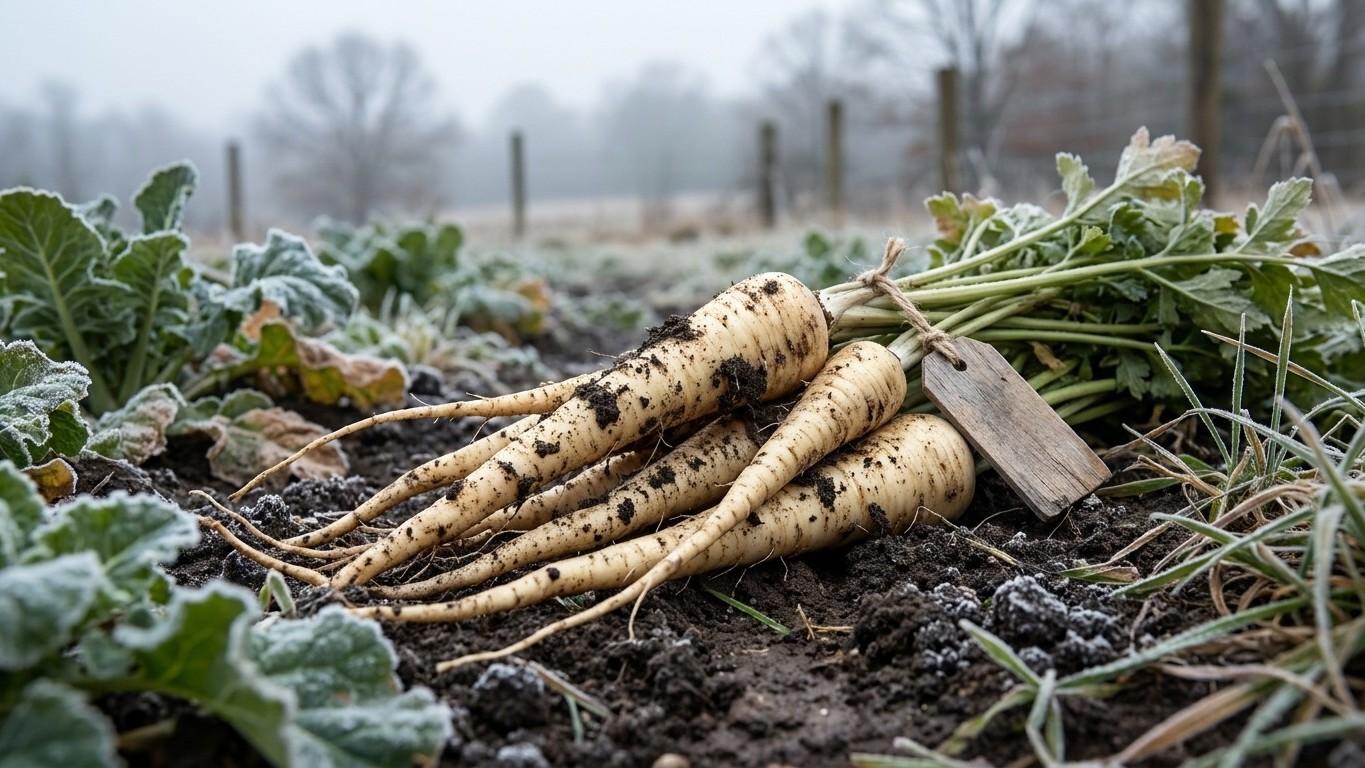

Yes. North Dakota’s winters bring long stretches of hard, sustained cold, and that’s exactly the exposure a parsnip root needs to convert its starch into sugar. A parsnip pulled from North Dakota ground after a run of frosty weeks won’t just survive here. It will taste like it.
The short answer
Fargo’s coldest month averages a daily minimum of just 0.2°F, according to NOAA NCEI Climate Normals covering 1991-2020. That’s not a single cold snap. That’s the average low across an entire month, meaning nights well below zero are routine, not rare. For a root vegetable that depends on frost to sweeten, this is about as favorable a signal as the numbers can give.
Here’s why that mean minimum matters more than any hardiness zone label. A hardiness zone tells you what a perennial plant can survive over winter. It says nothing about how many frosty weeks a biennial root crop sits in the ground absorbing cold before harvest. Parsnips don’t care what zone they’re in. They care whether the soil around them drops below freezing repeatedly, for long enough, while the root is still in the ground and still alive. A 0.2°F average minimum in the coldest month tells you that in North Dakota, that exposure isn’t marginal. It’s the norm.
The starch-to-sugar conversion in a parsnip root is a direct physiological response to cold stress. Utah State University Extension notes that parsnips taste best after several weeks of cool, frosty weather, and that this exposure is what converts the stored starch into sugar. A parsnip grown in a place with a mild, short winter, coastal California, for instance, will still grow to full size. It just won’t develop the sweetness gardeners actually plant parsnips for. North Dakota doesn’t have that problem. The frost arrives early relative to much of the country, it’s deep, and it lingers.
What this means practically: a gardener in Fargo, Bismarck, or Grand Forks who leaves parsnips in the ground into October and into the first weeks of consistent sub-freezing nights is doing exactly what the crop needs. The risk in this state isn’t insufficient cold. It’s the opposite, timing the harvest before the ground locks up so hard that digging becomes a real chore, or planning storage before a true deep freeze sets in. That’s a logistics problem, not a sweetness problem. On the sweetening question alone, North Dakota’s climate does the work for you.
Does the season fit?
Parsnips need 100 to 120 days counted from the day you sow, not from transplant, since they’re always sown directly in the ground. Add another wrinkle: germination alone takes 14 to 21 days, so those first three weeks look like bare soil even when everything is working exactly as it should. Here’s how the North Dakota calendar lines up against that requirement.
- Start with the last spring frost. At the Fargo reference station, that date falls between May 4 and May 15. Sow 2 to 3 weeks before that window closes, which puts a realistic seeding date in mid-to-late April, roughly April 13 through May 1, depending on how the season is running and how your own soil is thawing and draining.
- Add the germination lag. Nothing visible happens for 14 to 21 days. A sowing on April 13 might not show green until early May. That’s normal, not a failed crop, so resist the urge to till it under and start over.
- Count forward the full 100 to 120 days from seeding. From an April 13 sowing, 100 days lands around July 22 and 120 days lands around August 11. From a May 1 sowing, the range runs from roughly August 9 to August 29.
- Compare that to the first fall frost. The Fargo reference station sees its first fall frost between September 25 and October 5. Every one of the maturity dates above lands well ahead of that, by five to nine weeks depending on your exact sowing date.
- Read the gap as your sweetening window. Those extra weeks between “mature enough to eat” and “the ground is frozen solid” are exactly the frosty stretch the root needs. In North Dakota, that gap isn’t tight. It’s generous.
The arithmetic says this season fits comfortably, with real room to spare, for an April sowing. Push seeding into late May or June, though, and the math tightens fast: a June sowing plus 120 days runs past the reference station’s first frost date and toward the point where the ground itself becomes difficult to work. Sow on time and North Dakota’s frost calendar works in your favor twice, once to finish the crop, once to sweeten it. Sow late, and you’re racing a ground freeze instead of welcoming it.
One caution worth repeating: these frost dates come from a single airport weather station. Rural and suburban gardens in this state commonly see frost arrive a week or two earlier in fall and linger a week or two later in spring than the reference figures show, and elevation or a low-lying yard can push that further. Treat the dates above as a starting point, then watch your own county’s pattern before you commit a sowing date.
What goes wrong here
- Forked roots from heavy or stony ground. Much of North Dakota, especially the Red River Valley, carries dense clay soil that resists a parsnip’s long taproot and pushes it to split around obstructions. Utah State University Extension recommends deep, sandy soil for straight roots, and where the ground is heavy, double digging the bed to break up compaction before sowing. A raised bed filled with a lighter, sand-amended mix solves this without fighting the native clay at all.
- Forked roots from overwatering. This is a separate cause from soil texture, and it’s an easy one to trigger with good intentions. Inconsistent or excessive watering, heavy soaking followed by dry stretches, encourages the root to branch rather than grow straight down. The fix is steady, even moisture through the growing season rather than deep drenching on a whim.
- A season pushed too late to finish. Sowing in June instead of the April window described above eats into the buffer between maturity and the first fall frost. In a state where the ground can freeze hard soon after that frost arrives, a late-started crop risks still being immature when digging turns from routine to genuinely difficult. Sow within the recommended window and this risk mostly disappears.
- Ground freezing too hard before harvest. This isn’t a sweetening failure, it’s the opposite problem: North Dakota’s cold is generous enough that the soil can lock up solid before you get around to digging. A heavy layer of straw mulch over the row after a few hard frosts keeps the ground workable longer, letting you leave roots in place through more of the sweetening period without losing access to them entirely.
Common questions
Do parsnips need a specific variety to sweeten in North Dakota?
The available guidance from Utah State University Extension doesn’t name a particular variety, and none should be assumed. What drives sweetening is frost exposure and time in the ground, not a variety label.
Can I leave parsnips in the ground all winter in North Dakota?
The published guidance covers the days-to-maturity and the frost-sweetening mechanism, not a specific overwintering protocol for this state. What’s clear is that a heavy mulch layer helps keep soil workable through the frost period described above, so you’re not caught trying to dig through solid frozen ground.
What if my parsnips come up forked?
Check both possible causes rather than assuming one. Heavy, clay-rich, or stony soil is one driver, and double digging or switching to a raised bed with a sandy mix addresses it. Uneven or excessive watering is a separate driver, and steady, moderate watering through the season addresses that one instead.
When exactly should I Sow Parsnips in North Dakota?
Aim for 2 to 3 weeks before your local last spring frost. At the Fargo reference station, that frost falls between May 4 and May 15, putting a typical sowing window in mid-to-late April, though your own county may run a bit later. Expect no visible growth for the first 14 to 21 days while germination happens underground.