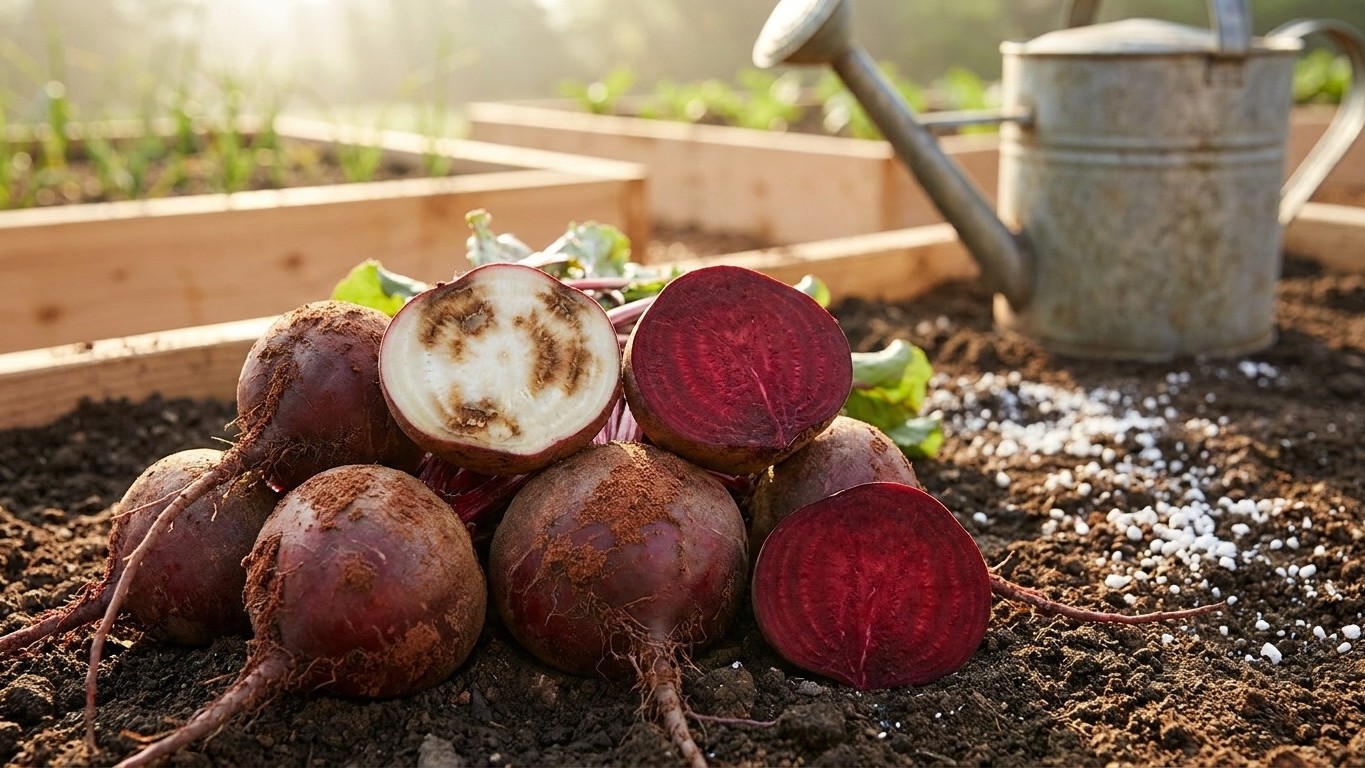

Pull beets when the roots have reached a useful size, which the seed packet counts as 60 to 80 days from seeding, and before the soil starts to freeze. Then top them and store them at 33 to 36 °F. Beets are the odd one out among root crops, because holding them right at freezing makes them keep worse. The sections below cover why, which room in a house comes closest, and how to judge a root in the garden.
Why colder is not better for beets
What does USDA say about beet storage temperature?
The answer comes from USDA Agricultural Handbook 66, the commercial storage reference, in a chapter by F. Adamicki. For topped beets, meaning the leaves are cut off, it calls for 1 to 2 °C, which is 33 to 36 °F, with relative humidity at 98 percent. It then adds a line most gardeners would not expect: during storage at 0 to 1 °C (32 to 34 °F), more black spot and rot occur than at higher temperatures.
That runs against habit. A gardener who stores carrots pushes them as close to freezing as the space allows, and the same instinct gets applied to every root in the bin. Beets don’t follow that rule. A degree or two of extra warmth gives you fewer spoiled roots, and the handbook’s target sits just above the range where the trouble shows up.
The humidity number matters as much as the temperature. Air at 98 percent is close to saturated, far damper than a typical house. Roots held in dry air lose water and wrinkle, which is why a cool but dry spot still disappoints.
How long do bunched beets last with the leaves on?
Bunched beets, with the tops still attached, keep about 10 to 14 days at 32 °F and above 98 percent humidity, according to the same handbook. Treat that as a ceiling reached only under ideal conditions. A warm kitchen, dry air or a bruised root will shorten it, and nothing about the figure promises a full two weeks.
The practical move is to cut the tops off soon after pulling, leaving a short stub of stem, and then store the roots at the topped-beet target. Leaves are the part that gives out first when beets are held as a bunch, and once they are gone the roots can be handled on the longer schedule that topped storage allows. If you want to eat the greens, cook them in the first few days.
Does the fridge count? A kitchen refrigerator is usually run colder than the 33 to 36 °F target, so beets in it sit in the range where the handbook reports more black spot and rot. That is fine for a week of eating. It is a poor plan for the bulk of a fall harvest.
The handbook is written for commercial storage rooms with controlled air, so a house will never match it exactly. The direction still holds. Aim for cool and very damp, and stop short of cold.
Where in the house that actually is
Which space comes closest in a New Jersey home?
The handbook gives a wider safety band for pits and cellars: the temperature should not drop below 31 °F or climb above 41 °F. Inside that band, 33 to 36 °F is the sweet spot. In a typical New Jersey house, an unheated, unfinished basement is the best candidate, particularly a corner on the north or an outside wall, well away from the furnace, the water heater and any ductwork. Many basements here sit in the 40s or 50s early in the fall, which is warmer than the band, and drift down as the weather turns. An enclosed, unheated bulkhead stairwell or a purpose-built cold room can do better.
Spaces that swing are the ones to rule out. An attached garage can slide below 31 °F on a January night, and a heated mudroom or pantry sits far above 41 °F. A freezer-adjacent shelf in a garage can be both too cold and too variable.
What should you check with a thermometer?
Put a min/max thermometer where the box will sit and leave it for several days before the harvest. Read both extremes, not just the current temperature. You want the low to stay at or above 31 °F, the high at or below 41 °F, and the average hovering in the mid-30s. If the reading is warm, the roots will still keep, but for fewer weeks, and you should plan to eat them sooner.
Humidity is harder to measure, but the beets will tell you. If they wrinkle within a couple of weeks, the air is too dry. Packing them in a lidded container with damp sand, or in a loosely closed bag, holds moisture around the roots.
Size matters here too. The handbook is explicit that large roots keep much better than small ones because they lose water and shrivel more slowly. Keep the biggest roots for storage and eat the small ones first, since the small ones will be the first to go limp.
How do you know when beets are ready to pull in New Jersey?
Beets are sown in place, so the clock starts at seeding. For a spring sowing, the reference airport station puts the last frost between March 29 and April 6. Suburban and rural gardens usually see it later, often by a week or two, so check your own county. Count the packet’s 60 to 80 days from the day the seed went in the ground, then start testing roots near the early end of that range. Pull one and look at it. A root that has reached usable size can come out, and the rest can stay in the ground a little longer.
For storage, a larger root is the better bet, so a fall crop is worth letting size up. That window closes when the ground begins to freeze, so pull the whole row before then. Where the plants have been chewed down to stubs, What Eats Beet in New Jersey, and When explains what to look for, and the full growing calendar is in Growing Beets in New Jersey.
The soil shapes the harvest as much as the calendar. The Downer series, which USDA lists as New Jersey’s representative soil, is a well-drained Ultisol with 79 percent sand, 6 percent clay and 15 percent silt, a surface pH of about 6.3 and organic matter near 1.2 percent. Sandy ground like that drains fast and dries fast. It is a starting point, because your own garden may be nothing like it, and a soil test will give you your real numbers. Beet Soil in New Jersey: What the Root Will Meet goes through how to read one.
Utah State University Extension describes beets as wanting deep, sandy, well-drained soil rich in organic matter, amended with no more than 1 inch of composted organic matter per 100 sq ft. It names two separate failures, and they should not be confused. Water stress in the first 6 weeks causes premature flowering, which is bolting. Heat above 85 °F combined with water stress makes the root woody. The first happens to young plants, the second to roots that are already sizing up, and in sandy ground both come down to how reliably the bed gets watered at the right stage.
Common questions
Can I store beets in the refrigerator?
For a few days of eating, yes. For long storage, a refrigerator is usually colder than the 33 to 36 °F target, and the handbook reports more black spot and rot at 32 to 34 °F than at slightly warmer temperatures. A cool basement that stays between 31 and 41 °F is the better home for a large harvest.
How long do beets keep with the leaves on?
About 10 to 14 days at 32 °F and above 98 percent humidity, and that is the maximum under ideal conditions. In a warm or dry spot, expect less. Cut the tops off to move to the topped-beet target of 33 to 36 °F.
Which beets should go into storage?
The big ones. Large roots lose water and shrivel more slowly than small roots, so they keep much better. Eat the small ones first.
When can I sow beets in New Jersey?
At the reference airport station, the last spring frost falls between March 29 and April 6. Suburban and rural gardens typically see it one to two weeks later, so your county extension office can confirm the date for your area. Count the packet’s 60 to 80 days from seeding, since beets are sown directly in the ground.