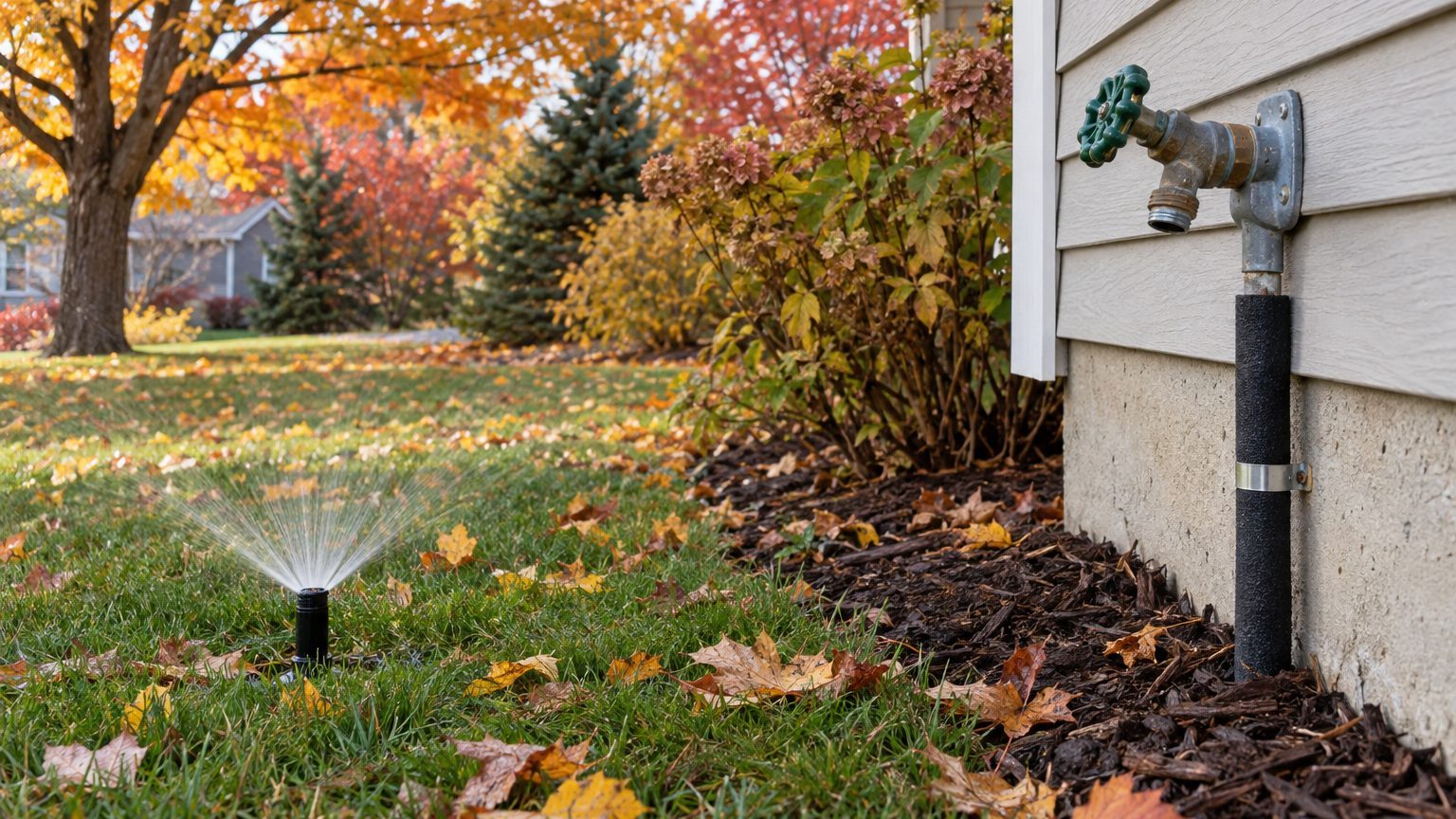

Shut down sprinklers and outdoor taps in the weeks before New Jersey’s first hard freeze. At the Newark airport weather station, the first fall freeze arrives between November 4 and November 16, and colder parts of the state get there sooner. Water left in a line or valve turns to ice when the temperature drops, and ice splits brass, plastic and copper. You usually find out in spring, when the water goes back on. Four jobs cover it: pick the window, clear the sprinkler lines, pull the hoses, and know what a cold snap does to the rest.
When to do it in New Jersey
Winterize before the first hard freeze, not after the first light one. NOAA’s 1991-2020 climate normals for Newark airport put the first fall 32°F freeze between November 4 and November 16, the band where the odds of a freeze run from 30 to 70 percent. A light freeze is a night that dips just under 32°F and warms up by mid-morning. A hard freeze holds well below 32°F for hours, long enough to freeze water standing in pipes, valves and the body of a faucet.
Those dates describe the airport, which sits in a warm, paved, built-up corridor. Suburban and rural yards typically see their first fall frost one to two weeks earlier, and more so at higher elevation. The colder the spot (farther north, higher up), the earlier the fall work belongs on your calendar. So the working rule is: finish before the November 4 to November 16 freeze window, and earlier in colder suburban, rural or northern yards.
New Jersey does not get the mild-winter exemption that lets southern homeowners skip the blowout. The mean daily minimum in the coldest month at Newark is 25.5°F (NOAA NCEI Climate Normals, 1991-2020). That means a typical January night sits well under freezing, and the cold lasts long enough to freeze a pipe. A full sprinkler blowout and a full faucet shutdown are the normal routine here. The USDA Plant Hardiness Zone Map (2023) places the state in zones 6a through 7b, a wide spread that tells you how much colder the northwest can be than the cities near the coast.
If it’s already mid-October, you have time but not a lot of it. Spend the next couple of weekends on this instead of waiting for a cold forecast. Pipes don’t care that the calendar says there’s still a week left if a front drops lows to the mid-20s early.
How do I find my own first-freeze date?
Start with your county’s Rutgers Cooperative Extension office, which can tell you how your area compares with Newark. The NOAA normals mentioned above are also published for weather stations across the state, so you can look up the one nearest you. Then subtract a week or two if you live in a suburb or on rural land. When the forecast first shows overnight lows close to 32°F and you haven’t started, do the work that day. The step-by-step version for taps is in Winterizing Outdoor Faucets Before the First Freeze.
Sprinkler lines: drain or blow out
Water expands as it freezes. In a pipe, the first ice forms a plug, and the liquid trapped between that plug and a closed valve has nowhere to go. Pressure builds until something gives, usually a fitting, a valve body or a section of poly pipe. Buried mainline is often below the frost line, but the parts that break first are the ones close to the surface: risers, sprinkler heads, valve diaphragms, and the backflow preventer standing above ground near the house. Any low spot in the line that holds water is a risk too.
Should I drain or blow out a sprinkler system?
There are three ways to empty a system, and they are not equally thorough.
| Method | How it works | Fit for New Jersey |
|---|---|---|
| Manual drain | You open drain valves at the low points and let gravity empty the lines | Works only on systems built with those valves and sloped pipe; water often stays in pockets and valves |
| Automatic drain | Drain valves open on their own when line pressure drops | Convenient, but they clear only the section they sit on and can stick or leak |
| Compressed-air blowout | An air compressor pushes water out through the heads, zone by zone | The method this climate calls for, since it clears the low spots gravity misses |
With a coldest-month mean minimum of 25.5°F at Newark, partial draining is a gamble. Gravity alone rarely empties every low spot, and a single pocket of water is enough to split a fitting. The safer routine is a compressed-air blowout, done before the November 4 to November 16 freeze window, with manual or automatic drain valves opened as a backup if the system has them.
The sequence is short. Turn off the water supply to the irrigation system and set the controller to its off or rain mode. Connect the compressor to the blowout port, if the system has one. Run each zone, one at a time, until the heads stop spitting water and only a light mist comes out. Then move on. Running air through a zone for too long can overheat and damage sprinkler heads, and too much pressure can crack fittings. Wear eye protection and keep your face away from heads and the backflow device while the air is on.
Hiring a professional makes sense in several cases. One is a system with no blowout port. Another is a compressor too small to move enough air. Others are a large number of zones, a backflow preventer with visible cracks, or any doubt about what pressure your pipes and heads can take. Compressed air in the wrong hands is a hazard, and a pro brings equipment sized to the system and does the same job in a fraction of the time. After the blowout, leave the main shutoff for the irrigation closed through winter and keep the lids on valve boxes.
Outdoor faucets and hoses
Outdoor taps need only a few minutes and no tools beyond your hands. First, unscrew every hose from every spigot. That includes splitters, nozzles, timers and soaker hoses. Drain each hose and coil it for storage. Next, find the interior shutoff valve for that outdoor line, often in a basement or crawl space near the wall where the tap sits, and turn it closed. Then open the outdoor tap fully and let the remaining water run out. Hoses off and the interior valve closed before the November 4 to November 16 freeze window is the decision that prevents most spring plumbing calls.
Leave the outdoor tap open all winter so any leftover water has room to expand without pressure. If there is no interior shutoff, if the valve won’t turn, or if it drips when closed, stop there. Cutting, replacing or modifying the supply line is plumber’s work, and an inexpensive shutoff problem is better solved before a hard freeze than during one.
Why does a frost-free faucet still fail with a hose attached?
A frost-free tap has a long stem that puts the actual valve seat several inches inside the heated wall. When the handle is closed, the barrel behind it is meant to tilt slightly downward and drain out through the spout. That only works if air can get in and water can get out. A hose, even one with a closed nozzle, traps water in the barrel. When temperatures fall, that water freezes in the cold part of the pipe, and the ice splits the barrel or a joint behind the wall. Nothing looks wrong from the outside. The leak appears in spring, when the tap is opened and water sprays inside the wall, onto a basement ceiling or across a rim joist.
So even a frost-free model needs the hose off, and many homeowners add an insulated cover over the tap on the coldest nights as a second layer. The cover doesn’t replace draining. More on how these taps work, and how to tell whether yours slopes the right way, is in Frost-Free Outdoor Taps. A tap that holds water after you close it, or that drips from the spout for a long time, probably has a worn or misaligned part. A plumber should look at it.
What goes wrong here
What if a cold snap arrives before I’ve drained anything?
The Newark dates are averages. Some years bring the first hard freeze earlier, and rural and northern yards often get it a week or two sooner than the airport. The classic mistake is waiting for a first frost warning, only to find a hard freeze before the weekend. If cold is forecast and you aren’t done, shut off the irrigation supply, open every drain valve and every outdoor tap, and pull the hoses that night. Schedule the blowout afterward. A system with water in it that goes through one freezing night may survive, but each night adds the chance that something cracks. Damage to sprinkler lines is usually a spring discovery: a geyser at a head, a zone with weak pressure, a hissing valve, or a soggy patch in the lawn that wasn’t there last year.
Why do forgotten hoses and valve boxes cause spring leaks?
A forgotten hose is the most common cause of a split tap. In spring, turning on the outdoor line can send water into the wall. The signs are a damp spot on a basement ceiling, a stained patch of drywall, or the sound of running water when every tap is off. Shut the interior valve right away and call a plumber. If pipes inside the house are frozen or you aren’t sure what is cracked, Frozen Pipes lays out what to do and what to leave alone.
Valve boxes can flood too. Water seeps in, pools around the valves, and freezes. The ice cracks valve bodies, solenoids or the backflow assembly. Keep box lids on, clear soil and debris, and check that the box isn’t sitting in standing water. Check every outdoor tap and valve box before the November 4 to November 16 window, with colder northern and rural yards earlier. In spring, open the irrigation supply slowly and walk the zones looking for leaks. Fall is also a good time to handle other outdoor jobs, and Winterizing a Lawn covers the ones that belong in the same weeks.
Common questions
Can I wait until the first frost warning to winterize?
It’s a risky bet. A first frost warning often means a light freeze, but a hard freeze can follow within days, and cold nights are hard to predict more than a few days out. At Newark, the first 32°F freeze falls between November 4 and November 16, and suburban and rural yards often see theirs one to two weeks earlier. Finish before the earliest date in your range instead of reacting to a forecast.
How do I know if my area freezes earlier than Newark?
Farther north and at higher elevation, the first fall frost arrives earlier. Your county’s Rutgers Cooperative Extension office can tell you how local conditions compare. Across the state, USDA hardiness zones run from 6a to 7b, which is a good sign that no single date fits everyone. For more fall and winter tasks tied to local conditions, see the New Jersey guides. When you’re not sure, plan for the earlier end of the range.
Do I still need to winterize if I have a frost-free faucet?
Yes, at least to the extent of removing the hose. A frost-free tap only drains properly when nothing is attached to the spout. If a hose is connected, water stays in the barrel and can freeze behind the wall. Close the interior shutoff only if you have one and it works, and leave the outdoor tap open if the setup allows it.
Can I blow out my sprinkler system myself?
Some homeowners do, but it takes the right compressor and a careful hand. The air has to be applied one zone at a time, at a pressure the heads and fittings can take, with eye protection on and nobody standing over a head or backflow device. If your system has no blowout port, has many zones, or you can’t confirm what pressure it tolerates, hire a professional and have it done before the first hard freeze.