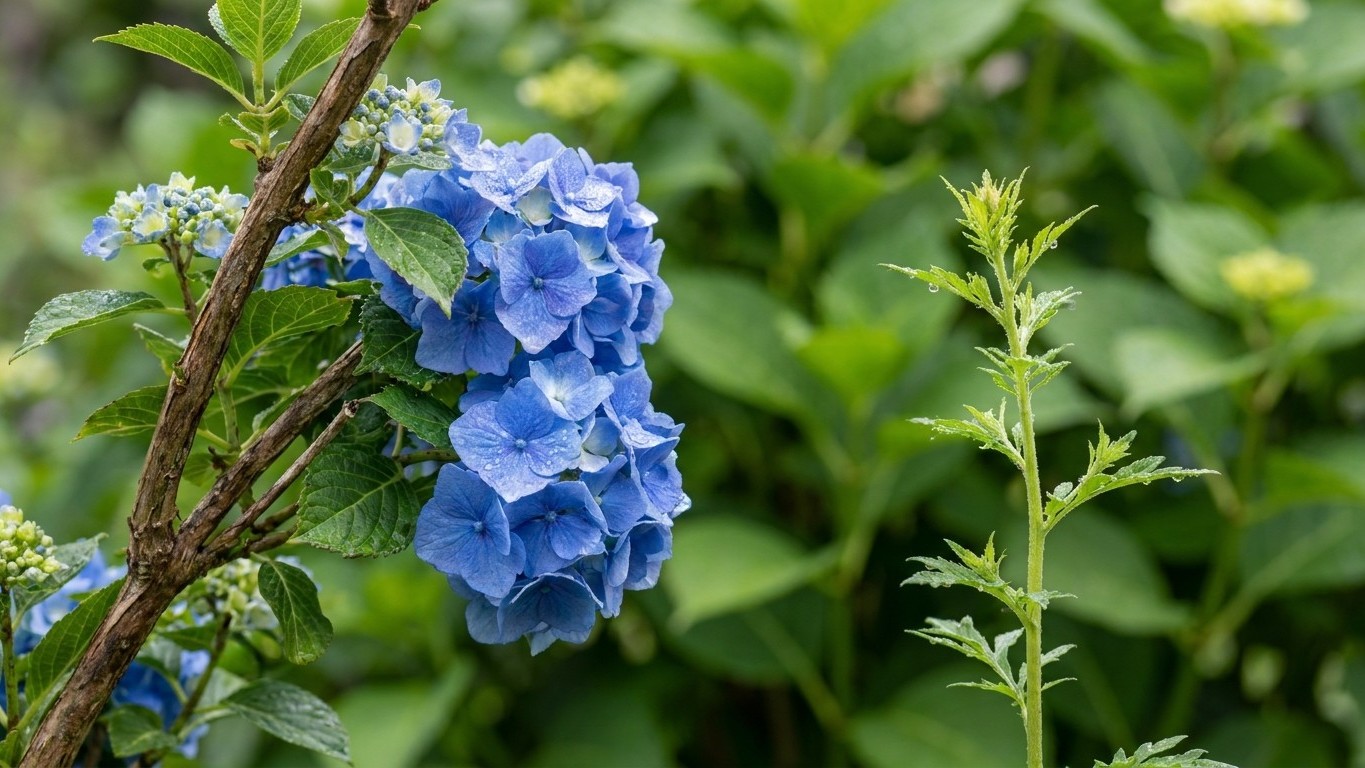

Most hydrangeas in Minnesota get by with a layer of mulch. Bigleaf types that set flower buds on old stems need a full cage of leaves or straw once the ground starts to freeze. Panicle and smooth hydrangeas bloom on new growth and shrug off most winters. The work sits in a narrow stretch of the calendar: after the first hard freezes of fall and before the last freeze of spring. Cover too early or uncover too early, and the buds die anyway.
What this comes down to in Minnesota

The cover season runs inside the frost window for the Twin Cities. The first fall frost arrives between October 11 and October 23, and the last spring frost falls between April 17 and April 30 (NOAA NCEI 1991-2020 Climate Normals, 32F freeze probabilities in the 30-70% band). The Twin Cities are the mild south of Minnesota, so the northern half of the state runs several weeks tighter at both ends.
How does winter damage a hydrangea?
Three things do the harm. Deep cold kills flower buds on any stem that sticks up above the snow. Warm spells in late winter and early spring wake the buds early, and the next freeze kills them. Dry wind pulls moisture out of stems that are frozen in place and cannot replace it. Snow is a free insulator, and buds sitting below the snow line usually come through.
The USDA Plant Hardiness Zone Map covers Minnesota with zones 3a to 5a. That system rests on a single variable, the average annual extreme minimum temperature. It says nothing about thaw cycles, wind or snow depth, and those matter just as much to a hydrangea. Treat the zone as a rough screen and the Twin Cities frost window as a timing anchor.
What does winter protection actually involve?
It comes in layers. Water the shrub deeply before the ground freezes, then spread a few inches of shredded leaves or bark over the crown. For old-wood bigleaf types, add a cylinder of hardware cloth or a ring of stakes wrapped in burlap, a little wider than the shrub. Fill it loosely with dry oak leaves or straw and top it with a lid or board to shed rain. Dry, loose fill is what insulates. Wet or packed leaves hold water against the stems and rot them.
Smooth and panicle types need far less. A couple of inches of mulch over the roots through the first winter or two is plenty, and established plants can be left alone. Which group your shrub belongs to decides how much work you face, and Which Hydrangeas Survive a Minnesota Winter sorts the common ones.
Working it out for your own garden
How do you time winter protection for your yard?
Count forward from the first fall frost, not from the calendar. In the Twin Cities that frost lands October 11 to October 23. The cover should go on two to four weeks later, after the leaves have dropped and the top inch of soil stiffens overnight. That puts the cover date at roughly October 25 to November 20 in the Twin Cities.
Stop feeding well ahead of that. Late nitrogen pushes soft growth that cannot harden off, so the last fertilizer should go on about eight weeks before the first frost. Count back eight weeks from October 11 to October 23 to find the last-feeding window, roughly August 16 to August 28.
Spring runs the same arithmetic in reverse. Take the lid off in the first half of April, then pull the fill away in stages as the April 17 to April 30 window approaches. Keep a bedsheet or a bag of leaves handy until the window has passed, because a late freeze on swelling buds does the damage you worked all winter to prevent.
How do you know what your shrub needs?
Work an example end to end. ‘Annabelle’ is a smooth hydrangea that blooms on new wood. Even if every stem dies back to the ground, it grows new ones and flowers the same summer, so it needs mulch and nothing more. ‘Endless Summer’ is a bigleaf that flowers on both old and new wood. If the old stems are protected, it gives an early first flush. If they die, it still blooms later on new growth, just with fewer flowers. A bigleaf that blooms only on old wood, with no rebloom, is the one that can lose an entire season to a bad winter.
Check the plant tag or the nursery listing before the first freeze. If you are unsure, treat the shrub as old-wood and cage it. The cost is an afternoon and a bag of leaves.
How do you tell what winter did?
Look at where the green begins. If stems are alive to the tips, the cage did its job. If they are alive only up to the mulch line, the plant lost its top and will bloom late, if at all, on new shoots. If nothing sprouts from the base, check the crown and roots before giving up on the plant.
What changes across the state
How far does the Twin Cities timing carry?
The frost window above belongs to the Twin Cities, which sit at the warm end of the state. Move north and winter arrives earlier and lingers longer, by several weeks at each end. That pushes the cover date earlier in fall and the uncover date later in spring. It also compresses the growing season, so a shrub that barely has time to harden off in the south has even less margin up north. The hardiness map reflects the same slope, running from zone 5a in the warmest pockets down to 3a in the far north.
Colder does not always mean worse for the plant. Northern Minnesota usually holds deep, continuous snow cover, which buries the lower stems under an insulating blanket. Southern Minnesota is the opposite. Snow is thinner and melts and refreezes several times a winter. A hydrangea in the south can be hit harder by thaw cycles than one farther north in steady cold.
What else shifts the timing inside a county?
Several local factors move things as much as latitude does. Lake Superior moderates the air near the North Shore, while a few miles inland can be noticeably colder. Cities hold heat, so a yard near downtown Minneapolis or St. Paul warms and cools later than an open field on the outskirts. In the open farmland of western Minnesota, wind strips snow off the ground and dries stems out. A windbreak or a spot on the east or south side of the house can matter more than a few miles of latitude. Low pockets collect cold air on still nights, so frost reaches them first and leaves them last.
The mistakes this state punishes

Winter protection fails in predictable ways, and most of them come from acting too soon or too tidily.
- Covering during a warm October. Mice and voles move into leaf-filled cages, and stems wrapped before the cold arrives stay damp and rot. Wait for the leaves to drop and the soil to stiffen.
- Sealing the shrub in plastic. Sun on a still winter day heats the air inside, stems wake up, and the next night kills them. Burlap and open-top cages let moisture escape.
- Uncovering fully on the first warm spell in April. A freeze can still come after April 30 in the Twin Cities, and later in the north.
- Pruning old-wood types in fall. Those stems carry next year’s flowers, and cutting them leaves nothing to bloom.
- Entering winter with dry soil. A deep soaking in the weeks before the freeze protects roots and stems through the dry months.
Newly planted shrubs deserve extra care. A hydrangea planted late in the season has not had time to build roots, and frost heave can push it out of the ground. Plant earlier when you can, and mulch new plants a bit deeper through their first winter. If you are still deciding what to plant, the state overview on growing hydrangeas in Minnesota covers the basics.
Checking this against your county
A state-wide frost range is a starting point, and your own yard may sit weeks away from it. Your county office at University of Minnesota Extension can tell you what local conditions look like and which winters have been hardest on shrubs near you. For the rest of the growing picture, the guide to growing hydrangeas in Minnesota is the place to go.
Common questions
Should I cut hydrangeas back in the fall?
Leave bigleaf and oakleaf types alone, since their flower buds are already formed on the stems. Smooth and panicle types can be cut in late winter or early spring, once the worst cold has passed. Leaving the stems up through winter also helps trap snow around the base.
Do panicle hydrangeas need to be covered?
Established panicle hydrangeas generally do not. They bloom on new wood and tolerate Minnesota cold well. A few inches of mulch over the roots is enough, and young plants benefit from extra mulch in their first winter or two.
Can I use plastic or a tarp as a winter cover?
Plastic traps moisture and heat, which wakes stems up early and encourages rot. Burlap, straw, dry leaves and open-top wire cages breathe, so they are the safer choice. If you use a lid, make sure air can still move in and out at the sides.
Does winter protection change the flower color?
No. Color depends on soil acidity and aluminum availability, and a cage of leaves does not alter either. If your blooms come out pink and you want blue, read Why Hydrangeas Are Pink in Minnesota, and How to Turn Them Blue.