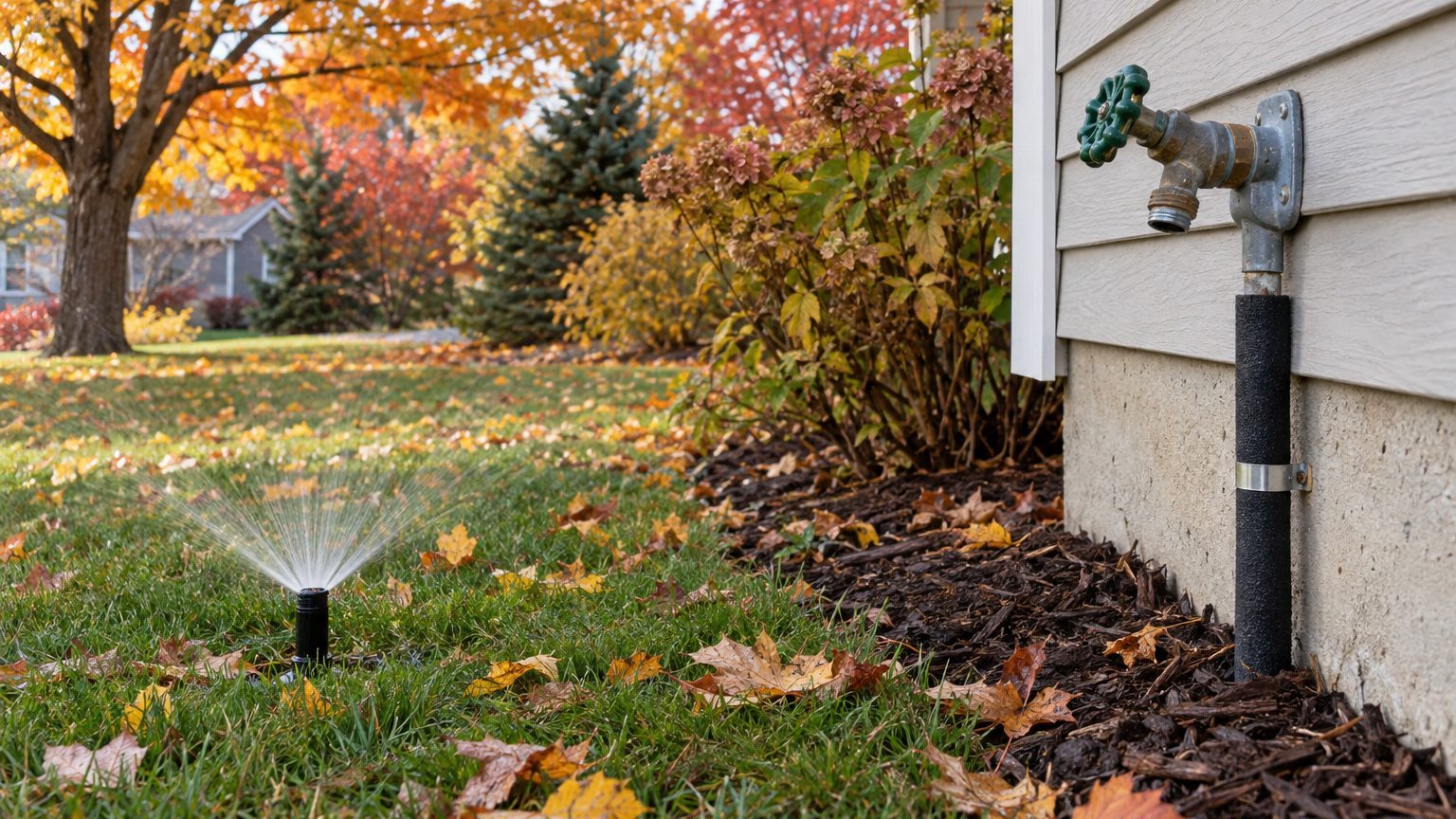

Finish sprinkler and outdoor faucet work before the first hard freeze, not after the first light one. Along the coast, the first 32°F freeze typically arrives between November 20 and December 5, and the Upstate gets there sooner. Because coastal winters are mild, a full compressed-air blowout is often more than the job needs. A handful of quick steps still protects the exposed pipe, the valves, and the backflow device, and the sections below show how to time them for your part of the state.
When to do it in South Carolina
Get the work done before the first hard freeze, not after the first light one. For the Charleston airport station, NOAA NCEI’s 1991-2020 Climate Normals put the first fall 32°F freeze in a window from November 20 to December 5, the band in which the odds of a freeze climb from 30 to 70 percent.
A light frost leaves a white crust on the lawn at dawn and is gone by breakfast. It rarely hurts anything but tender plants. A hard freeze, usually defined as 28°F or lower, is a night when the air stays that cold long enough to chill pipe, brass, and plastic that sit in open air. That is the night that cracks a hose bib or a backflow preventer. Plan to finish before the November 20 to December 5 window opens, and earlier still in the Upstate.
Charleston is the reference point, and the rest of the state shifts around it. Peninsular Charleston is milder than the airport station, so its first freeze tends to come later. The Upstate’s freeze season starts earlier and ends later. Its first frost arrives sooner than Charleston’s, so its fall chores belong earlier on the calendar too. The USDA Plant Hardiness Zone Map (2023) runs from zone 7 in the northwest to zone 9 on the coast, which tells you the same thing in another language: a homeowner near Charleston and one in the northwest corner are living with different winters.
Do you need a full blowout in a mild climate?
Often, no. The mean daily minimum of the coldest month at Charleston is 38.9°F, according to NOAA NCEI’s 1991-2020 Climate Normals. Even in January, the average overnight low stays above freezing. Buried irrigation lines on the coast seldom face a real freeze, and the parts that do are the ones standing in open air.
An average hides the cold nights, though. At the Charleston airport, January averages about nine nights at or below 32°F, and those nights find whatever is exposed. So the useful routine on the coast is short. Shut off the water supply to the irrigation system. Drain and wrap the backflow device and any pipe that rises above ground. Set the controller to off or rain mode so it does not run zones into a dry system. Pull the hoses off every spigot. Keep foam covers handy for the occasional night with a freeze in the forecast.
How will you know a hard freeze is coming?
The National Weather Service generally issues freeze warnings when temperatures of 32°F or lower are expected during the growing season, so a warning may not come on every cold winter night. Treat the first one as the deadline you have already missed, because the work goes faster and with less stress a few weeks earlier. Where winter nights run colder, as in the Upstate, the safer habit is a thorough drain of the whole system every year, ahead of the first frost and not in response to it.
Sprinkler lines: drain or blow out
Water expands when it freezes. Inside a sealed pipe it has nowhere to go, so the ice pushes outward until the weakest point gives way. In a sprinkler system the weak points are predictable: threaded fittings, the bodies of zone valves, the risers under each head, and the backflow preventer, which is usually the most exposed piece of the whole setup. The damage is easy to miss in winter. The crack sits there until spring, when the system pressurizes and the leak shows itself.
Manual drain, automatic drain, and blowout
A manual drain uses valves at the low points of the system. You close the supply, open those valves, and gravity pulls water out of the lines. It works only if the system was built with drain valves and with lines that slope toward them. It costs nothing but time, and on a gently sloping yard it clears most of the water.
Automatic drain valves do the same thing without your help. They open when line pressure drops and let water escape from the low spots. They are convenient, but they can leave water in valves and heads that sit above the drain point, and they do nothing for the backflow device.
A compressed-air blowout pushes water out of each zone in turn, starting with the zone farthest from the air source. It is the most thorough method and the standard one in cold states, where soil freezes deep and lines would otherwise split. The risks are in the air itself. Too much pressure can damage heads and fittings, and running air through a single zone for too long can overheat the plastic parts. Air should be pushed through in short passes, zone by zone, until only mist comes out.
Which method fits this climate?
Along the coast, with an average coldest-month low of 38.9°F at Charleston, a manual or automatic drain plus a drained and wrapped backflow device is usually enough. A blowout is reasonable insurance for anyone who wants every zone clear, and a better fit for the Upstate, where freezes come sooner and bite harder. Whichever route you take, shut off the irrigation supply and drain the backflow preventer before the November 20 to December 5 frost window opens, which means earlier for the colder northwest.
Hire a professional when the system has no drain valves, when you do not know how it was laid out, or when you do not own a compressor of the right size. A technician who services irrigation systems knows the pressure each type of head and pipe can take, and an hour of that skill is cheaper than a cracked valve manifold. Pros are also the sensible choice if the system has a pump, a well supply, or a mix of old and new components, since each can hold water in unexpected places.
Outdoor faucets and hoses
The routine for an outdoor tap involves nothing more than hands and valves. Start by disconnecting every hose, splitter, timer, and sprayer from every spigot. Drain the hose and coil it in a garage or shed, because a hose left on the ground fills with rain and can stretch or crack. Next, find the interior shutoff valve that feeds the tap. In some homes it sits in a crawlspace, garage, or utility room, and it is often a small handle in line with the pipe. Turn it off. Then open the outside tap and let the leftover water run out. Leave the outside tap open for the winter so any trace of water has room to expand. If the interior valve has a small bleeder cap, loosen it to let the last water out and close it again once the pipe is empty.
That is the whole job. Anything more, such as cutting into pipe, adding a shutoff, or replacing a tap, is a plumber’s work. Call one if you cannot find an interior valve, if the tap keeps dripping after the valve is closed, or if the handle will not shut off the water. A plumber should also look at any tap with a stain or damp spot on the wall around it. For a deeper walk through the routine, see Winterizing Outdoor Faucets Before the First Freeze.
Why does a frost-free faucet still fail with a hose attached?
A frost-free tap has a long stem that puts the shutoff seat deep inside the warm wall. The barrel in front of the seat is angled slightly downward, so when you close the tap the water in it drains out the spout. Attach a hose and that drain is blocked. Water stays in the barrel, sits in cold air, and freezes. The ice splits the pipe, usually in the cold stretch of pipe near the wall, and the break stays hidden until you turn the water on in spring and it sprays inside the wall. The fix is the same as for any other tap: take the hose off. More detail on how these fittings work is in Frost-Free Outdoor Taps.
Near the coast, where freezing nights are few, a foam cover on the faucet is a fair second layer on the nights when the forecast calls for one. Disconnect every hose before the November 20 to December 5 window opens, and sooner in the Upstate.
What goes wrong here
Mild winters make people late, and being late is a common cause of damage. The failures cluster around three situations, each of which shows up in spring.
What happens when a cold snap arrives before you have drained?
A few warm weeks in November convince people to put the chore off, and then one clear, still night drops well below freezing ahead of the frost window. The backflow preventer takes the hit, because it is full of water and stands above the ground. In spring, when someone turns the system on, the cracked body sprays water across the yard or hisses at the seams. Zone valves can fail the same way and weep or refuse to close. The prevention is to treat the start of the November 20 to December 5 band as the finish line, and to wrap the backflow device early even if the rest of the job waits.
What do a forgotten hose and a flooded valve box look like in spring?
A hose left on a spigot is a common mistake. It looks like nothing until the first warm weekend, when a wet stain spreads on an interior wall or the tap sprays out the back. Walk the property with a short list before the window opens and check each spigot, including the one behind the shrubs. If a pipe does freeze inside a wall or crawlspace, the steps in Frozen Pipes apply.
Valve boxes are the quieter problem. A box in a low spot fills with rainwater, and that water surrounds valves and fittings on the coldest nights. By spring a valve may weep, a zone may run without being told to, or a patch of grass beside the box may stay soggy. Lift the lids after a rain and bail out standing water. Clear leaves and mud, and call a professional if a valve keeps leaking. Check the valve boxes and backflow device in the weeks before the November 20 to December 5 window opens.
Common questions
Can I wait until a freeze warning is issued?
You can, but the margin is thin. A warning gives you a short stretch to shut off the supply, drain the device, and pull the hoses, all while the temperature falls and the weather turns unpleasant. Doing the work in the weeks before the first frost range costs nothing extra and removes the chance of an unlucky night.
Is winterizing worth it near the coast?
Yes, in a lighter form. The average coldest-month low at Charleston is 38.9°F per NOAA NCEI’s 1991-2020 Climate Normals, so deep freezes are uncommon. On the coldest nights of winter the temperature can still dip under 32°F, and the exposed backflow device and hose bibs are the parts that suffer. Shutting off the supply, wrapping the device, and removing hoses covers most of the risk.
Do I still need to water the lawn after I shut the sprinklers off?
Warm-season lawns slow down and go dormant as cool weather settles in, so their water needs drop sharply. Rain usually covers what is left. If a long dry spell hits, a hose and a hand-held sprinkler work on a day when no freeze is forecast, provided you disconnect again afterward. For the rest of the season’s lawn work, see Winterizing a Lawn.
When do I turn the system back on in spring?
Wait until the risk of a hard freeze has passed for your area, which comes sooner on the coast than in the Upstate. Close the drain valves first, open the supply slowly, and then run each zone while you look for geysers, leaks, and soggy spots. Your county extension office can tell you what is normal locally, and the other South Carolina guides cover the spring tasks that follow.