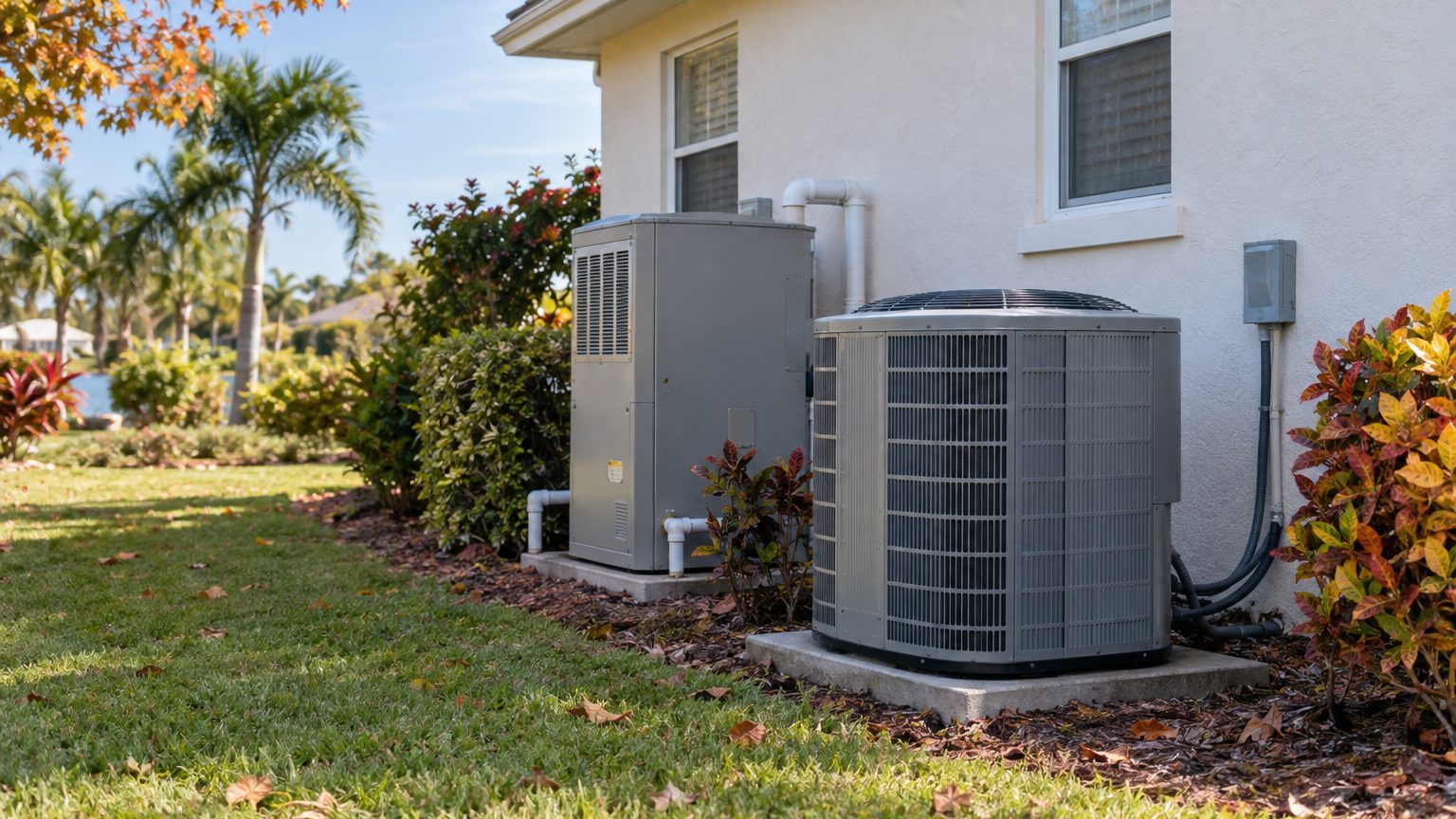

A heat pump costs less to run than a gas furnace in Louisiana, but the margin is small: $1.16 per million Btu of delivered heat at average residential prices. Winters are short and mild, so that gap plays out over relatively few cold hours. The decision therefore turns on things beyond fuel price: whether a gas line already reaches the house, whether the home needs cooling, and how much life the current equipment has left.
The short answer for Louisiana
On running cost alone, the heat pump wins. Computed from U.S. Energy Information Administration (EIA) residential prices and ENERGY STAR efficiencies, one million Btu of heat delivered to the house costs $16.48 with a heat pump rated at 8.1 HSPF2. The same amount from a natural gas furnace at 95% AFUE costs $17.64. Electric resistance, such as baseboard heaters or electric furnace strips, costs $39.13.
These numbers compare fuels on the same unit of delivered heat. They are not a yearly bill, because the annual total depends on the size of the house, its insulation and how many cold days the family heats through. They are not the price of buying or installing either system. And the gas figure rests on the statewide average residential gas price from the EIA, so a household’s own rate can move the result in either direction.
The heat pump’s lead over gas is modest, while its lead over resistance heat is large. Pick the heat pump when the house has no gas service or heats with resistance, and treat a working gas furnace as a close call that equipment age and cooling needs should settle. A tighter house shrinks the load either way, which is why insulation belongs in the same conversation.
What each option costs to run in Louisiana
Each row below shows the cost of one million Btu of heat actually delivered to the living space, after the equipment’s efficiency is applied.
| System | Efficiency used | Cost per million Btu delivered |
|---|---|---|
| Electric resistance (baseboard) | 100% efficient | $39.13 |
| Heat pump | 8.1 HSPF2 (seasonal COP about 2.4) | $16.48 |
| Natural gas furnace | 95% AFUE | $17.64 |
The electricity price behind the table is 13.35 cents per kWh, the average residential price year-to-date through July in the EIA’s Electric Power Monthly, Table 5.6.B. It is a statewide average, and rates vary by utility and rate plan. The gas figure starts from the EIA’s average residential natural gas price for the state (about $17.39 per thousand cubic feet, the 2025 annual average, so a different period from the electricity price), converted at about 1,037 Btu per cubic foot. Electricity is converted at 3,412 Btu per kWh. Swapping in the rates from a utility bill is the quickest way to adjust the comparison.
Why does efficiency matter as much as the fuel price?
One kWh of electricity carries 3,412 Btu. Baseboard heat turns all of it into warmth, so it delivers 3,412 Btu per kWh and nothing more. A heat pump moves heat from outdoor air into the house instead of creating it, and at a seasonal coefficient of performance (COP) of about 2.4 it delivers roughly 2.4 times the heat the electricity itself contains. That multiplier takes electricity from the most expensive row to the cheapest. A 95% AFUE furnace converts 95% of the gas it burns into household heat, so gas stays close behind. Judge each system by what a million Btu of delivered heat costs, since that figure combines fuel price and efficiency.
HSPF2 is the heating seasonal performance factor, a rating of heat delivered per unit of electricity over a typical season. The 8.1 used in the table matches the ENERGY STAR cold-climate minimum for ducted split systems and single-package units. The standard ENERGY STAR minimums are lower: 7.8 HSPF2 for split systems and 7.2 for single-package units. The cold-climate criteria set the bar higher for non-ducted (ductless) split systems, at 8.5 HSPF2. Because the rating matters, a heat pump at 7.8 HSPF2 would cost about $17.12 per million Btu, and one at 7.2 about $18.54, which is above the gas figure. The ENERGY STAR criteria also list 15.2 SEER2 for cooling, which is a separate rating and should only be compared with another unit’s SEER2. A deeper look at the rating is in What HSPF2 Measures, and Why Ductless Asks for More.
How cold it gets, and what that does to a heat pump
Winter is a minor season in the southern part of the state. At New Orleans International Airport, NOAA’s 1991-2020 climate normals show about 1,176 heating degree days a year, counted against a base of 65°F. A heating degree day adds up how far a day’s average temperature sat below 65°F, so the total scales with fuel use. The same station records about 3,206 cooling degree days, so air conditioning works far harder than heating over the year. The mean daily minimum of the coldest month is 46.1°F.
That coldest-month minimum matters because a heat pump’s efficiency falls as outdoor temperatures drop. The 8.1 HSPF2 used in the cost comparison is a seasonal average. In a deep-cold climate, the coldest nights pull efficiency below that average, and resistance strips or a furnace carry the load. In the New Orleans area, nights in the coldest month average well above freezing (a few freezing nights still occur in a typical year), so the heat pump runs close to its efficient range most of the winter. For that part of Louisiana, the $16.48 figure is a fair picture of how the equipment performs.
The degree-day and low-temperature figures come from a single station on the Gulf Coast. Parishes in the north of the state run colder, so the heating season there is longer and the coldest nights bite harder. A heat pump still handles most of that season, but a backup source matters more as you go north. How a heat pump behaves as temperatures fall is covered in How Cold Is Too Cold for a Heat Pump. The parish office of the LSU AgCenter or a local HVAC contractor can say how far below freezing the nearest weather station typically falls. For a view of how the heating months line up through the year, see the heating season overview. Near the coast, size the decision around cooling and mild-weather heating; farther north, plan on a backup source for the coldest nights.
What homes in Louisiana already heat with
The EIA’s 2020 Residential Energy Consumption Survey (RECS) shows electricity as the main heating fuel in 62% of Louisiana homes and natural gas in 33%. By equipment, 57% of homes run a furnace and 21% use a central heat pump. For steam or hot-water boilers, fuel oil or kerosene, the survey reports none, which means no households in the survey sample reported them as main heating equipment or fuel. Propane is listed as not reported because the estimate was suppressed as unreliable. These are state shares from a national survey, not a count for any one parish.
A home heated by electric resistance faces the $39.13 row, so a heat pump at $16.48 changes its bill the most. A house with no gas line has no gas option to weigh, so the choice becomes heat pump against resistance. A house that already has a gas furnace and gas service is a case where the $1.16 gap is the real question. A home heated by a boiler and radiators is a different conversion, because there are no ducts. That case usually points to ductless units, and the trade-offs are laid out in Ductless or Central.
When the other choice wins
Gas furnaces make sense in a few situations here. One is a working furnace with years of service left. At a gap of $1.16 per million Btu, the running-cost savings are small compared with replacing equipment that still does its job, so repairing can come out ahead. That decision is covered in Repairing a Furnace or Replacing It.
A second is a dual-fuel setup, a heat pump paired with a gas furnace that takes over on the coldest nights. It suits the northern part of the state, where the heating season is longer and the heat pump’s efficiency drops in the deepest cold. The furnace is the backup and the heat pump does most of the work.
Cooling is the third factor, and in Louisiana it carries real weight. A heat pump is also an air conditioner, so replacing a worn-out cooling unit with one adds heating at little extra cost. If the cooling equipment is relatively new and the furnace is healthy, there is less reason to disturb either.
The heat pump wins by default where no gas service reaches the house. Gas wins where a working furnace and a gas line are already in place and the equipment is not near the end of its life. Replace the furnace when it fails or when the air conditioner needs replacing, whichever comes first, and fold both jobs into a single heat pump decision.
Common questions
Is electric baseboard heat ever cheaper to run than a heat pump? At average residential prices, no. Baseboard delivers a million Btu for $39.13, while a heat pump at 8.1 HSPF2 delivers it for $16.48.
Does a heat pump keep up during a Louisiana cold snap? Near the Gulf Coast, the coldest month has a mean daily minimum of 46.1°F at the New Orleans station, which keeps a heat pump near its efficient range. In the northern part of the state, nights run colder, and backup heat from strips or a furnace covers the deepest cold.
Will a higher-rated heat pump cost less than $16.48 per million Btu? The figure uses 8.1 HSPF2, the ENERGY STAR cold-climate minimum for ducted split and single-package systems. A unit with a higher HSPF2 delivers more heat per kWh, so its cost per million Btu falls below that figure, while a unit rated lower costs more.
Does the $1.16 difference equal my yearly savings? It is the difference per million Btu of delivered heat. Your yearly savings depend on how many million Btu your house needs over a winter, and on your own electric and gas rates.
For the wider picture of heating a home in this state, see Heating a Home in Louisiana.