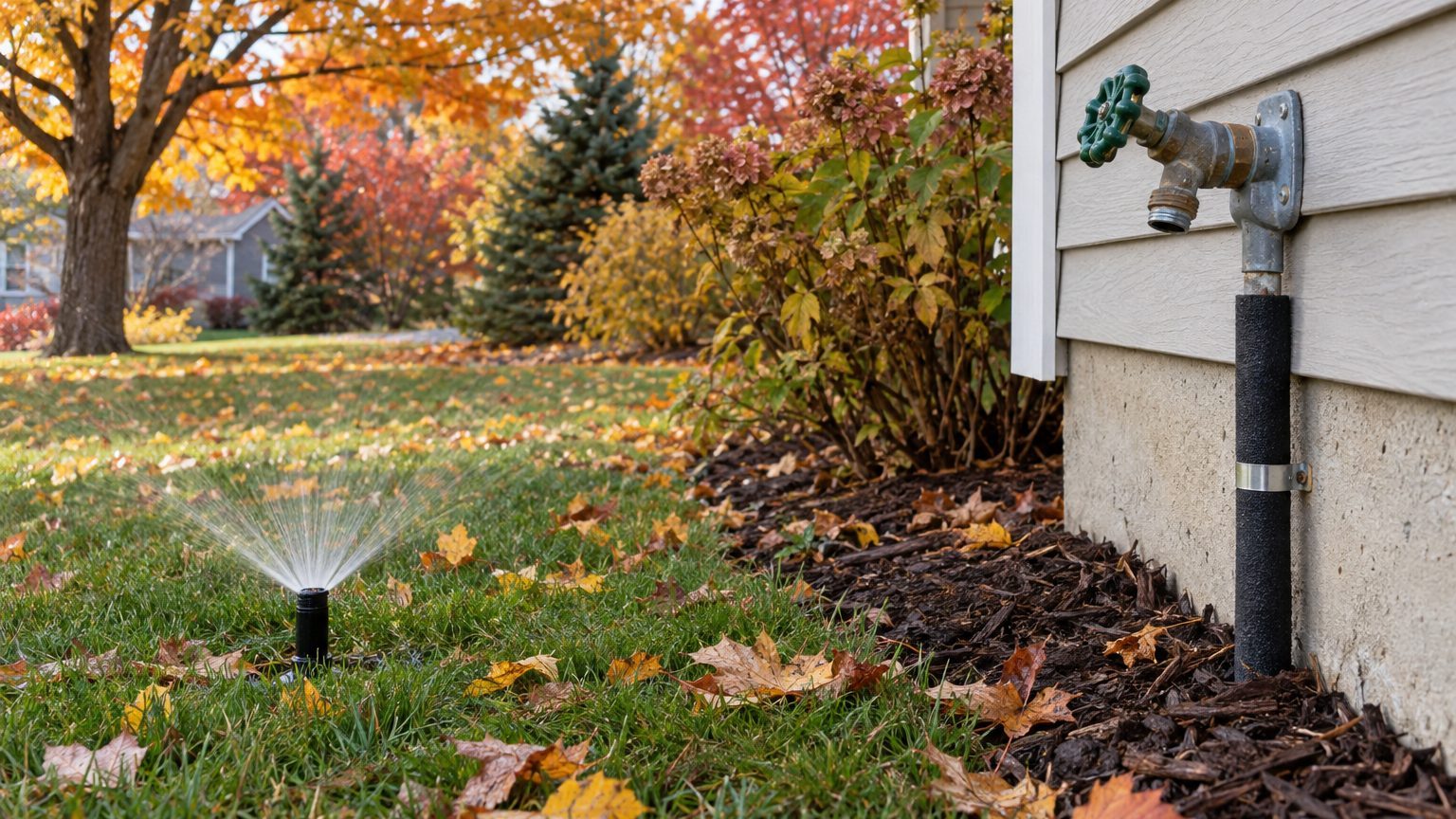

Alabama winters feel forgiving until one clear night proves otherwise. The reliable rule for sprinklers and outdoor spigots is to finish before the first hard freeze. In north Alabama’s reference data, that points to early-to-mid November, and earlier in colder pockets. A full compressed-air blowout is often more than a mild winter demands. Draining the water that can sit in exposed parts is not optional, and it takes an afternoon.
When to do it in Alabama
Aim to have sprinklers drained and hoses off the spigots in the weeks just before November 2 to November 16, the span when NOAA’s 1991-2020 Climate Normals put the first 32°F freeze at the reference airport station in the 30-70% probability band. The rule is before the first hard freeze, not after the first light one.
The difference matters. A light freeze is a few hours hovering around 32°F near dawn, and it mostly nips tender plants. A hard freeze stays below freezing long enough to chill pipe, valves and spigots all the way through. Buried lines have soil as insulation and usually survive the first, but anything exposed does not get that protection from either.
Why a mild winter still needs a plan
The mean daily minimum of the coldest month at the Huntsville reference station is 33.1°F (NOAA NCEI Climate Normals, 1991-2020). That sits just above freezing, and it explains why the full northern ritual does not apply across much of the state. But an average is a blend of mild nights and sharp ones. Freezes arrive in spells, usually a few nights at a time, and a single spell is enough to split an exposed fitting.
The USDA Plant Hardiness Zone Map (2023) shows the same thing from another angle. It places Alabama anywhere from 7a to 9a, a wide range, and it is built on the average annual extreme minimum, the coldest night of the year, not the typical winter night. That coldest night is the one that breaks pipes. Zones also differ across the state, so the Huntsville figures describe one reference point, not every county.
Where winter lows stay near the freezing mark, a full blowout is often unnecessary. What is worth doing is shorter:
- Shut off the water supply to the irrigation system and put the controller in its off or rain setting.
- Open the drain valves at low points so the water in the lines runs out.
- Insulate or cover the above-ground backflow assembly and any exposed pipe.
- Take hoses off every spigot and drain them.
- Keep covers and a short checklist handy for the night a freeze shows up in the forecast.
Adjusting for your county
The November 2 to November 16 range comes from an airport station. Suburban and rural properties typically see the first fall frost earlier, often by one to two weeks, and more so at elevation. In north Alabama and on higher ground, work earlier in the fall. Farther south, the later part of the window is realistic. Your county Extension office can give you local frost dates, and the other Alabama guides help with regional detail.
Sprinkler lines: drain or blow out
Water sitting in a pipe, valve body or sprinkler head turns to ice when the temperature drops below freezing, and ice takes up more room than liquid water. Nothing gives, so the pipe wall does. Fittings pop apart, PVC splits lengthwise, and brass or plastic valve bodies crack. The damage stays hidden until spring, when pressure returns and the break starts to leak or spray.
The exposed parts fail first. The backflow assembly, the vacuum breakers and the stretch of pipe near the house sit above ground without the soil’s insulation. Many spring repairs trace back to that short run by the foundation, not to the buried lines under the lawn.
Three ways to clear the lines
A manual drain means closing the supply, then opening drain valves at the low point of each zone and at the main line until the water stops. It needs no equipment, but the system has to have those valves. An automatic drain does the same job without you. Valves at low points open on their own once pressure falls after shutoff, and gravity empties the line. They only work where the pipe slopes toward them, and a valve clogged with grit leaves its pocket of water behind.
A compressed-air blowout pushes the water out through the heads, zone by zone. It is the most thorough method and the only one that clears lines laid flat or with dips in them. It is also the one that can hurt equipment or people. Too much pressure damages heads and fittings, air run through dry rotors can overheat their internals, and anyone nearby should wear eye protection.
| Method | How it works | Best fit | Watch for |
|---|---|---|---|
| Manual drain | Open low-point drain valves after shutting the supply | Systems with sloped lines and drain valves | Missed valves, zones that do not fully empty |
| Automatic drain | Valves open on their own when pressure drops | Properly graded lines | Clogged valves, pockets of trapped water |
| Compressed-air blowout | Air pushes water out zone by zone | Flat or dipping lines, colder parts of the state | Too much pressure, dry rotors, eye safety |
Which one this climate calls for
With a coldest-month minimum just above freezing, most Alabama systems do well with a supply shutoff and drainage. Shut off the supply and use the drain valves where lines slope to them, and keep compressed air for flat or dipping lines and for the colder north. Properties in the northern counties and on higher ground see harder and earlier freezes, so a blowout there is a reasonable insurance policy. Turf work follows the same fall calendar, and Winterizing a Lawn covers that side.
When a professional is the sensible choice
Call someone when the system has no drain valves, when you do not know how the zones were laid out, or when the property is large and has many zones. A small hobby compressor often lacks the air volume to clear a zone safely, and a rented or borrowed one raises the risk of pressure damage. Some water utilities also set their own rules for backflow assemblies, so ask yours before you touch one. A pro visit in fall costs far less than a split main in spring.
Outdoor faucets and hoses
The routine takes minutes. Unscrew every hose, splitter and sprayer from every outdoor tap. Find the interior shutoff for that tap, usually on the supply line near where it enters the house from a basement, crawl space or utility room, and turn it off. Then open the outside tap and let it run until it stops dripping. Hose off, interior valve closed, outside tap open is the sequence to remember, and it should be done before the first hard freeze.
Leave the outside tap open through the winter. That gives any last drops room to expand instead of cracking the pipe. Drain each hose and coil it indoors, since water sitting inside a hose is a small block of ice waiting for the next cold snap. If a tap has no interior shutoff, adding one is plumbing work and belongs to a plumber. Turning valves is as far as a homeowner should go. In the meantime, an insulated foam cover over the tap will help on the nights the temperature dips.
Why a frost-free faucet still fails with a hose attached
A frost-free faucet puts the valve seat at the end of a long stem, deep inside the warm wall, and the barrel slopes slightly downhill. When the handle closes, the water left in the barrel drains out the spout. A hose, a splitter or even a closed spray nozzle blocks that exit. The water stays in the barrel and freezes where the pipe is exposed or close to the wall’s cold face, and it can split the pipe inside the wall, where you cannot see it.
That is why hoses come off even when the spigot is labeled frost-free. More detail on the design and how it fails is in Frost-Free Outdoor Taps, and the full sequence for standard spigots is in Winterizing Outdoor Faucets Before the First Freeze. If the barrel slopes the wrong way or the wall is cold, those are installation issues for a plumber, not something to fix with a wrench.
What goes wrong here
The most likely failure is the early cold snap. The November 2 to November 16 range is a probability band at an airport station, not a promise, and suburban, rural and higher properties can see their first freeze one to two weeks earlier. Anyone waiting for the calendar can get caught. A few mild weeks lull people into postponing, and then a clear, still night arrives before the hoses are off. Start watching the forecast as the range nears, and do the work early, since draining a system that did not need it costs only an afternoon.
The forgotten hose comes next. A hose left on a frost-free tap leaves no sign in fall. In spring, the first sign is a drip inside the wall, a damp spot on drywall, a hissing sound when the tap is opened or water showing up in a crawl space. Check for it by walking the house with every tap open and every hose gone. Frozen Pipes explains what to do when a pipe has already burst.
The valve box is the third trap. Low boxes fill with water, and the valves and wiring sit in it all winter. A freeze cracks a valve body or manifold, which shows up in spring as a zone that will not shut off, a geyser at a head, a soggy patch in the lawn or a water meter dial that keeps turning when everything is off. In fall, check that lids are in place and that boxes drain. Turn the system back on slowly in spring, one zone at a time, and look for leaks before the full system is pressurized.
Common questions
Does a sprinkler system in Alabama need winterizing every year?
Yes, in some form. The coldest-month minimum at the Huntsville reference station is 33.1°F (NOAA NCEI, 1991-2020), just above freezing, so many winters are mild. But the average hides hard nights, and exposed backflow assemblies and above-ground pipe are vulnerable in any year. A supply shutoff and drainage every fall is cheap protection. A full blowout is more reasonable in the colder north.
What is the difference between a light frost and a hard freeze for pipes?
A light frost touches freezing for a short time near dawn and rarely hurts buried pipe. A hard freeze stays below freezing for hours, long enough to freeze water inside exposed pipes, valves and spigots. The first one is a warning. Winterizing should be done before the second arrives.
Can I leave hoses connected if my faucet is frost-free?
No. A connected hose, splitter or nozzle traps water in the faucet barrel, where it can freeze and split the pipe inside the wall. Disconnect and drain every hose before the first hard freeze, whatever the faucet label says.
Do my county’s dates match November 2 to November 16?
Probably not exactly. That range comes from NOAA’s 1991-2020 Climate Normals for the reference airport station. Suburban and rural properties often see the first fall frost one to two weeks earlier, and higher ground earlier still. Your county Extension office can tell you the local dates. Winterize before the earliest of them.