
In Alabama, only two of the pests the state’s extension service tracks actually target parsnip: aphids and spider mites. Everything else on the documented list feeds on beans, cucurbits, brassicas, or fruiting crops, not on a root vegetable in the carrot family. The bigger factor shaping damage here isn’t the pest at all. It’s the state’s mild coldest-month average, which changes how long a parsnip crop sits in the ground before anything, insect or otherwise, gets to it.
Which pests attack parsnip in Alabama

The Alabama Cooperative Extension System documents ten garden pests for this territory: Aphids, Corn earworm (tomato fruitworm), Cowpea curculio, Imported cabbageworm, Leaffooted bug, Mexican bean beetle, Spider mites, Spotted cucumber beetle, Squash vine borer, and Stink bugs. That’s the full list, and it’s the only one this page will work from.
Most of it has nothing to do with parsnip. Corn earworm targets corn ears and tomato fruit, not root vegetable foliage. Cowpea curculio lives on cowpea pods. Imported cabbageworm is a brassica feeder, chewing cabbage, broccoli, and kale, none of which parsnip belongs to. Mexican bean beetle needs bean foliage. Squash vine borer bores into squash and other cucurbit stems exclusively. Spotted cucumber beetle is built around cucurbits too, even though the adult beetle will wander onto other plants in a mixed bed. Leaffooted bug and stink bug both feed by piercing developing seeds and fruit, which means they matter for tomatoes, peppers, and beans far more than for a root crop that’s usually pulled before it ever flowers.
That leaves aphids and spider mites, and the extension service documents few pests specific to parsnip here beyond those two. Both are generalist feeders that don’t care much what family a plant belongs to, which is exactly why they show up on a root crop where the more specialized insects on the list don’t bother. Aphids cluster on the tender new growth and undersides of parsnip’s feathery leaves, feeding on sap and often bringing along a sticky residue that draws sooty mold. Spider mites do their damage in hot, dry stretches, rasping at leaf cells until the foliage takes on a stippled, bronzed look.
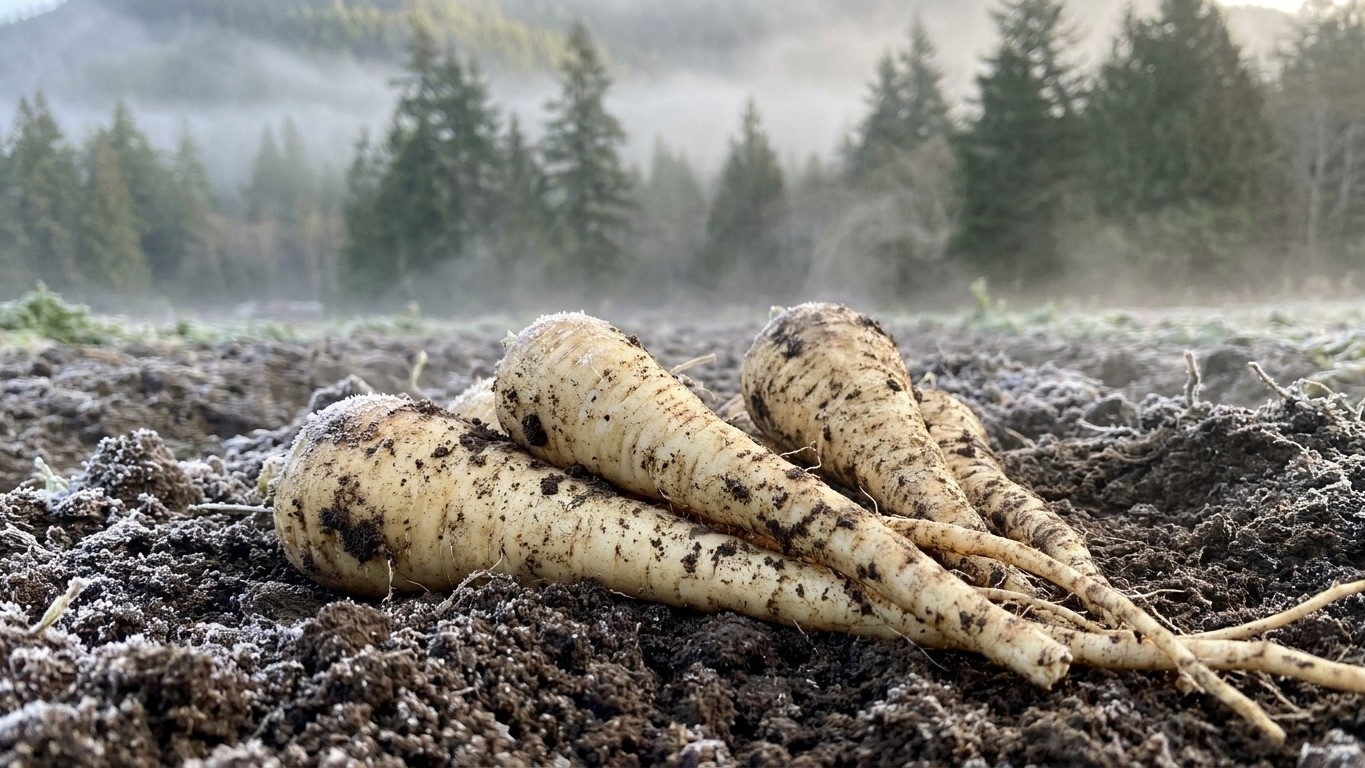
The decision that matters more than either insect is the calendar: parsnip needs 100 to 120 days from seeding to reach harvest, and it has to spend several weeks exposed to actual frost afterward before it develops its characteristic sweetness. A mild winter doesn’t do that job. Cold snaps do. Get the timing wrong and the crop is fine to eat but bland, no insect required.
When each one shows up, and what it does first
Parsnip seed goes into the ground directly, roughly two to three weeks before the last expected spring frost, and it’s slow to start. Germination takes 14 to 21 days, so bare-looking soil for three weeks is normal, not a failed sowing. With the reference station’s last spring frost falling between March 19 and April 3, seedlings are typically just breaking the surface as that window closes, which is also when the first insect activity of the season tends to begin.
Aphids arrive early relative to the rest of the garden, often within the first few weeks after seedlings put out true leaves. What shows up first isn’t a visible insect so much as a change in the leaf itself: new growth that looks curled, puckered, or slightly yellowed at the tips, sometimes with a faint shine from the honeydew aphids leave behind. Check the underside of the youngest leaves before assuming it’s a nutrient problem. That’s where the colonies build first, tucked out of direct sun.
Spider mites tend to show up later in the season, once warm, dry weather sets in and humidity drops. The earliest sign is rarely the mites themselves, which are close to invisible without a hand lens. It’s a dusty, faded speckling on the older leaves, starting low in the canopy where airflow is worst and moisture stress hits first. Left alone, that stippling spreads upward and the leaves eventually take on a bronze, dried-out cast.
Both pests slow down or stall out once cooler, wetter weather returns in fall. That matters here because parsnip’s harvest window runs long past summer. With the reference station’s first fall frost landing between November 2 and November 16, the crop is often still sizing up in the ground through that stretch, and it’s the cold snaps afterward, not the insects, that determine whether the roots turn sweet.
Telling the damage apart from everything else
A lot of what looks like insect feeding on parsnip is something else entirely, and treating the wrong cause wastes a season. A forked or split root has two separate possible causes here: heavy or stony ground that deflects the taproot, and overwatering that encourages branching. Don’t collapse those into one explanation. Neither is an insect problem, and no spray fixes either one.
Yellowing leaves get blamed on aphids reflexively, but nitrogen deficiency produces a similar pale, uniform yellowing that starts on the oldest leaves and moves inward, with no curling or honeydew involved. Bronzed, stippled foliage gets blamed on spider mites, but plain drought stress in a bed that dried out between waterings can look nearly identical without a single mite present.
| Symptom | Likely cause | What tells them apart |
|---|---|---|
| Curled, sticky new growth | Aphids | Check leaf undersides for clustered insects and shiny honeydew residue |
| Dusty, stippled older leaves in hot weather | Spider mites | Hold white paper under the leaf and tap; fine specks that move are mites |
| Uniform pale yellowing, oldest leaves first | Nutrient deficiency | No insects present, no curling, spreads evenly across the leaf |
| Forked or split root at harvest | Heavy soil, stones, or overwatering | Dig a test hole to check soil texture and drainage before assuming pests |
None of this is a substitute for a look through a hand lens or a call to a local office. If the cause isn’t obvious after checking leaf undersides and soil conditions, that’s a question for a county extension agent, not a guess made from a photo.
What actually works here, and what is a waste of time
Timing beats treatment on a crop with a 100-to-120-day season: a floating row cover set over the bed right after seeding keeps aphids off the youngest, most vulnerable growth without any spray at all. That single step, done at planting rather than after damage appears, does more than most reactive measures.
Once the crop is up and growing, a strong jet of water on the underside of leaves knocks aphid colonies down and interrupts spider mite webbing during dry spells, both cheap and immediate. Keeping the bed evenly watered also matters directly for mites, since drought-stressed foliage is what draws them in the first place. Spacing plants so air moves through the canopy helps too, since crowded, still air is what lets both aphids and mites build up unnoticed.
What doesn’t help: treating for corn earworm, cabbageworm, bean beetle, cucumber beetle, vine borer, or stink bugs on a parsnip bed. None of those insects target this crop, so a product aimed at them is a wasted trip and, worse, it can kill off the predatory insects, ladybugs and lacewings especially, that would otherwise keep aphid numbers in check on their own. Broad-spectrum treatments applied on a schedule rather than in response to an actual sighting tend to cause more of that problem than they solve.
Any decision about an actual insecticide, what’s labeled for use on parsnip and legal to apply in Alabama, belongs with a county extension office. This site doesn’t recommend products, and a label that’s approved in one state isn’t automatically approved in another.
Where to check this for your own county
The list of ten pests above comes from the Alabama Cooperative Extension System at the state level. That’s a useful starting point, not a guarantee of what’s actually in a given backyard. Pest pressure shifts county to county and even bed to bed, so a statewide list tells you what’s been documented somewhere in Alabama, not what’s crawling on a specific parsnip row this week.
The extension system runs county offices staffed by agents who track local pest reports and can look at an actual sample or photo, something this page can’t do. That’s the next step for anything that doesn’t match cleanly with aphids or spider mites, or for a forked root that doesn’t obviously trace back to heavy soil or overwatering.
It’s also worth remembering that the frost dates used throughout this page come from a single reference weather station, and a rural or elevated garden nearby will often see its last spring frost run later and its first fall frost arrive earlier than that station shows, sometimes by a week or two. A county office can confirm what that gap actually looks like locally, which matters directly for when to seed and how long the roots get to sit through frost before pulling them.
Common questions
Do parsnips need frost to taste good, or just cold soil?
They need actual exposure to frost after the roots have sized up. Cold soil alone doesn’t trigger the starch-to-sugar conversion; the plant needs several weeks of genuinely frosty weather in the ground, per Utah State University Extension.
Can parsnip seedlings be transplanted instead of direct-sown?
No. Parsnips are sown in place, and the 100 to 120 day timeline runs from that seeding date, not from a transplant date, since the taproot doesn’t tolerate disturbance well.
Is a mild Alabama winter enough to grow parsnip successfully?
It’s enough to grow the crop. It isn’t enough on its own to sweeten it, since sweetening comes from frost exposure specifically, not from the general hardiness of the winter.
Why isn’t stink bug or cucumber beetle covered here as a parsnip pest?
Both are documented pests in Alabama, but they target fruiting or cucurbit crops. Neither is known to feed on parsnip roots or foliage in a way the extension service documents for this crop.