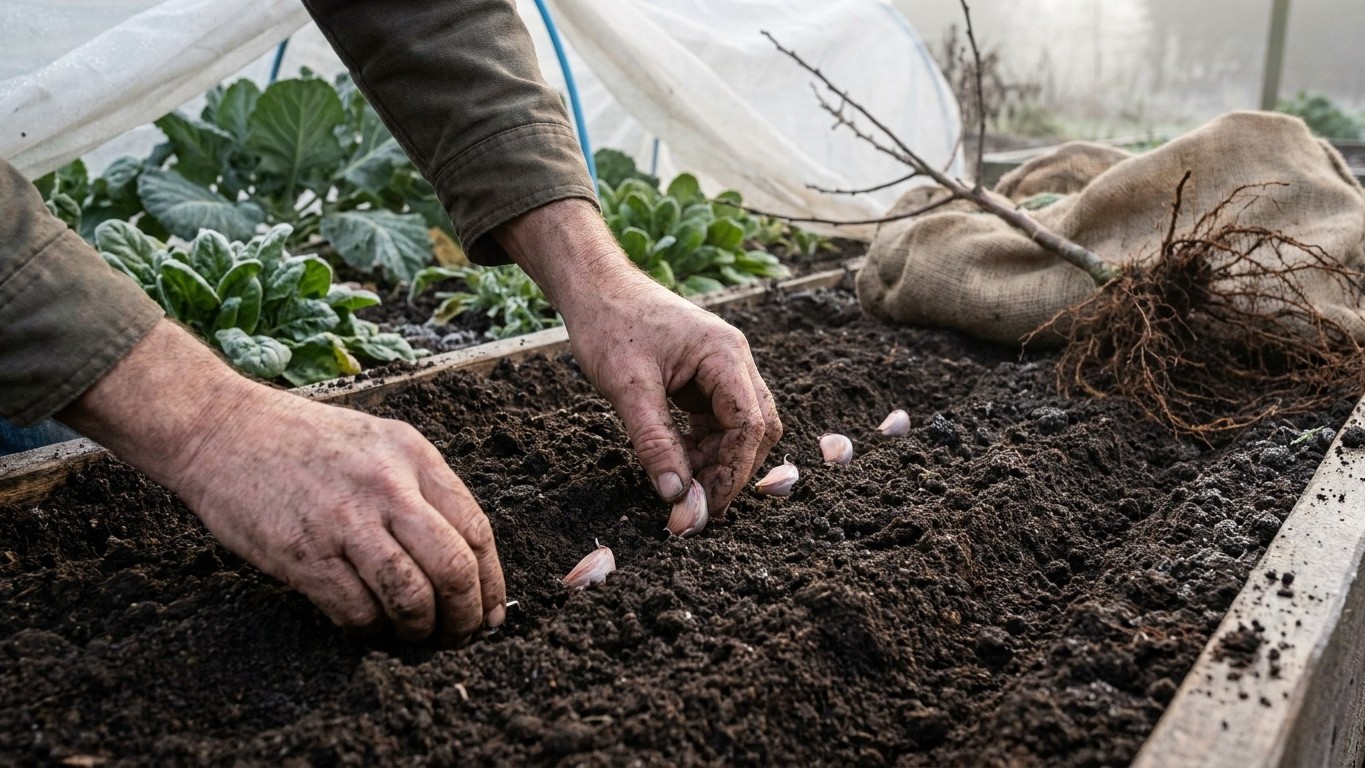

December in Alabama means garlic and shallot cloves going into the ground, bare-root fruit trees and roses waiting for dormant planting, and hardy greens still holding on in south Alabama beds under row cover. North Alabama gardeners lean on cold frames and low tunnels this month, while the Gulf Coast counties keep direct-sowing collards, spinach, and turnips. What actually goes in the ground depends less on the calendar than on which end of the state you’re standing in.
What goes in the ground in December

Alabama’s first fall frost lands between November 2 and November 16, and the last spring frost doesn’t clear out until March 19 to April 3, based on NOAA NCEI 1991-2020 climate normals for the reference station used here. December sits in the middle of that dormant stretch. But the state’s USDA hardiness range of 7a to 9a matters more here than in colder states: soil rarely locks up hard, and a lot of what would be off the table in Ohio or Michigan is still workable in Alabama.
Garlic and shallot cloves are the anchor crop for this month across the whole state. Push cloves into loosened, well-drained soil now and they’ll use the cool months to root before pushing top growth in spring. Bare-root fruit trees, blueberry bushes, and roses also go in during their dormant window, since the plant isn’t spending energy on leaves while its roots settle into new soil.
South Alabama, the milder zone 9a counties around Mobile and Baldwin, can keep direct-sowing collards, mustard, turnips, spinach, and radishes right through the month, especially with a floating row cover on the coldest nights. English peas often still go in here too. North Alabama’s zone 7a, up around Huntsville and the Sand Mountain area, sees harder and more frequent freezes, so the safer play is a cold frame or low tunnel rather than bare open ground for tender greens.
Where the ground is too cold or too wet to work, dormant divisions of rhubarb and chicory roots can be brought inside for forcing, giving you fresh growth indoors while the outdoor garden sits still.
What to start under cover
Counting backward from the last spring frost window of March 19 to April 3 tells you what belongs under lights now. Peppers and eggplant need a long runway, often eight to ten weeks of indoor growth before they’re ready to harden off, which puts a December or January start date squarely on the calendar for a March or April transplant. Onions grown from seed rather than sets need a similarly early start if you want stocky transplants by the time the soil warms.
The arithmetic is the same wherever you garden: take the earlier end of your local frost range, count back the weeks a given crop needs indoors, and that’s your sowing date. If you’re in south Alabama near the earlier side of that frost window, you can shift everything a week or two sooner than a north Alabama gardener working off the later end.
Two mistakes show up every year. Start too early and you end up babying leggy, rootbound seedlings for weeks longer than they can handle, stretching toward weak stems under indoor light. Start too late and the transplant goes into the ground undersized, losing the head start the whole exercise was meant to buy. Neither failure is about bad luck. Both come from skipping the backward count and going by feel instead.
What is ready to pick
December harvests in Alabama lean on what went in back in fall. Collards, kale, turnip greens, and mustard greens planted in September or October are often at their best now, since a light frost sweetens the leaves rather than damaging them. Brussels sprouts follow the same pattern, tasting better after a cold snap than before one.
Along the Gulf Coast, this is prime satsuma and kumquat harvest season for gardeners with citrus trees, one of the few fresh fruits coming off the tree anywhere in the state this time of year. Check fruit by color and a gentle twist rather than by date, since a mild fall can push ripening earlier or later than expected.
Inside, stored crops need a hands-on check rather than a glance. Pull out winter squash, sweet potatoes, and stored onions and look each one over: a soft spot or a sweet smell means that one goes into the kitchen now, before it takes the rest of the bin with it. Sprouts and microgreens grown on a windowsill also fill the gap when the outdoor harvest thins out, ready in a week or two from seed with no garden bed required.
The jobs that matter this month
Dormant pruning tops the list for fruit trees, muscadine vines, and cane berries. With the leaves gone, you can see the actual structure of the plant, which makes it far easier to cut out crossing branches and open the canopy before spring growth hides the problem again. Wait until the coldest stretch has passed on the tree if a hard freeze is forecast right after cutting, since fresh cuts are more exposed than intact bark.
Seed catalogs move fast this time of year, and popular varieties, especially disease-resistant tomatoes and heirloom peppers, sell out weeks before anyone’s actually sowing them. Ordering now protects your plan rather than forcing a substitute in spring.
Soil testing pays off precisely because nothing’s growing to disturb the sample. Alabama’s Cooperative Extension system runs soil test labs that turn results around well ahead of spring planting, giving you time to work in lime or amendments before beds fill up again. Turning the compost pile, sharpening pruners and hoes, and repairing raised bed frames or fence panels all belong on this list too, not because they’re urgent today but because every one of them is harder to do once the garden is full and your attention is split three ways.
Crop rotation planning also belongs here. Sketching out where tomatoes, brassicas, and legumes will sit next season, based on where they grew last, cuts down on soil-borne disease pressure before a single seed goes in the ground.
What not to do in December
A warm afternoon in the 60s doesn’t mean the soil has warmed to match. Air temperature swings fast in Alabama winters; soil temperature lags behind by days. Planting tomatoes, peppers, or other warm-season crops because the air felt like spring is a reliable way to lose the whole tray to the next freeze, since these plants read soil temperature, not the thermometer on the porch.
Pulling row covers or cold frame lids off too soon after a mild stretch is the same mistake in reverse. Alabama’s winter weather swings hard between mild spells and sharp cold fronts, and a week of 65-degree afternoons can be followed by a freeze within days. Leave protection in place through the full stretch rather than reacting to one good afternoon.
Nitrogen fertilizer is the third trap. Feeding it to dormant or semi-dormant plants pushes soft new growth right when a freeze is most likely to hit, and that tender growth is exactly what cold damages first. Hold nitrogen back until plants are actively growing again in spring, and if soil test results call for lime or phosphorus now, apply those instead since they work into the soil slowly over winter without triggering new shoots.
Checking this against your own county
A state-wide December guide is a starting point, not a set of instructions for your specific yard. Alabama runs from the Tennessee Valley to the Gulf Coast, and that distance moves frost windows by weeks, not days. Elevation on Sand Mountain, cold air pooling in a low-lying rural yard, or the moderating effect of being close to the coast can all shift your actual dates away from the reference figures cited here.
The Alabama Cooperative Extension System, at aces.edu, publishes county-level guidance and a state planting calendar built for exactly this kind of local variation. That’s the better source once you’re deciding an actual date for your own garden.
Common questions
Can I still plant garlic in Alabama if I missed October and November?
Yes. December is still within the workable window across most of the state, and garlic planted now typically has enough time to root before hard cold sets in, though yields may run slightly smaller than an October planting.
Is it too late to plant a fruit tree in December?
No, it’s close to the ideal window. Bare-root fruit trees are typically planted during dormancy, and December through late winter is the standard stretch for getting them in the ground before spring growth starts.
Why do my collards taste better after a frost?
Cold triggers the plant to convert starches into sugars as a natural defense against freezing, which is why collards, kale, and Brussels sprouts often taste sweeter after a light frost than they did in warmer weather.
Should I fertilize my garden beds in December?
Hold off on nitrogen. If a soil test calls for lime or phosphorus, applying those now lets them work into the soil gradually, but nitrogen is better saved for when plants are actively growing again in spring.