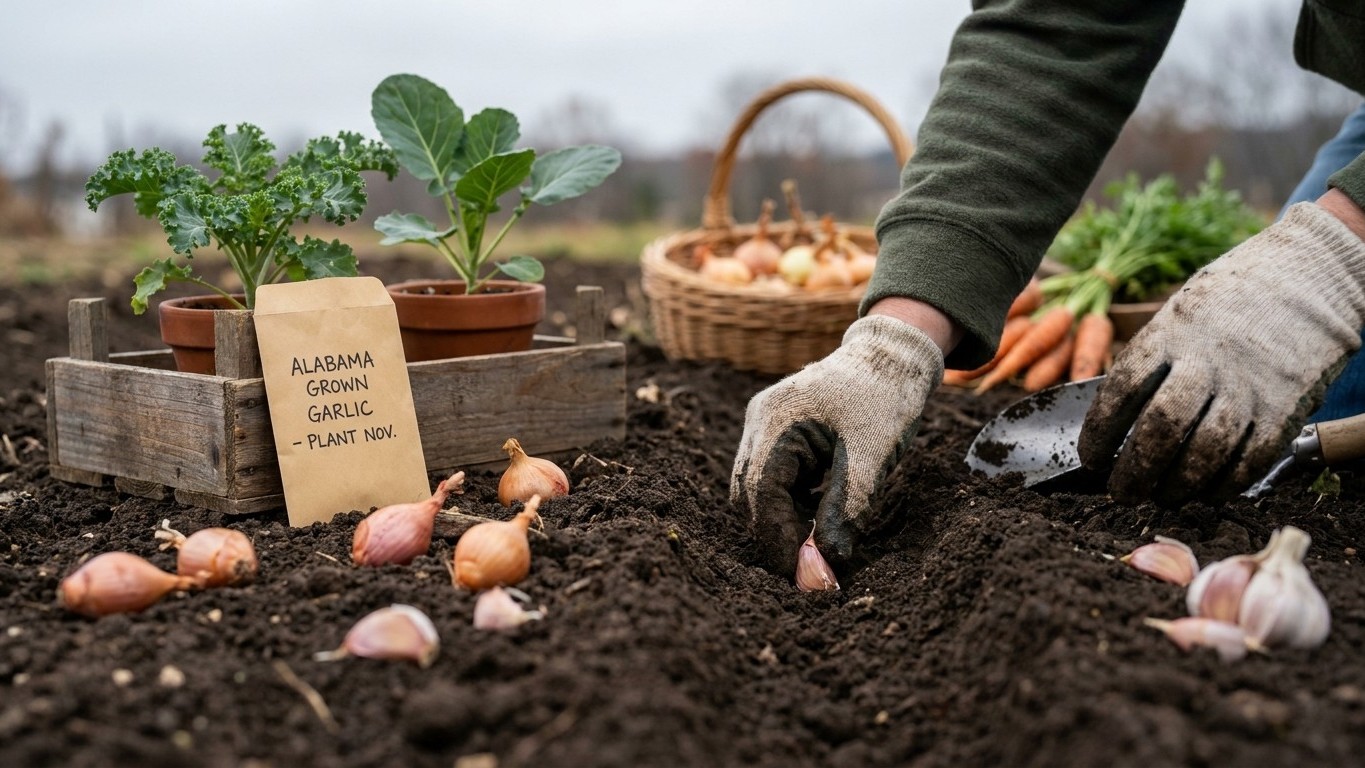

November in Alabama still means planting, not just cleanup. With the state’s first fall frost typically landing between November 2 and November 16, cool-season crops go into the ground now: garlic, shallots, hardy greens like collards and kale, onion sets, carrots, and cover crops. Alabama’s USDA hardiness zones run 7a to 9a, mild enough that November is a working month, not a shutdown.
What goes in the ground in November

The frost window is the thing that actually decides what survives, not the date on the calendar. Alabama’s first fall freeze arrives statewide between November 2 and November 16 according to NOAA’s 1991-2020 climate normals, which means early in the month much of the state still has open soil and workable conditions, while by mid-month a hard freeze is a real possibility in the northern counties. Soil temperature, not air temperature, is what a seed or transplant actually feels, and in zone 7a-9a country the ground rarely drops fast enough in November to shut the door completely.
Garlic and shallots are the anchor crop this month. Cloves want six to eight weeks of cool soil before the ground locks up, and Alabama’s mild winters give them that window comfortably if planted now. Bulb onion sets and short-day onion transplants go in alongside them in much of the state, since Southern onion varieties are bred to start growth in cool weather rather than wait for spring.
Hardy greens are the safe bet everywhere in the state this month: spinach, kale, collards, mustard, and turnip greens all tolerate a light freeze and often taste better after one, since cold triggers the plant to convert starches into sugar. Root crops like carrots, beets, and radishes can still be direct-sown in the first half of the month in central and south Alabama, where the frost window falls later.
What’s a gamble now: anything warm-season. Tomatoes, peppers, squash, and beans planted this late will not mature before frost stops them, no matter how mild the week feels. If the calendar says November, treat those as a bet against a freeze that’s already scheduled to arrive somewhere in the state within the next two to four weeks.
Bare-root and dormant plantings are worth the effort now too. Fruit trees, roses, and asparagus crowns can go in while dormant, giving roots a head start before spring growth resumes. Spring-flowering bulbs like daffodils and tulips also go in the ground this month, though in Alabama’s zones, tulips and hyacinths generally need a stretch in the refrigerator first since the state rarely gets the sustained chill they need naturally.
What to start under cover
Working backward from the frost window instead of a fixed date is what keeps this timing honest. Alabama’s last spring frost falls between March 19 and April 3 at the reference station, so a crop that needs roughly ten to twelve weeks of growth before transplanting, like onions started from seed, should go into trays now if the goal is a February or early March move to the garden. Count back from that spring window, not forward from today, and the math holds up no matter which county you’re in.
Cold frames and low tunnels are doing real work this month. Lettuce, spinach, and Asian greens started under cover now can keep producing through the coldest stretch, since the plastic or glass buys several degrees of protection and enough of a soil temperature buffer to keep roots active. Hardy annual flowers like larkspur and sweet peas are also commonly started under cover in the South this month, since their seedlings tolerate cold far better than heat.
The two ways this goes wrong are opposite problems. Start too early and the seedlings outgrow their trays before conditions outside are fit for them, turning rootbound and leggy while they wait. Start too late, particularly with onions, and the plants never build enough size before the days lengthen and force them into bulbing, leaving small, disappointing bulbs at harvest. The safe habit is to mark the spring frost window on a calendar and count backward from there every time, rather than trusting a memory of when it “felt right” last time.
What is ready to pick
Fall harvest is still very much active in Alabama gardens this month. Collards, kale, and turnip greens keep producing through repeated light frosts, and many gardeners wait for at least one freeze before picking, since the cold sweetens the leaves noticeably. Broccoli and cabbage planted in late summer often mature right around now, with heads ready once they feel firm and dense rather than soft or beginning to separate.
This is also pecan season across much of Alabama, one of the state’s signature fall crops, with nuts dropping as the shucks split open; a ready pecan falls freely from the tree rather than needing to be pried loose. In the warmest coastal counties near Mobile, satsumas and other cold-hardy citrus are ripening now too, with color change from green to orange being the clearest sign, though taste is the better test since color can shift before sugar content catches up.
Root vegetables like carrots, turnips, and radishes can be pulled as needed through the month, and cold soil actually helps them hold in the ground rather than forcing an all-at-once harvest. Stored summer crops deserve a check now too: sweet potatoes, winter squash, and any onions from the summer harvest should be inspected for soft spots or a sweet fermented smell, both signs that one bad piece is about to spread rot to its neighbors in storage.
The jobs that matter this month
Soil preparation for next year’s beds pays off disproportionately when it’s done now. Turning in compost or aged manure while the ground is still workable gives it months to break down and integrate before spring planting starts, rather than fighting cold, compacted soil in February.
Mulching earns its keep this month too. A layer of straw or shredded leaves over garlic beds, perennial roots, and any newly planted bare-root stock insulates against the freeze-thaw cycles that heave roots out of loose soil, a bigger risk in Alabama’s swings between mild spells and sudden cold snaps than in states with steadier winters.
Pruning, ordering, and planning
Dormant pruning on fruit trees and cane berries can begin once leaves drop, since cutting into dormant wood reduces stress on the plant and lets a gardener see the branch structure clearly without foliage in the way. Seed catalogs are also worth ordering from now, since popular varieties, particularly heirloom tomatoes and specialty peppers, tend to sell out of their best stock well before spring planting season arrives.
Testing soil pH and nutrient levels now gives enough lead time to amend before spring, since lime especially takes months to fully adjust soil chemistry. Compost piles benefit from a turn this month to keep the decomposition process active through the cooler weeks ahead, and garden tools should get a real cleaning and sharpening before they sit unused, since rust and dull blades set in fast when tools are put away dirty.
Checking stored crops belongs on this list every single week, not just once. A single soft potato or moldy onion in a storage bin can take down the whole batch within days if it’s not pulled and discarded promptly.
What not to do in November
The most common mistake is planting warm-season crops because a stretch of unusually warm days made the soil feel like spring. Alabama regularly gets a warm spell in November, sometimes stretching into the 70s, but that doesn’t move the frost window; it just makes the eventual freeze feel more sudden when it arrives.
Uncovering cold frames or removing row covers too early after a mild few days is the second classic error. Alabama’s fall weather swings hard between warm and cold fronts, and a plant that’s been hardened off under protection can take real damage if it’s exposed right before the next front drops through.
Heavy nitrogen feeding is also poorly timed this month. Nitrogen pushes soft, leafy growth, and that new growth is exactly what a freeze damages worst, since it hasn’t had time to toughen up. If a fall crop needs a boost now, a lower-nitrogen, higher-potassium feed supports root and cold hardiness instead of vulnerable top growth.
The last mistake is treating the whole state as one climate. A gardener in the Tennessee Valley near the state’s northern border works with meaningfully colder conditions than one near Mobile Bay, and applying one frost date to both ends of Alabama sets one of them up to lose a crop needlessly.
Checking this against your own county
A statewide frost window is a starting point, not a guarantee for any single yard. Alabama’s north-south length, plus elevation changes in the northern hill country, can shift real frost timing by two weeks or more compared to the reference station’s numbers, and a low-lying garden that collects cold air will freeze before a slope just a mile away.
| Region | General USDA zone range | Practical note |
|---|---|---|
| North Alabama | Toward 7a-7b | Earliest frost risk in the state; hardy crops and cover should go in first |
| Central Alabama | Around 8a | Middle of the frost window; most flexible planting timing |
| South Alabama / Gulf Coast | Toward 8b-9a | Latest frost risk; citrus and tender perennials have the most buffer |
For county-level guidance and updated planting calendars, the Alabama Cooperative Extension System is the reliable next stop, since it tracks local conditions the state average can’t capture.
Common questions
Is it too late to plant garlic in Alabama in November?
No. Garlic wants roughly six to eight weeks of cool soil before hard freezes set in, and with Alabama’s first fall frost landing between November 2 and 16, early-to-mid November planting still gives cloves time to root before winter dormancy.
Can I still direct-sow vegetable seeds outdoors this month?
Hardy crops like spinach, turnips, radishes, and mustard greens can still be direct-sown, especially in the first half of the month or in central and south Alabama, where the frost window arrives later than in the north.
Should I fertilize my garden beds in November?
Heavy nitrogen is the wrong choice this month since it pushes tender growth right before frost season. A lower-nitrogen amendment or simply working in compost supports the soil without encouraging vulnerable new growth.
What’s the biggest frost mistake gardeners make in Alabama this month?
Trusting a warm spell over the calendar. Alabama often sees a run of mild, even warm days in November, but the underlying frost window hasn’t moved, and tender plants left unprotected during that stretch are usually the ones lost when the next cold front arrives.