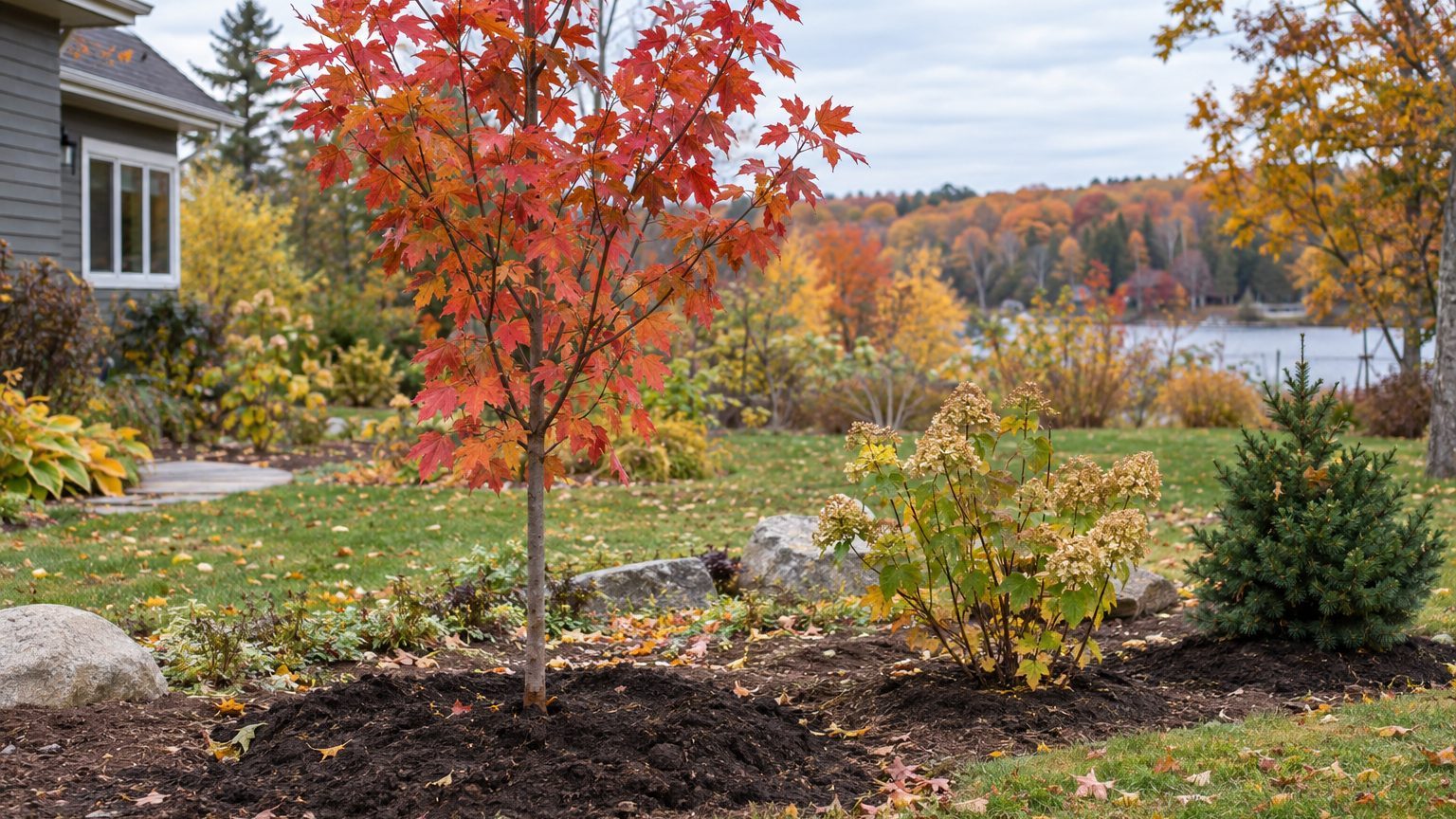

In Anchorage, the safe target for planting trees and shrubs in fall is August 11 to August 20, which is six weeks before the first fall frost. NOAA’s 1991-2020 normals put that frost between September 22 and October 1. Roots keep growing in cool, workable soil, so the real limit is the day the ground freezes, and that comes later. Colder parts of Alaska, farther north or higher up, reach both dates earlier and need to plant sooner.
The deadline in Alaska
Air temperature and soil temperature run on different clocks. By late September the air can drop below freezing overnight, yet the soil, which soaked up heat all summer under nearly endless daylight, stays workable and above freezing for a while longer. Roots keep pushing outward as long as it does. A tree planted in that window is quietly building the underground anchor it will need in spring, even while the leaves yellow and drop.
Working back from the first frost
The clearest rule comes from Cornell Cooperative Extension in New York: “Fall is an excellent time for transplanting, provided you get them to their new home at least 6 weeks before the ground freezes, allowing them time to establish roots before winter dormancy.” Notice what it counts from. Not the first frost, but the freezing of the ground itself, which happens later.
Alaska’s ground-freeze date varies too much by location to pin down honestly, so the practical move is to count back from something we can measure. NOAA NCEI’s 1991-2020 Climate Normals for the Anchorage station show the first 32°F freeze arriving between September 22 and October 1 (the band where the probability sits between 30 and 70 percent). Subtract six weeks and you get the safe target:
Plant between August 11 and August 20 to be safely inside the window.
| Marker | Anchorage | What it tells you |
|---|---|---|
| Safe planting target | August 11 to August 20 | Six weeks before the first fall frost, the conservative date |
| First fall frost | September 22 to October 1 | NOAA NCEI 1991-2020 normals, 32°F freeze probabilities |
| Ground freezes | Later than the first frost | The true outer limit, which shifts from year to year |
Why the true limit falls later
Because the ground freezes after the first frost, planting in late August or even into September is not necessarily doomed. But it is a gamble with shrinking odds. The August 11 to 20 range is the date that leaves roots a full six weeks, and every week you slip past it trims that cushion. Anchorage averages about 143 frost-free days, which makes it one of the mildest inhabited corners of the state. Long summer daylight helps plants make good use of a short season, but it does nothing for soil that is cooling on schedule.
Move north or inland and everything shifts earlier. Fairbanks-type Interior conditions and the far north bring a sooner first frost and a sooner freeze-up, so the planting target there sits before the August range above, not inside it. Check local frost data in First and Last Frost Dates in Alaska and count back from your own number. Gardeners just across the border can compare notes with How Late Can You Plant Trees and Shrubs in Fall in Yukon?, where the same logic applies.
One more figure matters for what you buy. The mean daily minimum of Anchorage’s coldest month is 11.0°F (NOAA NCEI Climate Normals 1991-2020). That, more than any planting date, decides whether a plant survives here at all. The USDA Plant Hardiness Zone Map 2023 runs from 1a to 8a across Alaska, far too wide a spread to plan around, so use the conditions where you actually live.
What to plant late, and what to wait on
Late-season planting favors plants that arrive with their roots intact and their hardiness beyond doubt. Container-grown and balled-and-burlapped trees and shrubs that are fully hardy for your area settle in well in fall, because cool soil and shorter days take the strain off the plant while it is still growing roots. There is no summer heat to make it thirsty and no push of new foliage demanding water it cannot yet pull up.
Choose fully hardy container or balled stock for anything that goes in near the end of the window. Locally grown nursery stock is the safest bet, since it has already lived through Alaska’s conditions. With a coldest-month minimum of 11.0°F in Anchorage, a plant sold as “borderline” for the region will be tested every winter, and a young, freshly moved specimen has the least reserve to spare. Save the experiments for spring, when a plant has a whole season to root before its first test.
Bare-root plants deserve caution in fall. Their roots are exposed and they have no soil buffer, so they need every day of the safe window and are better planted as early in it as possible, or held until spring. Perennials and small shrubs in containers are more forgiving than large trees because there is less top growth to feed.
Evergreens are the risky ones
Spruce, fir, pine, and other evergreens keep their needles all winter, and needles keep losing water even when the soil is frozen and the roots cannot replace it. A newly planted evergreen has a small root system and a full canopy, which is a poor match. If you want one, plant it at the early end of the window, at or before the August 11 to 20 range, so roots have the longest possible run. Anything set in later is better waiting until spring.
Deciduous trees and shrubs lose their leaves and, with them, most of that winter water loss. That makes them the easier fall planting choice. For general guidance on how to space, dig, and set a root ball, see Planting and Caring for Trees, Shrubs and Perennials.
A practical way to sort your shopping list: anything fully hardy and deciduous can go in through the safe window and a little past it. Anything evergreen, borderline, or bare-root goes in early or waits. When a nursery cannot tell you a plant’s hardiness, treat that as your answer.
Watering and mulch until the ground freezes
A new planting spends its first winter on a budget, and every dollar goes to roots. Top growth can wait. In the weeks after planting, a tree or shrub is not trying to get taller or fuller, it is trying to spread into the surrounding soil so it can hold on through freezing and thawing and find water next spring. Anything you do in fall should serve that goal.
Water deeply, right up to freeze-up
Keep watering deeply until the ground freezes, not just until the first frost. A slow soak that reaches the whole root ball and the soil beyond it beats a daily sprinkle that wets only the surface. Fall can be dry in Alaska, and cool air fools people into thinking plants have stopped drinking. Roots are still working, and dry soil freezes harder and pulls more moisture from the plant. Water when the soil a few inches down feels barely damp, and do a last thorough soak before the ground locks up.
Mulch in a ring, not a volcano
Mulch evens out soil temperature and slows moisture loss, which is exactly what a new root system wants. NC State Extension’s Gardener Handbook says: “A 2-inch to 3-inch layer of mulch suppresses most annual weed seeds and makes it easy to hand-pull any that do germinate.” On trees specifically it advises: “Provide a 3-inch layer of mulch to reduce water loss and maintain uniform soil moisture and temperature around roots.”
Spread mulch in a 2-inch to 3-inch layer, shaped like a doughnut with the trunk in the hole. Pull it back from the bark so a few inches of open soil surround the base. More is not better. A deep pile against the trunk holds moisture on the bark, invites rot, and gives gnawing animals a sheltered spot to feed. That is how a ring turns into a volcano. Wait until the top of the soil has begun to cool so the mulch does not trap late-season warmth, and keep it to the depth above. More detail on avoiding the common mistakes is in Mulching Without Killing the Plant.
What goes wrong
The most common failure is simply planting too late for this climate. A tree set in after the ground is already cooling and stiffening has no time to root, and it often looks fine until spring, then leafs out weakly or not at all. The planting window closes earlier the farther north and higher you are, so a date that works in Anchorage can be too late in the Interior. If you missed the August 11 to 20 range, hold borderline and evergreen plants until spring.
Winter burn shows up as brown, scorched needles or leaf edges in late winter. It happens when sun and wind pull water out of evergreen foliage while frozen soil keeps roots from replacing it. Young evergreens are the most exposed, and a lack of fall watering makes it worse. A burlap screen on the windward side can help a new evergreen, but the better protection is a good deep soak before freeze-up and early planting.
Heaving is the other quiet killer. In ground that freezes and thaws repeatedly, a shallow or poorly settled root ball can be pushed upward, exposing roots to drying air and cold. Firm the soil well at planting, water to settle it, and keep an even mulch layer to buffer the swings. Check new plantings after thaws and press any lifted root ball back down.
A dry fall makes all of it worse, because a plant going into winter thirsty has less to draw on. Regional details for gardeners across the state are collected in the Alaska guides.
Common questions
Can I plant a tree in Alaska in October?
It is a poor bet. NOAA’s normals put the first fall frost in Anchorage between September 22 and October 1, and the safe target of August 11 to August 20 is well behind you by then. The ground has not necessarily frozen, so roots may still grow a little, but there is far less margin. If you must plant, choose fully hardy, deciduous container stock, water deeply, and mulch in a ring.
Is the six-week rule counted from the first frost or from frozen ground?
Cornell Cooperative Extension counts from the day the ground freezes. Since that comes later than the first air frost, using the first frost gives a conservative date. For Anchorage, that means August 11 to August 20, with the actual limit falling somewhat later.
Does the deadline change in the Interior or the north?
Yes. Colder places get an earlier first frost and an earlier freeze-up, so the planting target moves earlier too. Anchorage is one of the mildest inhabited parts of Alaska, so its dates are the generous end of the range. Count back six weeks from the first frost for your own area.
What is the safest thing to plant if I am late?
A fully hardy, deciduous shrub or tree in a container or a balled root system, planted immediately and watered deeply until the ground freezes. Leave evergreens, borderline plants, and bare-root stock for spring. Anchorage’s coldest-month minimum averages 11.0°F, so a plant’s hardiness rating counts for more than its planting date.