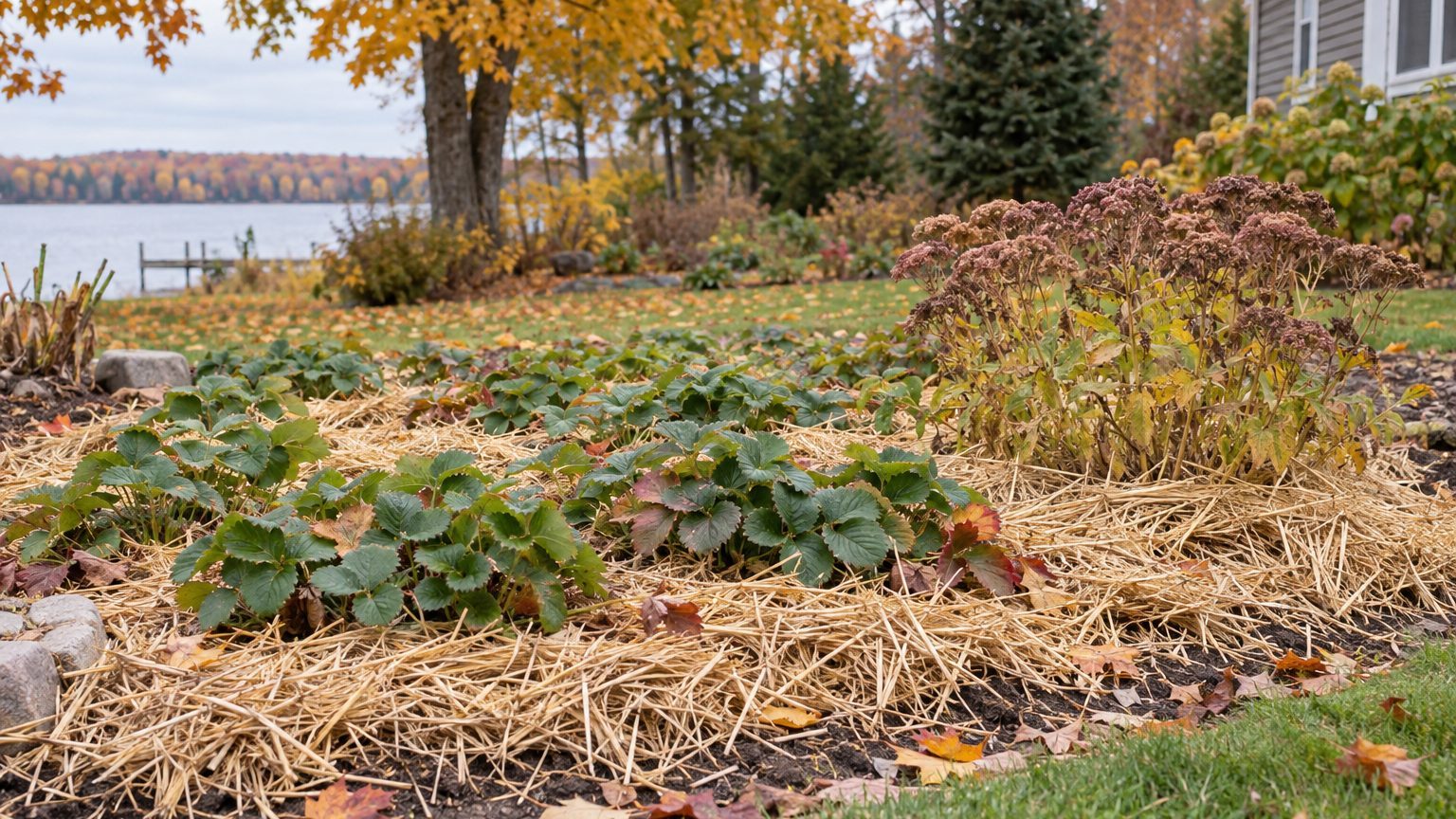

Wait for the ground to freeze, not just for the first frost. In Calgary, the average first fall frost lands on September 16, and winter mulch belongs on weeks after that, once nights have turned hard and the top of the soil is stiffening. Strawberries, borderline perennials and young transplants all follow the same rule. Mulch spread too soon shelters mice and invites rot instead of protecting anything. Here is how to read the timing, and what to do plant by plant.
When to put winter mulch down in Alberta
The logic runs backward from what most gardeners assume. Winter mulch is not a blanket meant to keep plants warm. Its job is to keep the soil frozen once it has frozen, so the ground stays put through the thaws instead of swinging between ice and mud. Soil that freezes, thaws and freezes again is what pushes shallow crowns up and out of the ground.
What the Calgary numbers say
Environment and Climate Change Canada’s 1981-2010 normals for the Calgary International Airport station put the average first fall frost on September 16. The word doing the work there is “average.” In one year out of two the frost arrives later, so September 16 is the midpoint of a window, never a safe date. The same station records a mean daily minimum of -13.2 °C (8.2 °F) in the coldest month. That is a mean of the daily lows, not a record cold snap, and it tells you the ground here will freeze solidly. The open question is when, and whether it stays that way.
One station is not a province. Northern and upland districts run weeks behind Calgary, which means their first frost comes earlier, and so does the right moment to mulch. If your garden sits higher or farther north, shift the whole job toward the front of the window, not the back. The First and Last Frost Dates in Alberta page gives the frost range for other districts. One more caution: Canadian normals cover 1981-2010, while US normals now use 1991-2020, so the two sets of dates should not be compared side by side.
Opening and closing the window
A first frost only nips tender annuals and the tops of some perennials. Freezing of the soil itself follows later, after several hard frosts in a row. So the window opens when plants have gone dormant (strawberry leaves dull and stop growing, perennial foliage browns) and a trowel meets a stiff crust at the surface. It closes when lasting snow buries the bed or the ground locks up too hard to work. Mulch after the soil surface begins to freeze, weeks after the first frost, and finish before snow settles in for good.
A simple check helps. If you can still dig the bed easily and the plants are green, wait. Southern Alberta also gets chinook winds that can melt snow and thaw the top layer in midwinter. If mulch is already down when one arrives, leave it alone. It is doing exactly the job it was put there for.
Strawberries
A strawberry plant keeps its growing point, the crown, right at the soil line. That makes it the most exposed part of the plant, and the part that matters most. Kill the leaves and the plant grows new ones. Damage the crown and the plant is finished.
Why the crowns need cover
Two things hurt them. The first is heaving. Strawberry roots are shallow, and when the soil thaws and refreezes, the expanding ice pushes the whole plant upward, tearing fine roots and leaving the crown perched above ground where it dries out. The second is bare cold. With a coldest-month mean minimum of -13.2 °C at the Calgary station, and chinooks capable of stripping away the snow that would otherwise insulate the bed, an uncovered crown can face deep cold with nothing over it.
Clean straw is the standard material, and for good reason. It is light, it traps air, and it resists matting. Look for straw, not hay, because hay carries seed heads that turn a strawberry patch into a weed patch. Whole leaves and grass clippings pack down into a wet mat against the crown, which is the opposite of what you want.
How deep, and when to pull it back
Depth is where people overdo it. The only depth figure in the sources behind this article comes from NC State Extension, which says: “A 2-inch to 3-inch layer of mulch suppresses most annual weed seeds and makes it easy to hand-pull any that do germinate.” That is a general mulching statement from North Carolina, not a strawberry rule, so treat it as a ceiling for the order of depth rather than a target to exceed. Straw settles over the winter, so judge the depth after patting it down, not in the loose pile. Cover the crowns and leaves fully, but do not bury the bed in a haystack. More is not better, and thick straw stays wet.
Spring is the other half of the job. Do not wait for flowers. Rake the straw off the crowns as soon as the snow is gone and new leaves show pale yellow-green underneath it. Leave it loosely in the aisles between rows, where it keeps berries clean and the soil evenly moist. Keep a little to hand in case a hard frost is forecast after growth starts. The Growing Strawberries guide covers the rest of the season.
Perennials and borderline plants
Most established perennials that are truly hardy here do not need a winter blanket. Peonies, daylilies and many native prairie plants have spent generations getting through Alberta winters on their own. Mulch matters for a narrower group, and it helps to know which plants belong in it.
Which plants benefit
Calgary sits in Canadian hardiness zone 4a, according to Natural Resources Canada’s Plant Hardiness Site (1991-2020 normals). That is a Canadian zone, not a USDA zone, and the two do not convert. Natural Resources Canada says so itself: there are no simple conversions between the systems, and Canadian zone 4a overlaps nine different USDA zones, from 3a to 7a. So a US plant tag cannot be read across by eye. Check what the plant is rated for in the Canadian system before deciding it is safe.
The plants that gain most from mulch are the ones at or past the edge of what zone 4a allows. That includes anything sold for a milder climate, tender roses, and some clematis. It also includes plants that are new. A perennial set out this fall has not anchored its roots, and neither has one divided late in the season, so both heave easily. Shallow-rooted plants like coral bells and garden mums are frequent victims for the same reason. Perennial herbs are a similar case, and Getting Perennial Herbs Through the Winter sorts out which ones need help.
A ring, not a pile
Shape matters as much as depth. Pile mulch against the crown or the stems and it holds moisture right where rot begins, and it hands voles a sheltered tunnel to the plant. Spread it in a ring around the plant instead, like a doughnut, with bare soil directly at the crown. For depth, stay with NC State Extension’s numbers. Its handbook gives the 2-inch to 3-inch range for weed control, and for woody plants it says: “Provide a 3-inch layer of mulch to reduce water loss and maintain uniform soil moisture and temperature around roots.” That second line concerns trees, but it suits shrub roses and other woody borderline plants too. Use a 2-inch to 3-inch ring, and keep the crown or stems themselves open.
Timing follows the same rule as everything else here. Wait for the surface to begin freezing, then mulch. The Mulching Without Killing the Plant guide goes deeper on materials and technique for the rest of the garden.
What goes wrong
Winter mulch fails in predictable ways, and almost all of them trace back to timing or shape.
Too early, too wet, too thick
Mulching too early is the most common mistake. If the soil is still warm and the plants are still green, a fresh layer holds heat and moisture against the crown. In spring you find out: soft, brown, mushy centers on strawberries or perennials that never leaf out. The fix is patience. Use the September 16 average frost date as the start of the watch, not the start of the work, and remember that in half of all years the first frost comes later.
Matting looks different. Whole maple leaves, wet grass clippings and thick layers of fine material seal into a soggy sheet that blocks air. Underneath, the plant sits wet and cold, then rots. Choose fluffy, coarse materials, keep the layer within the 2-inch to 3-inch range from the NC State handbook, and shred leaves before using them.
Voles, and the spring pull-back
Voles are the other reason to hold off. They travel under snow and love a deep, cozy layer of mulch, particularly if it goes on before the ground freezes and gives them time to move in. The tell is chewed bark at the base of young shrubs, or a maze of runways when the snow melts. Keep mulch pulled back from woody stems, and use a wire mesh guard around young trunks and shrub bases.
Forgetting to uncover is the quiet failure. Plants leaf out pale, leggy and weak under a lid of straw, and damp crowns invite rot in cool spring weather. Watch for new growth under the mulch. Pull the mulch back when the snow is gone and growth begins, not on a calendar date, and keep it nearby for a night when a hard frost is forecast.
Common questions
Can I mulch right after the first fall frost?
No. The first frost is a signal to start watching, not a signal to start mulching. In Calgary the average first fall frost is September 16, according to Environment and Climate Change Canada’s 1981-2010 normals, but the ground takes weeks longer to begin freezing. Mulch too soon and you get warm, damp cover that favors rot and rodents.
Is shredded leaf mulch as good as straw for strawberries?
Shredded leaves can work on perennials if the layer stays loose, but straw is the better choice for strawberries. Whole leaves mat into a wet blanket against the crown. Clean straw traps air without packing down, and it is easy to rake back in spring. Avoid hay, which carries weed seed.
Do herbs need the same treatment?
Some do, and some do not. Borderline perennial herbs benefit from a ring of mulch after the ground starts to freeze, while hardy ones usually manage without it. Getting Perennial Herbs Through the Winter explains which is which.
If we get plenty of snow, is mulch still worth it?
Snow is good insulation, but in southern Alberta it is not reliable. Chinooks can strip a bed bare in a day, exposing crowns to the cold that follows, with the coldest month averaging -13.2 °C at night at the Calgary station. Mulch is cheap insurance for strawberries and borderline plants. Districts farther north or higher up run colder and see their first frost earlier, so they should mulch earlier in the window. For more on local timing, browse the other Alberta guides.