
At 61.17 degrees north, the reference latitude for this territory, the answer is straightforward: sow onion seeds indoors in February, transplant them outside once the ground thaws, and choose long-day varieties only. Alaska’s summer sun delivers 18 hours and 56 minutes of daylight on the longest day of the year, which is exactly what tells an onion when to stop growing leaves and start forming a bulb. Everything else follows from that single number.
The short answer for Alaska

Onions don’t respond to temperature the way tomatoes or peppers do. They respond to day length. A bulb forms when the number of daylight hours crosses a threshold specific to the variety, and nothing about soil warmth or rainfall changes that trigger. At 61.17°N, near Anchorage, the longest day of the year delivers 18 hours and 56 minutes of daylight. That figure sits well above the 14-to-16-hour range that long-day onions need before they’ll bulb, which is exactly the point: this latitude only works for long-day types.
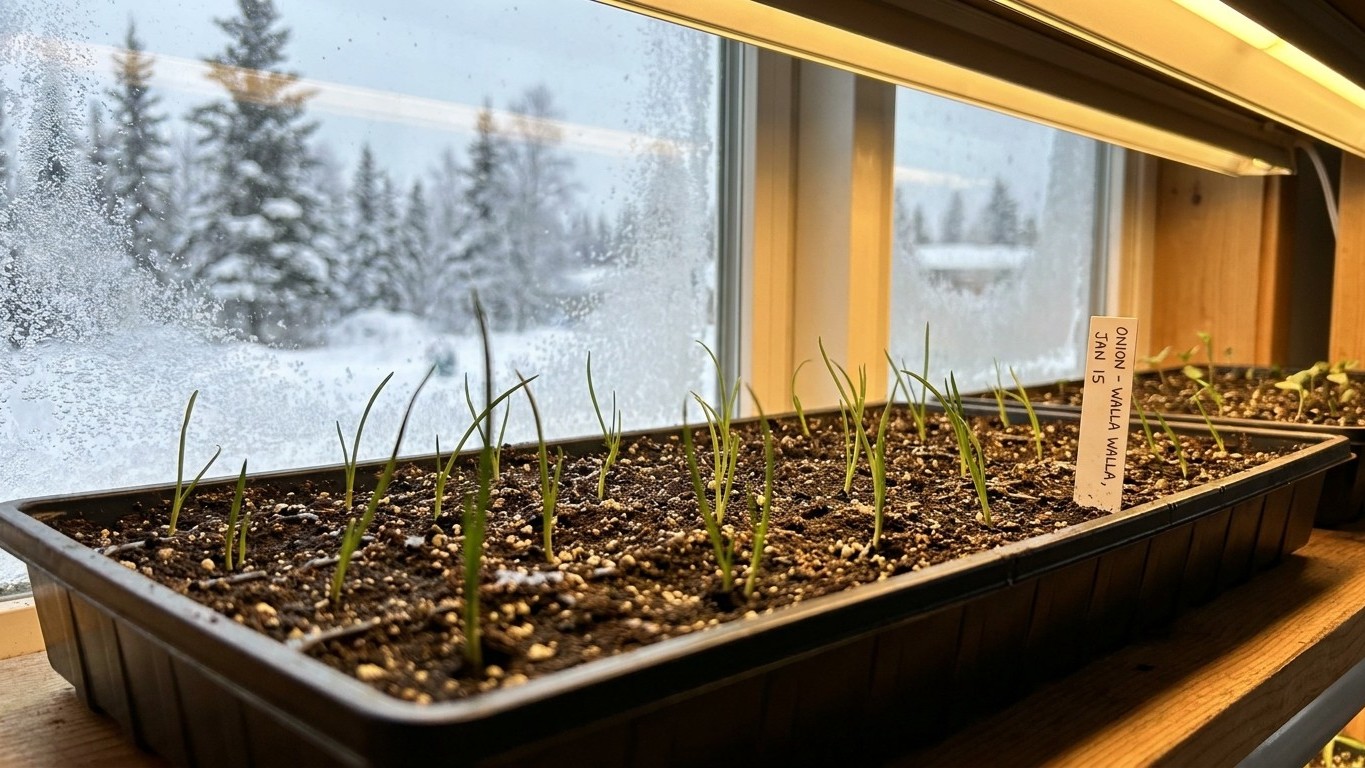
That’s a sharp contrast with states in the South or mid-Atlantic, where gardeners can tuck onion sets into the ground in fall and let them overwinter. Mild-winter climates make autumn planting possible because the plants survive cold snaps and resume growth in late winter. Alaska doesn’t offer that option. Winters here are long and severe enough that onions started in fall simply won’t survive, so the entire growing window compresses into late winter and spring. Seeds go indoors under lights around February, six to eight weeks ahead of the last frost, and transplants move outside once soil is workable, typically as the frost risk fades in May.
Among the long-day varieties documented for this territory, Redwing is the clearest fit, with a published range of 43 to 65 degrees north that comfortably covers 61.17°N. Ailsa Craig sits closer to the edge, with a documented range of 38 to 60 degrees north, just inside 1.5 degrees of its upper bound. That puts it in blurred territory: it may bulb reliably at this latitude, but a gardener planting it here is working at the outer limit of what the variety was bred for, not squarely inside it.
What will not work here
Planting an onion variety that isn’t rated for this latitude doesn’t just mean a smaller harvest. It usually means no harvest at all. Short-day and intermediate-day onions are bred to trigger bulbing at day lengths well below what Alaska’s summer sun delivers, and once that threshold hits, the plant stops making leaves and starts making a bulb regardless of how small it still is. Plant one of these here and the sequence is predictable: healthy green tops all season, a bulb that never sizes up because the plant simply hadn’t grown enough leaf mass before the trigger fired, and then rot as the plant tries to keep functioning past its natural stopping point.
This is a variety mistake, not a feeding mistake. No amount of fertilizer or watering fixes it, because the plant isn’t responding to nutrients, it’s responding to the clock.
- Gabriella, Madalyn, Red Rock, White Castle (short-day): bulb at around 12 hours of daylight, a threshold this latitude crosses in early summer while the plants are still small, leaving undersized bulbs
- Cabernet, Calibra, Candy, Elsye, Expression, Monastrell, Red Long of Florence, Red Long of Tropea, Scout, Sierra Blanca (intermediate-day): trigger before the plant has built enough leaf mass at this latitude, producing the same undersized result
- Barolo, Blush, Bridger, Frontier, New York Early, Patterson, Powell, Red Carpet, Rossa di Milano, Safrane, Talon, Walla Walla Sweet (long-day, published range topping out below 61.17°N): bred for day lengths shorter than what this latitude delivers, putting bulbing outside the range these varieties were tested for
The same logic explains why a late planting date shrinks the crop instead of merely delaying it. Bulbing starts on the calendar, not on the plant’s schedule. Whatever size the onion has reached when day length crosses the threshold is the size the bulb will be. Start seeds late, and the plant simply hasn’t built enough leaf mass by the time bulbing kicks in, so the harvest comes in smaller across the board, not later.
What changes across Alaska
Alaska isn’t one latitude, it’s a state that stretches from roughly 55°N in the Southeast panhandle to well past 71°N along the Arctic coast, a spread of about 16 degrees. The 61.17°N figure used above comes from a station near Anchorage, and gardeners well north or south of that city are working with meaningfully different daylight totals.
Reading the spread
Head north into the Interior or above the Arctic Circle and daylight totals climb further still, with parts of the far north experiencing continuous daylight for stretches of the summer. That extends the long-day trigger window even more, but it also compresses the usable growing season on the other end, since frost lingers later into spring and returns earlier in fall. Gardeners that far north often need to start seeds earlier indoors and manage a shorter transplant window outside.
Head south toward the Panhandle and daylight totals drop, along with a milder frost-free window that can open a few weeks ahead of Anchorage’s. Even there, though, the shift isn’t large enough to make intermediate-day varieties viable. Their published ranges top out around 45 to 46 degrees north, well south of even Alaska’s mildest gardens.
| Region | Approx. latitude | What changes |
|---|---|---|
| Southeast Panhandle | ~55°N | Milder frost-free window, transplant date may shift earlier; long-day varieties remain the only fit |
| Anchorage (reference) | 61.17°N | 18h56 on longest day; Redwing fits, Ailsa Craig at the edge of its range |
| Interior / far north | 65°N and above | Even more daylight, shorter frost-free season, earlier indoor start needed |
Sweet now, or onions that last
The compounds that make an onion sharp are the same ones that let it keep in storage. That’s not a marketing distinction, it’s chemistry: pungency comes from volatile sulfur compounds, and those compounds do double duty as a natural preservative once the onion is cured and stored. University of Missouri Extension puts it plainly: sweet onions do not store as well as the more pungent types.
Southern gardens, where short-day varieties thrive, tend to produce sweeter, milder onions that eat well fresh but don’t hold up in a root cellar past a few weeks. Alaska’s day-length math rules out those varieties entirely, which means the trade-off isn’t really a choice here. Long-day onions grown at this latitude tend to run sharper and more pungent, and that’s exactly what makes them worth growing in a place with a winter this long.
A jar of onions harvested in September and cured properly can realistically still be usable in March, not because the gardener did anything special, but because the variety that survives Alaska’s day length also happens to be the kind built to last. That’s a fair trade for a garden that only gets one shot at a growing season each year.
Checking this against your own garden
The 61.17°N figure describes conditions near Anchorage. A garden in Juneau, Fairbanks, or Utqiagvik is working with a different number, and the difference matters enough to check before ordering seed.
- Look up your own latitude if you’re gardening well north or south of Anchorage, using any mapping tool or your address on a coordinate lookup site
- Confirm your local last and first frost dates rather than assuming Anchorage’s timeline applies statewide
- Contact your local University of Alaska Fairbanks Cooperative Extension Service office for frost data specific to your borough
- Check the published day-length range for any variety before ordering, especially if you’re near a boundary the way Ailsa Craig is here
- Track your own daylight hours on the summer solstice if you’re unsure how your garden compares to the reference figure
The Moon calendar is a separate, older custom: see when to plant onions by the moon, written as tradition rather than fact.