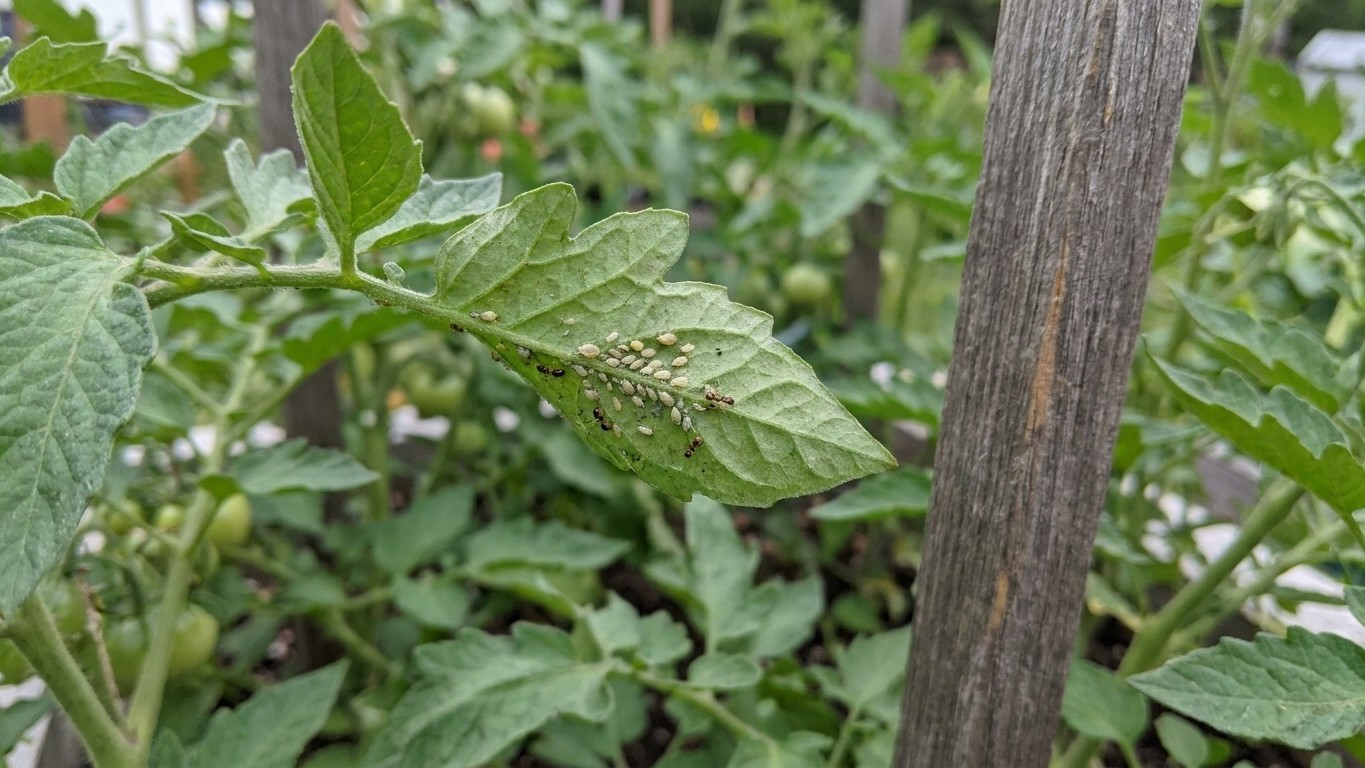

Alaska’s tomato pest list is short compared to the Lower 48. Near Anchorage, NOAA’s 1991-2020 climate normals put the frost-free window at roughly May 3 to May 12 through September 22 to October 1, about 143 days, and most of that crop grows under some kind of cover. That keeps out tomato hornworms, Colorado potato beetles, and most soil-borne pests that need a long, warm season to build numbers. What does turn up, reliably, is aphids, spider mites, whiteflies, and slugs. Check the undersides of leaves on any transplant before you set it out, since that’s where the first three usually arrive.
What this comes down to in Alaska

Alaska’s short, cool season is the filter that decides this whole list. Tomato hornworms and Colorado potato beetles need months of sustained heat to build a generation, so the season simply runs out before they can establish. What gets through instead rides in quietly: aphids already clustered on a transplant’s leaves, spider mites building up in the dry, still air of a tunnel once summer heat settles in. Season length keeps the big pests out; tunnel air is what lets the small ones in.
Tomato hornworms and Colorado potato beetles are effectively a non-issue in Alaska gardens. Both need a longer, hotter season to establish, and neither is a routine problem for growers working within the frost window above. The pests worth actually watching for are the ones that ride in on transplants or build up in the still air of a tunnel.
Aphids
Aphids are usually the first pest you’ll see, often arriving already established on a purchased or greenhouse-grown transplant rather than flying in from outside. They cluster on new growth and the undersides of leaves, sucking sap and leaving a sticky residue called honeydew that can turn black with sooty mold. A heavy cluster stunts new growth and curls leaves before you notice the insects themselves. Check every transplant’s leaf undersides before you set it in the ground or the tunnel, since a small cluster caught early is a five-minute squash-and-rinse job, while an established colony calls for insecticidal soap or a strong water spray repeated every few days.
Spider Mites
Spider mites show up once a tunnel starts running hot and dry through the middle of summer, since that is exactly the condition they favor. They’re barely visible without a hand lens, and the first sign is usually a fine stippling or bronzing on the upper leaf surface rather than the mites themselves. Look for the fine webbing they spin between leaves and stems in a bad infestation. Raising the humidity with a midday misting and hosing down the undersides of leaves does more to knock back a light infestation than any spray, and a miticide is rarely needed if you catch it at the stippling stage.
Whiteflies
Whiteflies tend to show up around the same time as aphids but go unnoticed a little longer, since the adults hide on the undersides of leaves until the plant is disturbed. Brush a leaf and a small cloud of tiny white insects lifting off is the giveaway. Both the adults and the flat, pale nymphs feed by sucking sap and can spread plant viruses in the process, which is one more reason several catalog cultivars, including Sun Gold and Sakura, carry resistance to Tobacco Mosaic Virus or Tomato Mosaic Virus. Yellow sticky cards hung just above the plant canopy catch adults and give you an early count before the population climbs.
Slugs
Slugs are the pest of the cool, damp end of the season, most active on overcast or rainy nights once the plants are outdoors or the tunnel is ventilated for summer. They leave ragged holes in leaves and, worse, in ripening fruit near the soil line, along with a telltale silvery slime trail. Damage often shows up on fruit that touches mulch or bare soil, so keeping ripening trusses off the ground helps as much as any bait. Handpicking at night with a flashlight, or setting out shallow dishes of beer as a trap, controls a light population without needing a pesticide at all.
Working it out for your own garden
The fastest way to identify which pest you’re looking at is to work through it in order: location, symptom, and time of day. A pest found only on plants that started life indoors, or that showed up within the first couple of weeks after you moved transplants out, almost always rode in on the plant itself, which points to aphids or whiteflies rather than something that flew in from outside. That’s worth remembering while you’re following the transplant schedule on Tomato Planting Dates in Alaska: Counting Back From Your Frost Window, since the same week you’re hardening off transplants is the week to be checking leaf undersides.
Match the symptom to the pest
- Sticky residue and curled new leaves: aphids.
- Fine stippling on upper leaves plus webbing: spider mites.
- A small white cloud lifting off when you brush the plant: whiteflies.
- Ragged holes in leaves or fruit, with slime trails, discovered in the morning: slugs.
If none of those match, or the damage looks like something chewing through a stem at soil level overnight, the more likely explanation in Alaska is a cultural problem rather than a named pest at all: cold soil, uneven watering, or a nutrient gap. Rule out weather and watering before you reach for a pesticide, since a surprising amount of what looks like pest damage in a short-season climate is actually stress from a cold snap or an overwatered pot.
A ten-dollar hand lens settles most arguments a naked eye can’t. Check three or four leaves scattered through the canopy, not just the ones with obvious symptoms, since aphids and whiteflies tend to colonize new growth first while the older leaves still look clean. What looks like dust on a leaf underside is often a light mite population rather than dirt.
What changes across the state
The frost dates and pest patterns above come from NOAA’s station near Anchorage, and Anchorage is one of the mildest, most tunnel-friendly parts of the state, not a stand-in for all of it. The USDA’s plant hardiness map puts Alaska anywhere from zone 1a to zone 8a depending on where you are, a wider spread than most entire regions of the Lower 48, and pest pressure shifts just as much across that range.
Interior heat versus coastal damp
Interior tunnels run hotter and drier at midday than coastal ones, which pushes spider mite pressure higher inland even where the season itself is shorter. Mites build up fastest in warm, still, low-humidity air, and an interior tunnel can hit that mark by early afternoon on a clear summer day. Coastal and Southeast areas, with their cooler, wetter summers, tend to see less mite trouble but more slug pressure, since slugs need the damp ground and overcast nights a maritime climate supplies in quantity. Higher elevation gardens, and anywhere close to a large body of water, generally run cooler and later than the valley floor around them, which delays every pest on this list by roughly the same stretch it delays the tomato plants themselves.
None of that changes which pests are on the list, only how much pressure each one puts on your particular tunnel or bed. A grower in a cold, damp coastal town should expect slugs to matter more than mites. A grower in a hot, dry interior tunnel should expect the reverse.
The mistakes this state punishes

Skipping quarantine on new transplants
The single most common mistake is skipping a quarantine step on a purchased transplant and setting it straight into a tunnel full of other plants. Aphids and whiteflies don’t need to fly in from outside when a grower carries them in by hand, and a short season leaves little slack to recover from an infestation that gets a head start. Quarantining new transplants on their own tray for about a week, checked daily, catches most infestations before they reach the rest of the crop.
Running a closed tunnel and picking a long-season variety
The second mistake is letting a tunnel run hot and closed through the warmest weeks of summer to chase a few extra degrees of heat for a long-season variety. That’s exactly the still, dry, warm air spider mites need to build up fast, and it’s also the setup that pushes a grower toward a cultivar like Amish Paste or Brandywine, around 85 and 78 days from transplant, which leave only 34 and 41 days of margin before the Anchorage-area fall frost window even without a pest setback. A mite outbreak on a long-season cultivar with little margin left can cost the harvest outright. The same outbreak on a 55 to 60 day cultivar like Sakura or Jasper still leaves room to recover. See Tomato Varieties That Ripen in Time in Alaska for the full range of margins by cultivar.
The third mistake is waiting until slug damage shows up on the fruit itself before doing anything about it. By the time a slug has reached a ripening tomato, it has already been working through the lower leaves for weeks. Checking the base of the plant and the mulch layer with a flashlight starting in late summer, when nights turn cool and damp, catches the problem while it’s still confined to foliage.
Checking this against your county
Every figure above is anchored to the Anchorage area, and pest pressure, humidity, and season length all shift the further you get from it. A state-wide figure is a starting point, not an instruction for your plot. The University of Alaska Cooperative Extension Service, at uaf.edu/ces, keeps county-level offices that track what’s actually showing up in gardens near you that season, and it’s worth a call before assuming a state-wide pattern applies to your particular tunnel or bed. Bring a sample or a clear photo of the damage if you can. It’s the fastest way to get a pest identified correctly instead of guessing from a general description.
Common questions
Do tomato hornworms ever show up in Alaska?
Essentially no. Hornworms need a longer, hotter season to complete their life cycle than Alaska’s frost-free window allows, and they aren’t a routine problem for tomato growers in the state. If you find a large green caterpillar on a tomato plant here, it’s worth getting a clear photo and checking with your local extension office before assuming it’s a hornworm.
Can I just spray a general insecticide as a precaution?
You don’t need to, and it usually backfires. Most Alaska tomato pest problems are caught early with a weekly leaf-underside check, and a broad-spectrum spray inside a closed tunnel can wipe out the few predatory insects that would otherwise keep aphids and mites in check on their own.
Why do my tomato leaves have tiny yellow speckles but I can’t see any bugs?
That’s the classic early sign of spider mites, which are small enough to miss without a hand lens. Check the leaf underside for fine webbing between the leaf and stem, and raise the humidity around the plant before reaching for a miticide.
Do slugs actually eat tomato plants, or just my lettuce?
They’ll eat tomatoes too, especially ripening fruit that touches the soil or mulch, though they usually go for softer greens first if both are available in the same bed. Staking or caging plants so fruit clears the ground removes most of the opportunity.