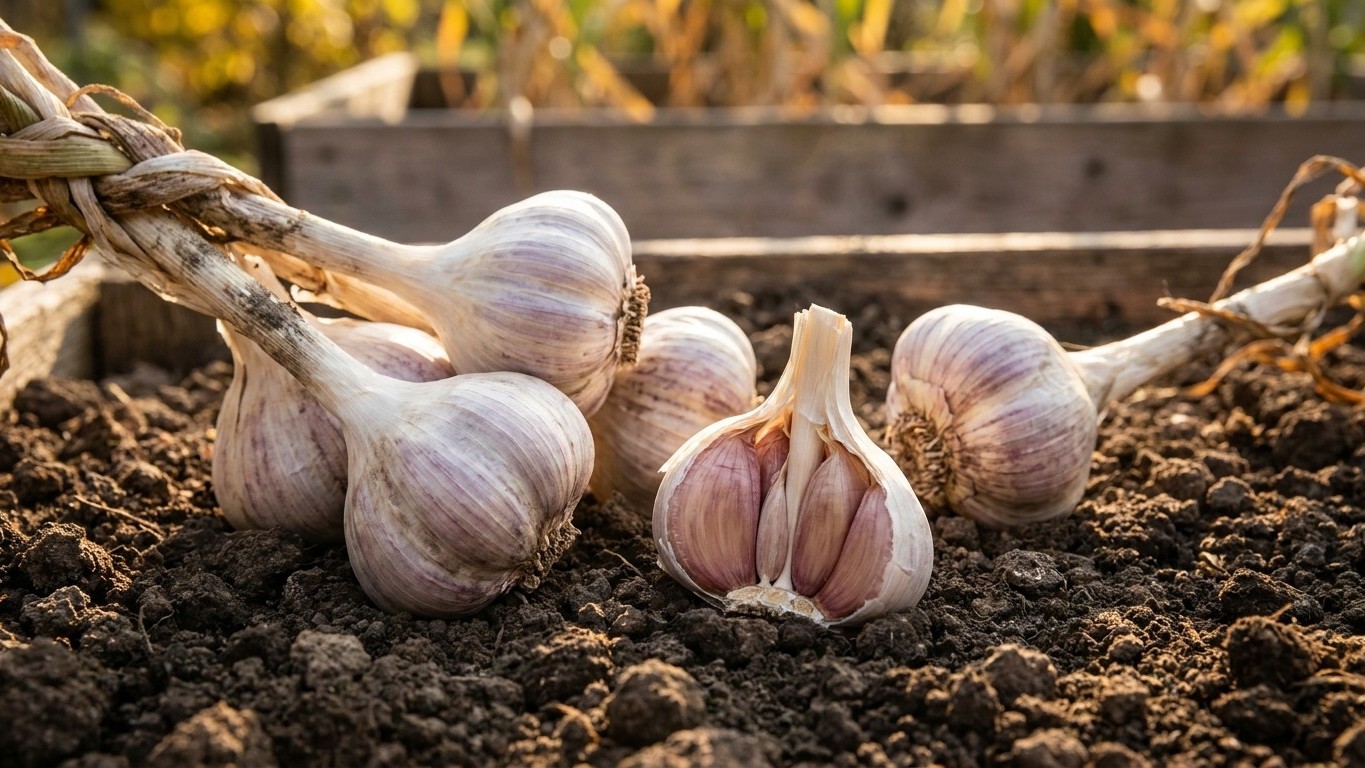

Garlic in Alberta is usually ready to lift in mid-July through early August, planted the previous autumn and pulled once the lower leaves brown off while five or six upper leaves stay green. Curing follows for three to four weeks in a dry, shaded, airy spot before bulbs move into cool, dark winter storage. Timing shifts year to year with how the growing season played out.
When garlic is ready to lift in Alberta
The signal to watch is the leaves, not the calendar. Each leaf on a garlic plant corresponds to a wrapper layer on the bulb underneath, so when the lower third to half of those leaves have gone brown and dry while the upper leaves are still green, the bulb has finished sizing and the wrappers are set. Pull too early and the cloves are undersized with loose skins that won’t cure well. Wait too long past that point and the wrappers split, leaving bulbs exposed and prone to rot in storage.
What decides the exact week in Alberta is the length of the growing season the bulb got, and that traces back to the previous autumn. Garlic here goes into the ground in fall, ahead of the ground freezing solid, so it can put down roots before winter dormancy. Environment and Climate Change Canada’s Canadian Climate Normals for 1981-2010, recorded at the CALGARY INT’L A station, put the average first fall frost at September 16. That figure is a midpoint, not a safe date. In one year out of two, frost actually arrives later than that average. It’s also a single-station reading. Alberta is not one climate zone, and northern districts or higher-elevation land run weeks behind what Calgary sees.
A garlic clove planted well ahead of that average frost date gets more time to establish roots before the ground locks up, and that head start often shows up the following summer as an earlier, larger harvest. A clove planted late, into a fall that ran colder or arrived sooner than the midpoint suggests, tends to lift later the next year with smaller bulbs. That’s the mechanism behind the range gardeners see season to season: it’s less about the July weather and more about what happened the previous September.
Test-pull one or two bulbs from the row before committing to the whole bed. Brush off the soil and look at the wrapper layers directly. If they’re tight and the cloves are well-defined, the rest of the row is ready. If the skins still feel thin or fused, give it another few days and check again rather than lifting the entire planting on a guess.
Curing it, and where to hang it here
Curing is what turns a freshly pulled bulb, still carrying moisture in its neck and outer layers, into something that will actually keep. The bulbs need three to four weeks in a spot that’s dry, shaded from direct sun, and has enough airflow to carry moisture away from the necks. Direct sun on freshly lifted bulbs can scald the outer wrapper and shorten storage life, so curing happens out of the light even though the process itself depends on dry air.
An unheated garage, a covered porch, a shed with the doors cracked, or a barn all work, provided the space stays out of rain and direct sun and gets some air movement. Alberta’s summer air tends to run dry, and chinook-driven days can push relative humidity down further, which generally helps curing along rather than working against it. The risk here isn’t usually humidity, it’s heat buildup in an unventilated space with no airflow, which can cook the bulbs instead of drying them gently.
How to know curing is done
Bundle bulbs loosely by the neck, or lay them in single layers on screens or mesh trays so air reaches all sides. Leave roots and tops attached during this stage. Curing is finished when the neck feels tight and papery rather than fleshy, and the outer wrapper has that dry, rustling quality instead of a damp, leathery one. At that point, trim the roots close to the base and cut the tops down to about an inch of neck, unless the bulbs are being braided for hanging storage.
For questions specific to Alberta growing conditions beyond curing, such as regional pest and disease bulletins or soil test recommendations, Alberta’s Agriculture and Irrigation extension service is the province’s own resource for that kind of local detail.
Storing it through a Alberta winter
Once curing is done, storage conditions are almost the opposite of curing conditions: instead of warm and dry with airflow to pull moisture out, bulbs now need cool, moderately humid, and dark to keep from drying past the point of usefulness or sprouting early. A target range most home growers use is somewhere between freezing and about 40°F, with enough humidity in the air that the bulbs don’t shrivel, but not so much that mold sets in.
| Stage | Temperature | Humidity | Light |
|---|---|---|---|
| Curing | Warm, ambient summer temps | Low, dry air | Shaded, no direct sun |
| Storage | Cool, near freezing to 40°F | Moderate | Dark |
A refrigerator is usually the wrong call for whole bulbs. Fridges run humid enough to encourage mold on papery wrappers, and the cold can trigger sprouting once bulbs come back out to room temperature. An unheated but insulated room, an enclosed cold porch, or a root cellar-type space tends to work better because it holds a steady cool temperature without the condensation a fridge produces.
How many months a given bulb will actually hold up isn’t a fixed number this page can put on it, since that depends on the variety, how well it cured, and how it’s handled after storage begins, and no verified figure for that duration is published here. What does matter in the meantime is checking stored bulbs periodically. Pull out any that have gone soft, moldy, or started sprouting green shoots, since one compromised bulb in a braid or a mesh bag can spread rot to its neighbors faster than most people expect.
Store bulbs loose in a mesh bag, a paper sack with holes, or an open crate rather than sealed plastic. Airflow around each bulb matters as much in storage as it did during curing, just at a much lower intensity.
What goes wrong here
Most storage failures trace back to curing that wasn’t finished, not to the storage space itself. Bulbs cured in a spot without enough airflow, or pulled into storage before the necks fully tightened, tend to soften or mold within weeks no matter how carefully the storage room is set up afterward.
Pests are a smaller factor for stored garlic than for many other crops, but the region does have documented pressure worth knowing about. Montana State University Extension, Urban IPM, documents these insects as ones that turn up in this general region:
- Brown marmorated stink bug
- Grasshoppers
- Miller moths
- Social wasps
- Thrips
None of these are garlic-storage specialists, but thrips in particular can build up on garlic foliage during the growing season and weaken bulbs before harvest, which shows up later as thinner wrappers that don’t cure or store as well. Checking foliage for thrips damage, tiny silvery streaking on the leaves, before harvest can flag a bulb that’s likely to underperform in storage regardless of how well it’s cured.
Sunscald from curing in direct light, splitting from a harvest that ran too late, and bruising during the lift itself round out the common causes of early spoilage. Bruised bulbs in particular are worth setting aside and eating first rather than mixing into long-term storage, since a soft spot on a bulb is an entry point for rot that spreads to whatever it’s stored next to.
Common questions
Can I harvest garlic in Alberta before the leaves brown?
Pulling early gives undersized cloves with loose, underdeveloped wrappers that don’t cure or store well. Waiting for the lower leaves to brown while several upper leaves stay green is the more reliable signal than picking a fixed date on the calendar.
Does hardneck and softneck garlic cure the same way in Alberta?
The curing process itself, three to four weeks in a shaded, airy, dry spot, applies the same way regardless of type. What differs is mainly how bulbs get arranged afterward, since softneck varieties braid easily while hardneck bulbs are usually bundled or laid on trays.
Can stored garlic go in the refrigerator instead of a cold room?
A standard refrigerator tends to run more humid than whole bulbs need, which can encourage mold on the wrappers, and the cold-to-warm cycle when bulbs come out can trigger early sprouting. A cool, dark, moderately humid space outside the fridge generally holds bulbs longer.
Where can Alberta gardeners get local growing guidance beyond curing and storage?
Alberta’s Agriculture and Irrigation extension service, at https://www.alberta.ca/agriculture-and-irrigation, covers province-specific growing conditions, pest bulletins, and soil guidance beyond what applies to curing and storage alone.