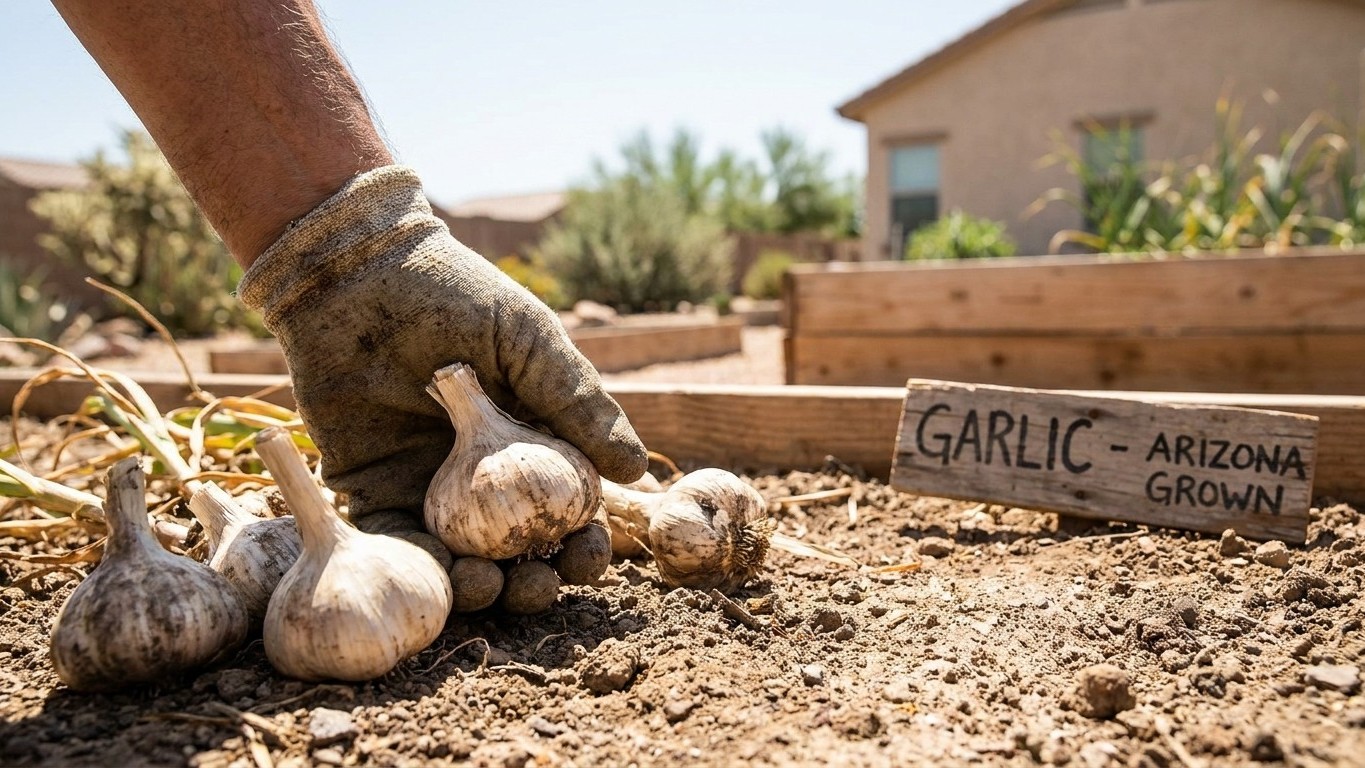

Six freezes in thirty years — that’s all the low desert has managed lately, and it’s why garlic variety choice here hinges on cold, not calendar dates. Phoenix, Tucson, and Yuma gardens sit inside a nearly year-round frost-free stretch, which rules out the hardneck types that need a real winter to split into cloves. Softneck strains like Inchelium Red and Early Red Italian don’t need that trigger — they head up fine on desert warmth alone. Save the hardnecks for the high country, where the cold actually shows up.
The short answer for Arizona

Garlic variety choice in Arizona comes down to how much real cold your garden gets each winter, not a planting date. In the low desert, that’s very little: NOAA’s 1991-2020 climate normals for the Phoenix-area station put the frost-free season at a full 365 days, and hard freezes at 32°F or below showed up in only 6 of the past 30 springs. That’s barely a winter at all by the standard garlic uses to split a bulb into cloves.
Low desert: softneck by default
Early Red Italian, Inchelium Red, Italian Late, and Lorz Italian all come from softneck lines bred for mild-winter growing regions, and they’ll form full heads in Phoenix, Tucson, and Yuma gardens without needing a hard freeze to trigger clove separation. Softneck is the safer default anywhere in the low desert, plain and simple.
High country: hardneck where winters actually freeze
Varieties like German Red, German White, Chesnok Red, Duganski, Georgian Crystal, Georgian Fire, Bavarian Purple, Blue Music, Fall Festival, and Ivan all evolved in genuinely cold winter climates, and they want a sustained cool period to divide cleanly around a central stalk. Flagstaff and the surrounding high country get that kind of winter almost every year, hard freezes included, a completely different climate from the station NOAA measured near Phoenix.
The 6-in-30 figure matters because it’s a frequency, not a guarantee. Some springs in the low desert do freeze, most don’t, and a garden can’t be planned around an event that shows up one year in five. That’s why a frost-based calendar doesn’t work for choosing garlic type in the low desert. Once you’ve picked a type suited to your winter, the timing question belongs on a separate page: see When to Plant Garlic in Arizona for the week-by-week arithmetic.
Working it out for your own garden
Once you’ve prepped your bed as covered in Growing Garlic in Arizona, the next decision is elevation-specific, and the Phoenix numbers above come from a single NOAA weather station. Arizona changes climate faster over a short distance than almost any other state, so treat that 6-in-30 figure as a worked example, not your own answer.
To do the same arithmetic for your own place, start with two numbers from NOAA’s climate normals for the station closest to you. The National Centers for Environmental Information publishes these free, for thousands of US stations: the length of the frost-free season, and how many years out of the 30-year record actually reached 32°F. If your station’s frost-free season runs close to Phoenix’s 365 days, or freezes show up in only a handful of the 30 years, you’re in a mild-winter softneck climate no matter what county you’re in. If your station shows hard freezes most winters, you’re closer to a Flagstaff-type climate and hardneck varieties will divide the way they’re supposed to.
Elevation is doing most of the work
Arizona has no ocean and no lake large enough to moderate a local freeze record, but it has something that plays almost the same role: elevation. Air cools reliably as elevation rises, which is why a straight drive from Phoenix up to Flagstaff crosses from a climate that almost never freezes to one that freezes hard, without changing latitude at all. Elevation is the fastest way to guess which garlic type belongs in your garden before you’ve pulled a single NOAA number. Low and flat generally means softneck. Up on the plateau generally means hardneck.
Cold air also pools in low spots even within a single town. A backyard at the bottom of a wash, or in a low corner of a subdivision, can run several degrees colder on a still winter night than a yard fifty feet higher up the same street, even though both sit under the same NOAA station’s record. That local drainage won’t change which garlic type your overall climate calls for, but it explains why a neighbor two streets over sometimes gets away with a variety that struggles in your own bed. None of this replaces checking your own station’s numbers directly. NOAA’s normals are public, specific to a named station, and will tell you plainly whether your winter looks more like Phoenix’s or more like Flagstaff’s.
What changes across Arizona
Arizona’s garlic climates split into three rough bands, and where your garden falls decides which of the fourteen varieties named above are worth planting.
| Zone | Example areas | Winter character | Garlic type suited |
|---|---|---|---|
| Low desert | Phoenix, Tucson, Yuma | Rare hard freezes, mild through winter | Softneck: Early Red Italian, Inchelium Red, Italian Late, Lorz Italian |
| Transition / mid-elevation | Prescott, Payson, Sedona | Occasional frost, cool but not severe most winters | Either type, worth trialing both on a small scale |
| High country | Flagstaff, the White Mountains, towns along the Mogollon Rim | Regular hard freezes most winters | Hardneck: German Red, German White, Chesnok Red, Duganski, Georgian Crystal, Georgian Fire, Bavarian Purple, Blue Music, Fall Festival, Ivan |
Why the transition band is unpredictable
The transition band is the one worth watching closest, because it’s wide and inconsistent. Prescott sits high enough to get real frost some winters and mild ones in others, and a single hard freeze arriving in an otherwise soft winter can be enough to push a marginal hardneck through proper clove division, while a mild year leaves the same variety round and undivided. Gardeners in that middle ground get better information from planting a few of each type and watching what actually happens in their own bed than from any statewide rule.
The Mogollon Rim line
The Rim marks the roughest version of that split. Land above it gets Flagstaff-style winters, and land below it, even a few miles south, can drop back into transition or low-desert territory depending on elevation and how far south it sits. A county line means nothing here. Coconino County alone spans both Flagstaff’s hard winters and warmer canyon country at lower elevation within the same county boundary.
The mistakes this climate punishes
Two mistakes cost most of the crop in Arizona, and which one gets you depends on which side of the state you’re on.
Wrong type for the winter you actually have
In the low desert, the common mistake is planting a hardneck variety out of habit, or because a catalog photo looked appealing, then getting a harvest of small, round, undivided bulbs because the winter never delivered the sustained cold that variety needed to split into cloves. The fix sits upstream of planting day: choose Early Red Italian, Inchelium Red, Italian Late, or Lorz Italian before a single clove goes in the ground.
Wrong depth or timing at elevation
In the high country, the mistake runs the other direction. Gardeners plant a hardneck clove too shallow, or too late in the fall for it to root before the ground goes cold, and it either heaves out of the soil over winter or sits ungerminated until spring costs it weeks of growing time. Depth and timing matter more than variety choice once you’re above the frost line, and that’s the ground the planting calendar page covers in more detail.
The disease risk that isn’t about cold at all
A third risk runs statewide and gets ignored because it has nothing to do with freezing. UC IPM’s Pest Management Guidelines for Onion and Garlic, UC ANR Publication 3453, list Fusarium basal rot as active across a wide temperature band, and Arizona’s growing season sits inside that published range in seven separate months from planting through late spring. White rot‘s published range overlaps six of those same months, including one month at its published optimum. Southern blight runs hottest in the shoulder months right around planting and harvest, and pink root hits its published optimum in two of them.
Those figures describe soil temperature, not the air temperature you’d check on a porch thermometer, and comparing them against Arizona’s air averages is an approximation, not a direct measurement. A monthly average also hides a lot of daily swing on either side of it, and none of these ranges come from an Arizona-specific study, so no single number here describes every garden in the state. None of that makes any of the four diseases guaranteed, and staying outside a published range never means a disease is impossible either, since infected seed stock carries these pathogens wherever it’s planted.
Certified, disease-free seed garlic is the single biggest lever against all four of these pathogens, more than any timing choice.
- Buy certified seed garlic rather than replanting bulbs of unknown history
- Avoid waterlogged beds through the cool months, when white rot’s published range overlaps Arizona’s winter almost completely
- Lift bulbs promptly once the tops start to dry down, since southern blight‘s published optimum lines up with Arizona’s hottest shoulder months
Checking this against your county
Every figure here comes from one NOAA station near Phoenix and one set of UC IPM temperature ranges, and Arizona is too large and too varied in elevation for either to stand in for your own county. The University of Arizona Cooperative Extension keeps county-level offices with staff who track local frost history, soil conditions, and variety performance specific to their area. Check with your county’s extension office before committing a full bed to one variety, especially in the transition band between low desert and high country. Find your county’s office through the University of Arizona Cooperative Extension directory.
Common questions
Can I trick a hardneck into dividing in Phoenix by refrigerating the cloves first?
Refrigerating seed cloves for a few weeks before planting is a workaround some growers try to simulate the cold hardneck garlic wants. It doesn’t reproduce a full winter’s worth of sustained cold, and results are inconsistent even when it partly works. Treat it as an experiment on a few cloves, not a substitute for choosing a softneck suited to a mild winter like Phoenix’s.
Do I need to buy fresh seed garlic every year, or can I replant my own bulbs?
Replanting your own bulbs is fine as long as they showed no rot or discoloration at harvest, since Fusarium basal rot and white rot both carry forward in infected seed stock regardless of soil temperature. Given how many months of Arizona’s growing season overlap both diseases’ published ranges, it’s worth rotating in certified stock every couple of years even from a clean-looking bed.
Is Growing Garlic in Tucson basically the same as Phoenix?
Tucson sits in the same low-desert category as Phoenix, with winters mild enough that softneck varieties are the safer bet there too. Tucson’s own NOAA station record differs from Phoenix’s, though, so check its normals through NCEI or ask Pima County’s extension office rather than assuming the 6-in-30 freeze figure applies exactly.
I’m in Prescott, between the desert and Flagstaff. Which type should I plant?
Trial both the first year instead of committing a full bed. Plant a few cloves of a softneck like Italian Late alongside a hardneck like Ivan, and let your own site’s freeze pattern that particular winter tell you which one to expand the following fall.