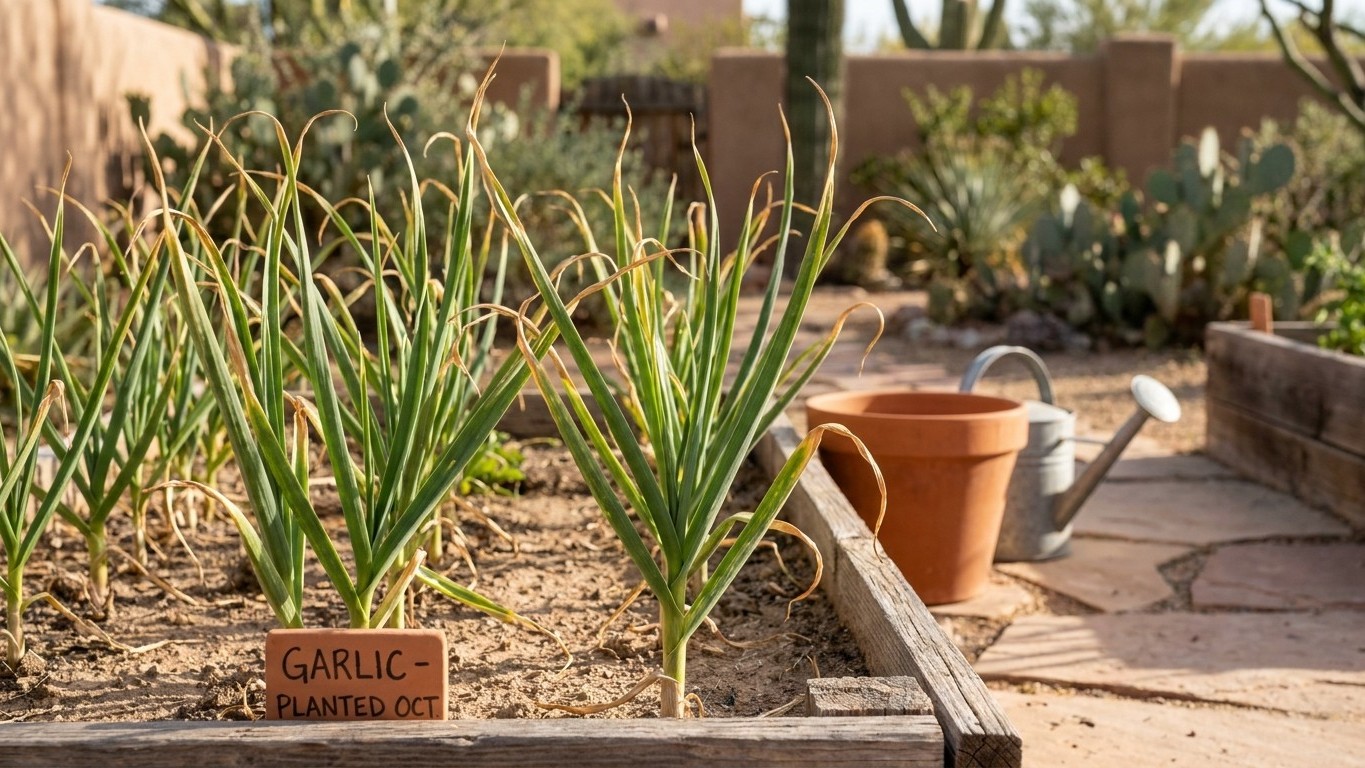

Phoenix’s frost-free season runs 365 days most years, which makes “count back from first frost” useless advice the moment you try to apply it here. Six hard freezes in the last thirty springs isn’t a pattern you can build a planting date around. So the clove doesn’t go in the ground on a countdown from cold, it goes in when the summer heat finally breaks and the soil starts cooling instead of baking, with enough mild weeks ahead to actually form a bulb.
The short answer for Arizona

If you garden in or around Phoenix, there is no reliable fall freeze to build a planting calendar on. NOAA’s 1991-2020 climate normals put the frost-free season at 365 days, and a hard freeze turned up in just 6 of the last 30 springs on record at that station. A countdown from “days before first frost” only works if a frost shows up most years, and Phoenix’s doesn’t. If you’ve already worked through the basics of Growing Garlic in Arizona, you just need to pin down when the clove actually goes in the ground.
That doesn’t mean the planting date stops mattering here, it means the anchor changes. In the low desert, the limiting factor isn’t cold, it’s heat: cloves need to go in once the worst of summer has broken, so roots can establish in soil that’s cooling rather than baking, and the plant gets enough weeks of mild weather over the winter to actually form a bulb instead of staying a single fat, undivided clove. Plant by temperature and day length here, not by a frost date that isn’t reliable enough to plan around.
Higher up, in places like Flagstaff and the rim country, frost is real and it arrives hard and often. That climate has nothing to do with the Phoenix station’s figures. If you garden at elevation, pull your own station’s data from NOAA or from the University of Arizona Cooperative Extension rather than borrowing the Phoenix numbers used here.
Even where a fall freeze does exist, remember that a frost date is a midpoint drawn from thirty years of records, not a guarantee. In roughly half of those years, the first real freeze fell later than the median date. Build in a margin, whichever region you garden in.
Working it out for your own garden
Start with your own station’s numbers, not Phoenix’s. Pull up NOAA’s climate normals for the station nearest you, or call the University of Arizona Cooperative Extension office for your county, and settle two questions before you touch a clove.
- Whether your nearest station shows a reliable fall freeze most years, or a long frost-free season like Phoenix’s 365 days
- If it does freeze, the median date of that first freeze, remembering it’s a midpoint and not a guaranteed safe day
- How your elevation compares to the low desert, since higher ground cools off faster each autumn than the valley floor
If your area has no reliable frost
For gardeners in the low desert basins, around Phoenix, Yuma, and similar low-elevation valleys, skip the frost countdown entirely. Watch daytime highs coming down off their summer peak instead, and plant once the heat has broken enough that root growth won’t cook in the top few inches of soil. Garlic goes into the ground in autumn and comes out the following summer, so in this climate the planting date’s main job is giving the crop enough mild weeks in between, not dodging a freeze that isn’t reliable to begin with.
If your area does freeze
Where a real winter exists, elevation is doing most of the work. Higher ground cools off weeks ahead of the low desert, which is why the high country around Flagstaff and the White Mountains reaches its first freeze long before Phoenix sees anything close to cold, and why mid-elevation towns such as Prescott or Sedona sit somewhere in between the two. None of those station figures live in the Phoenix record, so treat any specific date for those areas as something to look up locally, never as something borrowed from the low desert.
Once you have your own frost data, the arithmetic runs the same way it does anywhere garlic is grown: count backward from that freeze by enough weeks for roots to get established, then check the result isn’t so early that tender top growth is still soft and green when the first hard freeze lands. Because the frost date itself is a midpoint, treat it as the center of a range rather than a line you can plant right up against.
What changes across Arizona
Arizona holds several distinct growing climates within a few hours’ drive of each other, and garlic timing shifts with each one. Never assume Phoenix’s figures describe anywhere else in the state.
The low desert, meaning Phoenix, Yuma, and the towns along the Colorado River valley, has no reliable fall frost by NOAA’s record. Garlic timing there runs entirely on escaping summer heat rather than dodging cold, and the growing season for onions and garlic essentially never stops for freeze on that record.
The high country, meaning Flagstaff, Williams, and the White Mountains, sits at elevation on the Colorado Plateau and gets hard, repeated freezes every winter, well before Phoenix sees anything close to cold. Check NOAA’s normals or the Cooperative Extension office for that county directly rather than applying anything above.
Mid-elevation towns such as Prescott, Sedona, and Payson sit between the two extremes, cooler than the valley floor but milder than the high plateau, and both their frost timing and how much winter chill a hardneck garlic actually receives will land somewhere in between as well. Match the variety to the winter your garden actually gets, not the one the rest of the state gets.
The mistakes this climate punishes
Planting a hardneck where winters stay mild
Hardneck types want real winter chill to trigger proper bulb formation. Skip that chill and the result is small, rough bulbs, or a plant that never divides into cloves worth harvesting. In the low desert around Phoenix, where NOAA’s normals show essentially no hard freeze in most years, a hardneck like Bavarian Purple, Blue Music, Chesnok Red, Duganski, Fall Festival, Georgian Crystal, Georgian Fire, German Red, German White, or Ivan is fighting the climate from the day it goes in the ground. Softnecks such as Early Red Italian, Inchelium Red, Italian Late, and Lorz Italian ask for less cold and are the more forgiving choice wherever winter barely shows up.
| Variety | Neck type | Best suited to |
|---|---|---|
| Early Red Italian | Softneck | Mild winters, low desert |
| Inchelium Red | Softneck | Mild winters, low desert |
| Italian Late | Softneck | Mild winters, low desert |
| Lorz Italian | Softneck | Mild winters, low desert |
| Bavarian Purple | Hardneck | Cold winters, high country |
| Blue Music | Hardneck | Cold winters, high country |
| Chesnok Red | Hardneck | Cold winters, high country |
| Duganski | Hardneck | Cold winters, high country |
| Fall Festival | Hardneck | Cold winters, high country |
| Georgian Crystal | Hardneck | Cold winters, high country |
| Georgian Fire | Hardneck | Cold winters, high country |
| German Red | Hardneck | Cold winters, high country |
| German White | Hardneck | Cold winters, high country |
| Ivan | Hardneck | Cold winters, high country |
For a longer rundown of which types perform where, see Garlic Varieties That Suit Arizona Winters.
Planting into soil that’s still hot, or waiting too long
The opposite mistake shows up as rot rather than a poor bulb. UC IPM’s onion and garlic guidelines (UC ANR Publication 3453) show Fusarium basal rot‘s published 59-90°F range overlapping the mean air temperature for seven months of Arizona’s growing season, September, October, November, February, March, April, and May, which covers nearly the entire planting-to-harvest window statewide. White rot‘s cooler 50-75°F range overlaps six months, November through April, including one month sitting right at its published optimum. Timing alone won’t dodge either disease, since a clove that’s already infected will rot on schedule no matter what week it goes in the ground. Start with clean, certified seed stock rather than saved bulbs of unknown history, and improve drainage anywhere white rot has shown up before.
Southern blight favors the opposite end of the thermometer, with its 86-95°F optimum lining up with September and again with June and July, per the same UC IPM publication, which is why bulbs left in over-summered soil carry more risk than a fresh clove going in each fall. Pink root‘s 75-85°F optimum turns up in October and again in May, right at the two ends of a typical Arizona garlic season, planting and harvest.
Checking this against your county
Before committing to a planting date, contact the University of Arizona Cooperative Extension office for your county. Agents there can point you to the nearest weather station’s own frost record, tell you whether your area has a reliable fall freeze at all, and flag local disease pressure, like white rot or Fusarium basal rot, that’s already shown up in nearby gardens. That’s information no statewide article, this one included, can responsibly hand you county by county.
Common questions
Can I Plant Garlic in spring instead of fall in Arizona?
No. Garlic needs to go in during autumn and comes out the following summer, and a spring-planted clove in Arizona runs straight into the heat that stops bulb development before it’s had time to size up.
Do I need to chill garlic cloves before planting in Phoenix?
Some gardeners in mild-winter climates pre-chill hardneck cloves to make up for the cold they won’t get in the ground, but that adds a step and a risk of its own if done wrong. It’s usually simpler to plant a softneck like Inchelium Red or Lorz Italian, which doesn’t need the extra chill in the first place.
How do I know if my garden counts as low desert or high country?
If you’re near Phoenix, Yuma, or another low-elevation valley with mild winters and no real hard freeze most years, you’re in the low desert. If you’re near Flagstaff, Williams, or the White Mountains at real elevation with hard winter freezes, you’re in the high country, and you should pull frost data for that area specifically rather than using anything above.
What happens if I planted a hardneck and the winter turned out too mild?
The bulbs will likely come out small or fail to divide into distinct cloves, though they’re still edible. It’s a sign to switch to a softneck variety the following season rather than a sign you did the planting itself wrong.
If you follow the almanac, here is when to plant garlic by the moon. It is a tradition, not a proven method.