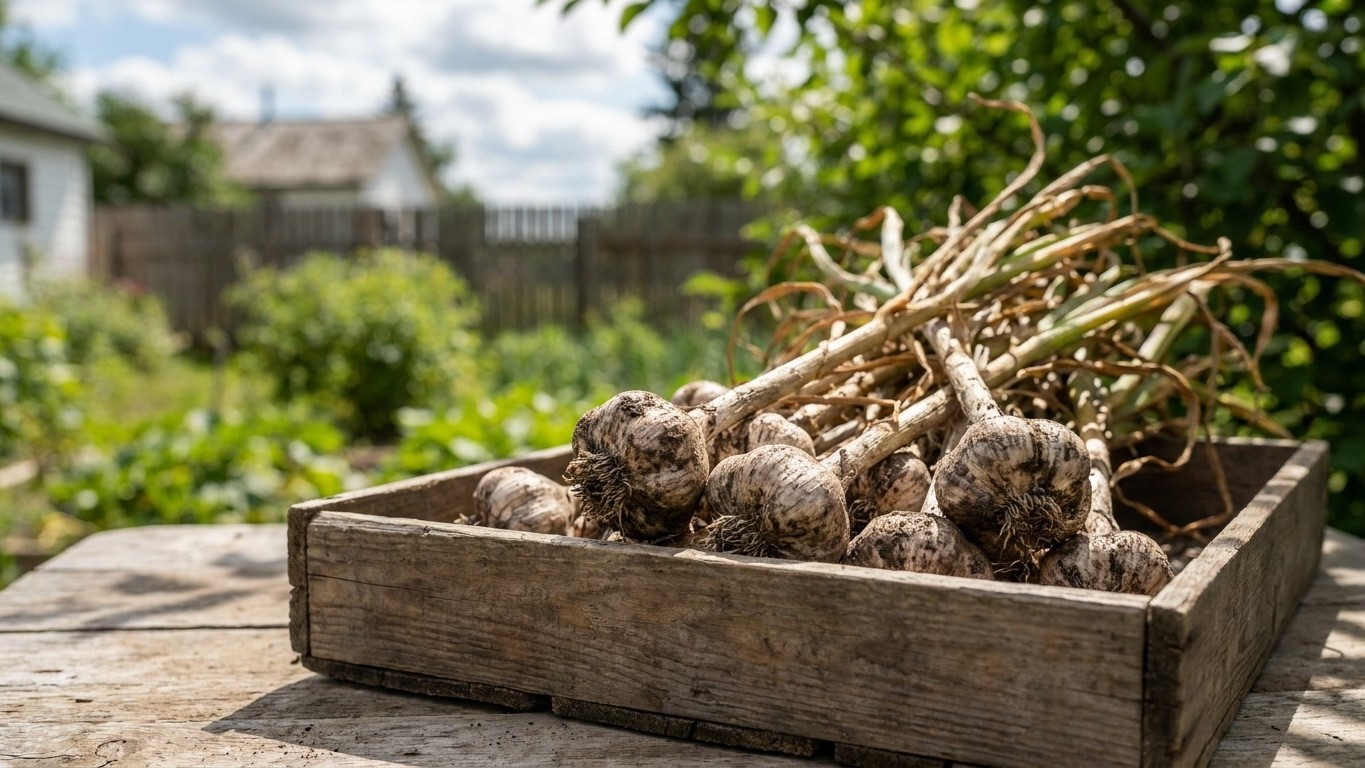

Alberta’s winters deliver far more cold than garlic needs to divide into cloves, so the crop is not marginal here the way it is in warmer states. Environment and Climate Change Canada’s 1981-2010 climate normals put the average first fall frost at Calgary Int’l A at September 16, and that date is the anchor for planting, not a hard deadline. The one thing to do now: get cloves into the ground in the weeks before that date, deep enough to survive freeze-thaw, and pick a hardneck variety unless you have a specific reason to plant softneck.
Will garlic get the cold it needs in Alberta

Garlic clove has to sit through a stretch of real cold after planting or it never splits into a head. Instead of a bulb made of cloves, the grower digs up a single round, undivided bulb the following summer, basically an onion-shaped disappointment. University of Georgia Extension (publication C854) puts the requirement at six to eight weeks of temperatures below 40°F before the plant will divide properly, which is why choosing Garlic Varieties That Suit Alberta Winters matters as much as timing the planting itself.
Why Alberta clears this easily
This is the one place on the vernalization question where Alberta growers can relax. With Environment and Climate Change Canada’s Calgary normals showing an average first frost around September 16, and a prairie winter that runs weeks below freezing after that, the ground here spends far longer than eight weeks below 40°F every single year. The risk in this province is never a shortfall of cold. It is the opposite: cold arriving hard and fast enough to kill a clove that has not rooted or was not planted deep enough, which is a winter-hardiness problem, not a vernalization problem, and the two get confused in general garlic advice written for milder places.
Where the shortfall options actually apply
Growers in warm-winter states sometimes have to refrigerate their cloves for six to eight weeks before planting to fake the cold they will not get from soil, or they fall back on softneck types that need less chilling in the first place. Alberta growers do not need to do either. Growing Garlic in Arizona: Planting Dates, Varieties and Winter Cold covers a climate where that refrigeration step matters. Here, the ground itself is the refrigerator, and the only decision left is timing the planting so the clove roots before that cold arrives, which is the subject of the next section.
When to put the cloves in
Anchor the planting date on the frost, not on the calendar month. Environment and Climate Change Canada’s 1981-2010 normals for Calgary Int’l A put the average first fall frost at September 16, but that figure is a midpoint calculated across thirty years, meaning roughly half of those years saw frost arrive later and half saw it arrive earlier. Treat it as the center of a window, never as a date you can plan against with confidence, and consult this guide on When to Plant Garlic in Alberta for a fuller breakdown of the timing.
The window that actually works
Garlic planted in fall needs enough time in the ground to grow a root system before the soil locks up solid, but not so much time that it pushes tall green top growth that then gets hammered by hard frost. Growers generally aim to get cloves in several weeks ahead of that average first frost, which for the Calgary area means planting is usually underway well before the third week of September. Because the September 16 figure is a mean and not a guarantee, it is worth watching the ten-day forecast and soil temperature rather than planting off a fixed date every year.
What shifts the window around the province
Calgary Int’l A is one station, and Alberta is not one climate. The foothills and higher elevations west of Calgary cool off earlier in the season than the city itself, which means growers there are often planting ahead of that Calgary-area average rather than on it. The Peace River country and other northern districts also tend to see their first frost arrive earlier than the Calgary normal. If you garden north or west of Calgary, or at meaningfully higher elevation, treat the September 16 figure as a date you need to beat, not one you can match. Growing Garlic in New Hampshire: Planting Dates, Varieties and Winter Cold is a useful comparison for another cold-winter state where growers plant on the same logic, working backward from an autumn frost rather than a spring one.
Which types suit Alberta
Garlic splits into two groups, and which one performs better is decided by winter, not by taste. Hardneck garlic wants a real cold season to trigger good bulb formation, sends up a curling flower stalk called a scape that gets cut off before harvest, and tends to store for a few months rather than a full year. Softneck garlic tolerates milder winters, skips the scape, and is the type that braids and stores the longest, which is why it dominates grocery store shelves.
Alberta’s winter is squarely a hardneck winter. The cold here is not marginal or borderline the way it is in a place where growers have to weigh their options carefully. Given a full, hard winter, hardneck varieties generally reward that cold with better bulb division and stronger flavor, which is the main reason experienced growers in this province lean hardneck even though it means eating through the harvest faster than a softneck crop would allow.
Varieties available in each type
From the hardneck side, cultivars include Bavarian Purple, Blue Music, Chesnok Red, Duganski, Fall Festival, Georgian Crystal, Georgian Fire, German Red, German White and Ivan. From the softneck side, Early Red Italian, Inchelium Red, Italian Late and Lorz Italian are available and worth growing where longer storage matters more than scapes and top-end cold tolerance.
| Variety | Type | Main strength |
|---|---|---|
| Bavarian Purple | Hardneck | Cold tolerance |
| Blue Music | Hardneck | Cold tolerance |
| Chesnok Red | Hardneck | Flavor, cooking use |
| Duganski | Hardneck | Cold tolerance |
| Fall Festival | Hardneck | Cold tolerance |
| Georgian Crystal | Hardneck | Vigor |
| Georgian Fire | Hardneck | Strong flavor |
| German Red | Hardneck | Cold tolerance |
| German White | Hardneck | Cold tolerance |
| Ivan | Hardneck | Cold tolerance |
| Early Red Italian | Softneck | Storage length |
| Inchelium Red | Softneck | Storage length |
| Italian Late | Softneck | Storage length |
| Lorz Italian | Softneck | Storage length |
Days-to-maturity figures for these cultivars are usually counted from spring transplant in warm-climate seed potato or onion-family conventions, so treat any maturity number you see on a seed packet as a rough guide rather than a fixed date, and lean instead on the leaf-based harvest signs.
Soil and bed preparation
Garlic sits in the same patch of ground for roughly ten months, through freeze, thaw and spring mud, so the bed has to drain well before anything else matters. Standing water rots a clove long before any disease organism gets the chance to, and a low spot that puddles after a fall rain is a bad place to plant no matter how good the soil otherwise looks.
Working the bed
Loosen the soil to a full spade’s depth in the weeks before planting so the root system, which is what actually drives bulb size, has room to spread without hitting compacted ground. Work in a couple of inches of finished compost or well-rotted manure at this stage rather than fresh manure, which can burn root tissue and carries a higher risk of weed seed. Raised beds or ridged rows help in any spot where drainage is even slightly in question, since a few extra inches of elevation is often the difference between a clove that survives spring melt and one that rots.
Timing the clove separation
Break bulbs into individual cloves right before planting, not weeks ahead. A clove that has been separated too early starts to dry out at the basal plate, which is the tissue it needs intact to root well. Plant the largest, healthiest cloves from each bulb and eat or cook with the smaller ones, since clove size at planting correlates directly with bulb size at harvest.
What the climate here favours, and what it does not
UC IPM’s Pest Management Guidelines for Onion and Garlic (UC ANR Publication 3453) publish soil temperature ranges for the main garlic diseases, and running Alberta’s growing-season air temperatures against those ranges gives a sense of which problems find favorable conditions here and which do not. These are soil thresholds compared against air temperature averages, so treat the result as a tendency worth watching for, never as a diagnosis or a forecast of infection.
Where the window opens
White rot, caused by the fungus Sclerotium cepivorum, has a published range of 50 to 75°F. Alberta’s growing-season air temperatures fall inside that band in three months, September, June and July, and one of those months sits right at the pathogen’s published optimum. That is the disease this climate keeps in range longest, and it is also one that survives in soil for years once introduced, so the real defense is never planting cloves from a bulb you are not confident is disease-free rather than relying on temperature to keep it away.
Fusarium basal rot, caused by Fusarium oxysporum f. sp. cepae, has a published range of 59 to 90°F, and only one month of Alberta’s growing season, July, falls inside that band. A single month in range is a narrow window compared to white rot’s three, which is some of the reassurance this climate offers.
Where it stays closed
Southern blight, caused by Sclerotium rolfsii, has a published optimum of 86 to 95°F, and no month of Alberta’s growing season reaches a mean air temperature inside that band. Pink root, caused by Setophoma terrestris, has a published optimum of 75 to 85°F, and again no month here reaches it. Outside its optimum, a disease is less active, not eliminated. Infected planting stock or contaminated soil carries either pathogen regardless of climate, so a cold prairie summer is not a guarantee, just a climate that does not push these two toward their most aggressive state the way a hot southern summer would.
Getting it through the winter
Mulch is what separates a garlic bed that survives an Alberta winter from one that gets heaved out of the ground. Lay a thick, insulating layer of straw or shredded leaves, on the order of four to six inches, once the soil surface has started to firm up with cold but before the ground locks solid. Mulch applied too early traps warmth and encourages the clove to push top growth that then gets killed back by real cold. Mulch applied too late misses the point of insulating the soil before the deep freeze arrives.
Why depth of planting matters more here than in mild climates
A clove planted too shallow is at real risk of frost heaving, where repeated freeze and thaw cycles physically push it upward until part of it sits exposed at the surface. A shallow clove that heaves loses its winter protection exactly when it needs it most, and often does not recover even if it is pushed back down and re-covered in spring. Planting depth and mulch depth work together, not as substitutes for each other, and a grower who skimps on one to compensate for the other usually loses cloves along the row edges first, where insulation is thinnest.
In spring, pull mulch back gradually rather than stripping it off in one visit, once new green growth is visible pushing up through it. Leaving a thin layer down a little longer helps buffer the soil against a late cold snap, while removing it too late can smother emerging shoots and invite rot in wet spring soil.
Harvest and curing here
Read the plant, not the calendar, for harvest timing. Garlic is ready to lift when the lower third to half of the leaves have browned and died back while the upper leaves are still green. Pulling too early gives small, papery bulbs that do not store well, and waiting too long past that point causes the wrapper layers to split apart, leaving cloves exposed and vulnerable to soil organisms.
Curing in a prairie climate
Alberta’s continental summers tend to run dry compared to a humid coastal or eastern climate, which generally works in a curing grower’s favor since garlic cures by slowly losing moisture through the neck and wrapper layers in still, airy conditions out of direct sun. Hang bulbs in loose bunches or lay them in a single layer on screens somewhere shaded, dry and well ventilated, a garage or covered porch with airflow works well. A dry summer cures faster than a wet one, but even here, a stretch of humid or rainy weather right after harvest can slow curing enough that mold sets in on the outer wrapper before the bulb has fully dried. Give the crop two to three weeks minimum before trimming necks and roots and moving bulbs to long-term storage, and check a few bulbs by feel, a properly cured neck should feel dry and tight rather than soft or damp.
Local help
Frost dates, soil conditions and disease pressure all shift across a province this large, and Calgary’s numbers will not match every county exactly. Alberta’s provincial agriculture and irrigation department is the place to check for local soil testing services and more specific regional guidance before you commit a bed to garlic. Find it at alberta.ca/agriculture-and-irrigation.
Common questions
Can I Plant Garlic in spring in Alberta instead of fall?
You can, but spring-planted garlic in this climate almost always produces smaller bulbs because it misses the long cold period that drives clove division and skips most of the fall root-growing window entirely. Fall planting ahead of the average first frost is the standard approach here for a reason.
How deep should I plant garlic cloves in Alberta specifically?
Deeper than you would in a mild-winter state, given how much freeze-thaw cycling this climate puts a bed through. A clove planted too shallow is the most common cause of frost heaving reported by prairie growers, so err toward the deeper end of whatever range your seed source recommends and cover with a full mulch layer on top of that.
My garlic sent up a scape but the plant looks small, is that a problem?
Not necessarily, and it points at cultivar rather than climate. Scapes are a hardneck trait, and cutting them off once they curl redirects the plant’s energy into the bulb rather than the flower stalk. A small-looking hardneck plant with a healthy scape is often just weeks away from a normal-sized bulb once that scape is removed.
Do I need to refrigerate garlic cloves before planting in Alberta?
No. That step exists for growers in climates too warm to deliver the six to eight weeks below 40°F that University of Georgia Extension identifies as the vernalization requirement. Alberta’s winter provides far more cold than that on its own, so refrigerating seed garlic here adds nothing.
Why did my garlic come up as one round bulb with no cloves?
That is a sign the plant never went through a proper vernalization period, usually because it was planted too late in fall to root before hard freeze, or because a very mild, short winter interrupted the cold spell. In an Alberta winter this is uncommon, so check planting date and depth first before assuming a variety or seed stock problem.