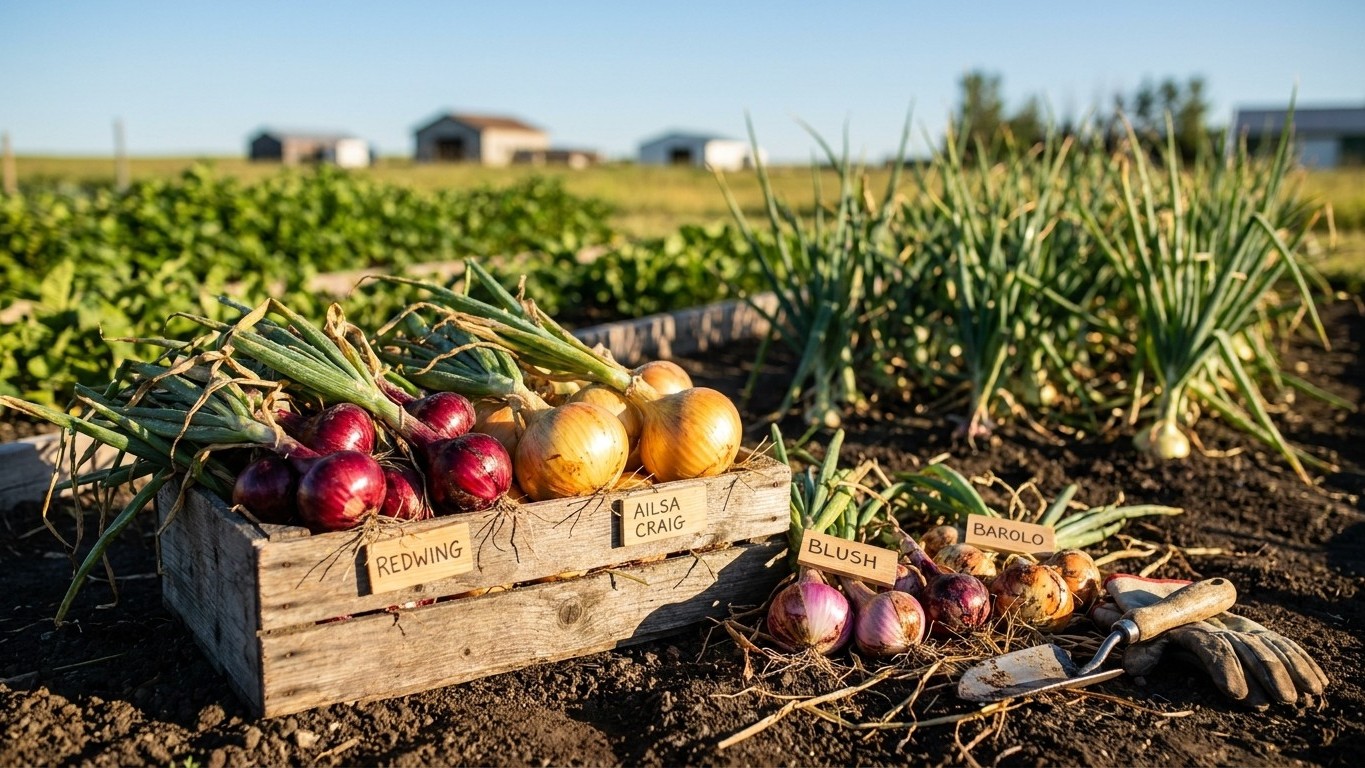

Calgary sits at 51.11 degrees north, and on the summer solstice the city gets 16 hours and 20 minutes of daylight. That single number decides which onions will actually form bulbs here. Alberta’s growing season falls squarely in long-day territory, meaning varieties bred to wait for 14 to 16 hours of daylight before bulbing are the ones worth planting. Six documented varieties match this latitude outright, and a handful more sit close enough to the edge to be worth a trial row.
The short answer for Alberta

Onions don’t check a thermometer to decide when to stop growing leaves and start swelling a bulb. They count daylight hours, almost like flipping a switch. The trigger for short-day types sits around 12 hours, according to Clemson Cooperative Extension’s Home & Garden Information Center. Long-day types hold off until the day stretches to somewhere between 14 and 16 hours before bulbing even begins.
Calgary’s longest day delivers 16 hours and 20 minutes of light, well past that long-day threshold. That’s exactly why prairie gardens have always leaned on long-day onions, and why gardeners several hundred miles south can’t grow the same varieties at all. Six documented varieties have a published range that covers 51.11 degrees north outright:
| Variety | Day-length type | Published range |
|---|---|---|
| Ailsa Craig | Long-day | 38-60N |
| Barolo | Long-day | 38-55N |
| Blush | Long-day | 38-55N |
| Patterson | Long-day | 38-55N |
| Redwing | Long-day | 43-65N |
| Walla Walla Sweet | Long-day | 35-55N |
Redwing’s range runs all the way to 65 degrees north, which is a useful reminder of how far long-day onions can travel once you’re past their threshold. Walla Walla Sweet sits at the milder end of the group but still clears Calgary’s latitude with room to spare. Any of these six is a defensible starting point for an Alberta plot, and none of them require guesswork about whether the local summer will give them enough light to finish the job.
What will not work here
Onions matched to the wrong day-length group fail in one of two ways. Planted where the day never gets long enough, a long-day onion spends the whole season pumping out leaves and never bulbs at all, eventually rotting in the ground once the plant gives up. Planted where the trigger day length arrives too soon, an onion bulbs before it has had time to build any size, and that’s the failure waiting for the eighteen varieties below at this latitude:
- Cabernet (intermediate-day, 35-45N)
- Calibra (intermediate-day, 35-45N)
- Candy (intermediate-day, 33-40N)
- Elsye (intermediate-day, 32-45N)
- Expression (intermediate-day, 32-45N)
- Gabriella (short-day, 20-35N)
- Madalyn (short-day, 20-35N)
- Monastrell (intermediate-day, 35-46N)
- Powell (long-day, 43-47N)
- Red Carpet (long-day, 40-45N)
- Red Long of Tropea (intermediate-day, 35-48N)
- Red Rock (short-day, 30-36N)
- Red Sensation (short-day, 25-35N)
- Scout (intermediate-day, 32-46N)
- Sierra Blanca (intermediate-day, 32-45N)
- Texas Grano 1015Y (short-day, 25-35N)
- Vidora (short-day, 25-35N)
- White Castle (short-day, 30-38N)
Most of this list is short-day and intermediate-day stock bred for growing regions where the sun never climbs as high as it does over Calgary in June. At 51.11 degrees north, the day length these varieties are waiting for shows up early in the season, sometimes only weeks after the plants go in the ground. The bulbing switch flips while the onion is still a small seedling with only a few leaves, and that’s all the size it will ever reach. It’s a variety mistake, not a feeding or watering mistake, and no amount of fertilizer fixes it after the fact. Powell and Red Carpet are the two long-day exceptions on this list; their documented range tops out at 47 degrees and 45 degrees north, several degrees short of Calgary, which means their performance this far north simply hasn’t been established.
What changes across Alberta
Every figure above belongs to one weather station: CALGARY INT’L A, at 51.11 degrees north. Alberta itself runs for hundreds of miles beyond that point in both directions, from farmland near the U.S. border up toward the boreal forest in the north. A gardener working land well north of Calgary is standing under a longer solstice day than 16 hours and 20 minutes, which pushes them further into long-day territory and makes varieties like Redwing, rated up to 65 degrees north, a safer bet than anything at the lower end of the range. A gardener closer to the southern border gets a shorter longest day, closer to the lower edge of the long-day threshold, which is where the blurred-zone varieties start to matter.
Seven varieties have a published upper bound that sits within about a degree and a half of Calgary’s latitude, close enough that they land in genuinely uncertain territory rather than a flat yes or no:
- Bridger (long-day, 35-50N)
- Frontier (long-day, 40-50N)
- New York Early (long-day, 38-50N)
- Red Long of Florence (intermediate-day, 38-50N)
- Rossa di Milano (long-day, 38-50N)
- Safrane (long-day, 42-50N)
- Talon (long-day, 42-50N)
Each of these tops out at 50 degrees north, a single degree shy of Calgary’s 51.11. That’s close enough that they may well bulb reasonably here, but their documented range simply doesn’t confirm it. Treat them as a trial row planted alongside a variety you already trust, not as a first choice for the whole bed.
Checking this against your own garden
None of this replaces knowing your own coordinates. A reader gardening well north of Calgary, say toward the Peace Country, is dealing with more solstice daylight than 16 hours and 20 minutes, which strengthens the case for long-day varieties even further. A reader near the southern edge of the province is dealing with somewhat less, which is exactly the situation where the blurred-zone varieties become more relevant, not less. A quick check of your own latitude, easy to find through any online mapping tool, tells you which side of Calgary’s number you’re actually standing on.
Frost dates matter just as much as latitude, and they aren’t the same thing. Two towns at nearly identical latitude can still have last-frost dates weeks apart because of elevation, wind exposure, or how close they sit to the Rocky Mountains. Your regional agricultural extension office keeps records of local frost dates and can confirm whether a given variety’s maturity window fits your actual growing season, not just the province-wide average. Calgary’s figures are a solid starting point for most of southern and central Alberta, but they were measured at one station, not stamped across the whole map.