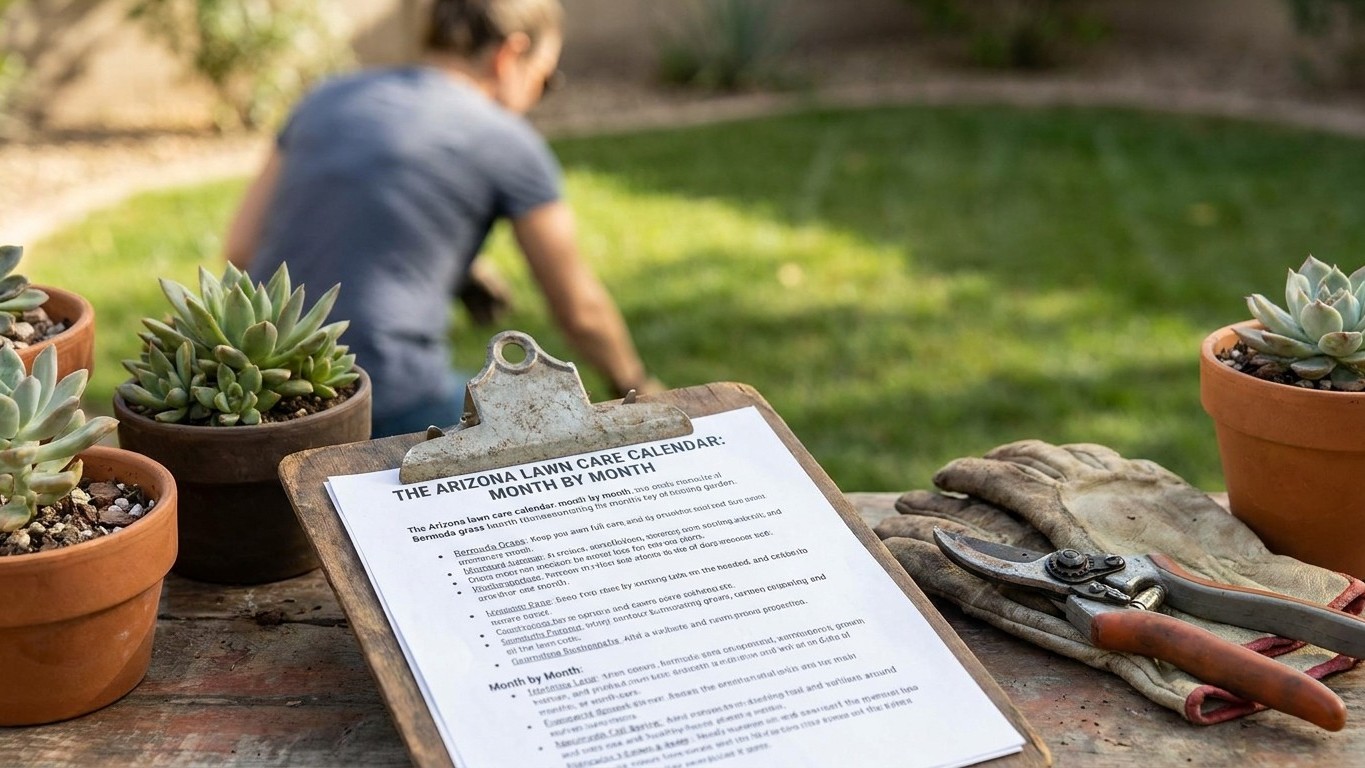

Phoenix logs a freeze in only about one spring out of five, and its stretch of 90-degree-plus days runs long enough to make frost irrelevant to a lawn calendar here. That single fact rules out tall fescue and ryegrass before you’ve even picked a mowing height. What survives the low desert is a short, specific roster — Bermuda, zoysia, St. Augustine, centipede, bahia, carpetgrass, seashore paspalum — and each one asks for a different water budget and a different month-by-month rhythm.
The short answer for Arizona
Phoenix, the reference station behind the figures in this piece, falls into warm-season turf territory. The Homestead Post reaches that call by reading NOAA’s climate normals for days at or above 90°F and the mean daily low of the coldest month against the season tolerances Clemson Cooperative Extension lists in HGIC 1214, Selecting a Lawn Grass. Under that system, the species that actually hold a low-desert Arizona lawn are Bermudagrass, Zoysiagrass, St. Augustinegrass, Centipedegrass, Bahiagrass, Carpetgrass and Seashore Paspalum, the seven grasses Clemson and Penn State Extension group together as warm-season turf.
Cool-season grasses like tall fescue and perennial ryegrass are not on that list for a reason. They stall and thin in sustained heat, and Phoenix’s run of days at or above 90°F is long enough that a cool-season lawn spends more of the year in decline than in growth. NOAA’s 1991-2020 climate normals put Phoenix’s frost-free season at 365 days, with a freeze recorded in only 6 of the past 30 springs. Heat, not frost, is the limit a Phoenix-area lawn calendar has to work around.
Which grass actually fits comes down to water. Bermudagrass tolerates the least irrigation of the group, which is why it’s the most common warm-season lawn grass in the low desert. St. Augustinegrass and Centipedegrass ask for more water and more shade than most low-desert yards offer. The choice is a water-and-shade tradeoff, not a single best answer, and it’s worth working through species by species on The Best Grass Seed for Arizona Lawns before you commit a whole yard to seed or sod.
Working through the year

Bermudagrass is the species most low-desert lawns actually have, and Clemson’s Bermudagrass Maintenance Calendar (HGIC 1216) is the fullest published breakdown of what a lawn like it needs through a growing season. Zoysiagrass, St. Augustinegrass and Centipedegrass each carry their own Clemson calendar, HGIC 1217, HGIC 1218 and HGIC 1215, and the practices below track those documents by species rather than by South Carolina’s calendar months. Arizona’s growing season starts earlier and runs longer than South Carolina’s, so treat the months here as a sequence, not a fixed date, and confirm exact local timing with Arizona Cooperative Extension before you act on it.
Mowing height and nitrogen, species by species
Each species has a published mowing height and a rough seasonal nitrogen budget in the Clemson calendars, and the two move together: a grass mowed low generally needs less nitrogen to stay dense than one mowed tall.
| Species | Mowing height | Rough seasonal nitrogen | Calendar |
|---|---|---|---|
| Bermudagrass | 1 to 2 inches | roughly 2 to 4 lb N per 1,000 sq ft, split across the growing season | HGIC 1216 |
| Zoysiagrass | 1 to 2 inches | lighter than bermuda, roughly 1 to 3 lb N per 1,000 sq ft | HGIC 1217 |
| St. Augustinegrass | 2.5 to 4 inches | roughly 2 to 4 lb N per 1,000 sq ft | HGIC 1218 |
| Centipedegrass | 1 to 2 inches | the lightest feeder of the four, under 1 lb N per 1,000 sq ft | HGIC 1215 |
Irrigation, pre-emergent and aeration
Clemson’s irrigation figures are written for South Carolina’s rainfall pattern, and a Phoenix-area lawn on the same species will need meaningfully more water than that document assumes, since the low desert gets little of its own rain to offset it. Rather than borrow a number that doesn’t fit the climate it was measured in, check the irrigation rate your water provider or Arizona Cooperative Extension publishes for your species and soil type.
Pre-emergent herbicide timing works the same way in every climate: it’s tied to a sustained soil-temperature signal rather than a fixed date, so the trigger point that Clemson’s calendar describes for crabgrass happens earlier in the Arizona desert than it does in the Carolinas, simply because the soil warms sooner. Aerate once the grass is actively growing and never during winter dormancy, when the turf can’t recover from the disturbance. If you overseed with annual ryegrass for winter color, do it while the bermuda is still green enough to compete, and plan on mowing and watering the ryegrass through winter before it fades out on its own as the bermuda wakes up.
What changes across Arizona
Every figure above is measured at or near Phoenix, and Phoenix is low desert. Flagstaff and the high country across northern Arizona are a different climate entirely, not a colder version of the same one. They freeze hard most winters, which puts them back in cool-season turf territory, where tall fescue and Kentucky bluegrass are the realistic choices rather than Bermudagrass or Zoysiagrass.
Tucson and the rest of the low desert track closer to Phoenix’s pattern than Flagstaff does, but even within the low desert, elevation and exposure shift the calendar by a couple of weeks in either direction. A south-facing yard boxed in by block walls holds heat longer into fall and breaks dormancy earlier in spring than an open, north-facing lot nearby. None of that shows up in a single statewide figure.
Yuma and the far southwest corner of the state run hotter and drier again, which stretches the summer stress window on a warm-season lawn even longer than it runs in Phoenix. In between, towns at mid elevation such as Prescott and Payson sit in a transition band, where either a warm-season lawn that goes pale for part of the winter, or a cool-season lawn that struggles through the hottest weeks of summer, can work depending on how much upkeep you’re willing to put into the weak season. Treat every date in this article as a Phoenix-area estimate, then adjust for how your own yard compares, or check it against your county extension office’s timing.
The mistakes this climate punishes
Feeding a warm-season lawn after it slows down
Applying nitrogen once day length and temperature have already told a warm-season lawn to slow down pushes tender new growth that the grass can’t use before dormancy, and it often feeds winter weeds more than it feeds the turf. The damage doesn’t show right away. It shows as a patchy, weak lawn going into the cool months and a flush of weeds in late winter that a properly timed feeding schedule would have starved out.
Planting a cool-season lawn as a permanent low-desert yard
Seeding tall fescue or perennial ryegrass as a permanent lawn in Phoenix fails within the first real summer, no matter how much it’s watered, because sustained heat above what the species tolerates stops growth outright. The exception is overseeding ryegrass temporarily over dormant bermuda for winter color, which works precisely because the ryegrass is never asked to survive a desert summer, it’s mowed out or shaded out as the bermuda comes back.
Cutting too short during the hottest stretch
Mowing below the height listed for the species in the table above during peak summer heat strips away the leaf tissue that shades the crown and the soil surface underneath it. The damage shows within days as a bleached, thinned patch, not weeks, and recovery is slow because growth itself slows under heat stress even in a warm-season grass built for it. Raise the deck before a heat spell, not after the lawn already looks scorched.
Checking this against your county
Every date and rate in this calendar is anchored to Phoenix, and the closer your county sits to Phoenix’s elevation and heat pattern, the more directly it applies. Anywhere else in the state, especially the high country or the far southwest corner, the county Cooperative Extension office is the source to check before committing to a mowing height, a feeding schedule or a seed order. Arizona Cooperative Extension, run through the University of Arizona, publishes county-level guidance and can point you to the office covering your address at extension.arizona.edu. Call before a big purchase, not after a lawn has already struggled through a season on the wrong species. For the step before this one, choosing the grass itself, see Arizona Lawn Care.
Common questions
My bermuda lawn just went brown, is it dead?
No, warm-season turf like Bermudagrass browns and goes dormant when temperatures drop, even without a hard freeze, and it greens back up once the weather warms. Check for green at the crown by parting the thatch before assuming the worst.
Can I keep a fescue lawn in Phoenix if I just water it enough?
Not through a full year. Extra water doesn’t offset the heat itself, which is why cool-season species aren’t on the recommended list for the low desert. A fescue or bluegrass lawn fits better in the high country, where winters actually freeze.
Should I overseed my bermuda with ryegrass every winter?
It’s optional, and it buys winter color at the cost of extra mowing and watering through the cool months. Some low-desert lawns skip it entirely and let the bermuda go tan for winter instead, which is less work and no less healthy for the grass.
How do I know if my town runs more like Phoenix or more like Flagstaff?
Elevation and how often your area actually freezes in winter are the two things to check. If hard freezes are common, you’re likely closer to cool-season territory, and your county extension office can confirm which grass list applies to your address.