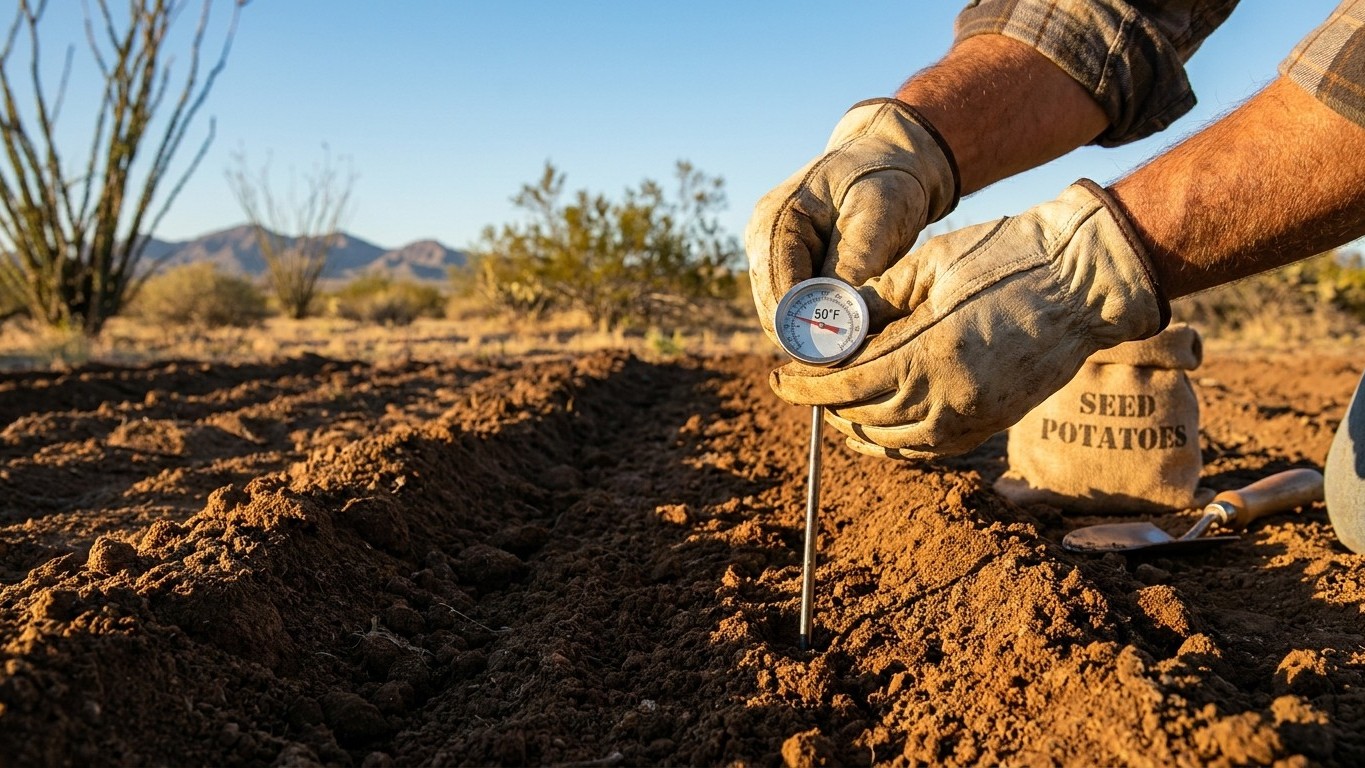

For most of Arizona’s low desert, including Phoenix, there’s no last frost date worth Counting Back From. NOAA lists a 365-day frost-free season for that region, and station records show 32°F showed up in only 6 of the last 30 springs. The number that actually sets your planting date is soil temperature: get potatoes in once soil hits 50°F, and get them out before it climbs past 90°F, because that’s when tuber set stops.
The short answer
Skip the frost calendar. That’s the honest starting point for gardeners in Phoenix and the surrounding low desert. NOAA’s 1991-2020 Climate Normals, drawn from station USW00023183, list a 365-day frost-free season for that reference city, and the daily records behind those normals show a 32°F reading in only 6 of 30 springs, usually as a brief cold snap sometime between late December and mid-January. There’s no reliable window to measure “days before last frost” against, because in most years there isn’t a last frost to count from.
That doesn’t mean timing doesn’t matter. It means the clock that matters is a different one. Utah State University Extension and the University of Maine Cooperative Extension, the two sources that anchor potato-growing guidance used here, agree on the mechanism that actually governs planting: potatoes go in the ground as soon as soil reaches 50°F, and that point typically falls 14 to 21 days before a region’s last frost date. In a place with a real frost date, that offset gives you a planting week. In the low desert, where frost is nearly absent, the 50°F soil threshold becomes the whole answer by itself.
Flip the problem around and it gets more useful. Instead of asking “when is my last frost,” ask “when does my soil pass 50°F, and how many weeks do I have before it passes 90°F?” Soil above 90°F inhibits tuber set and fill, according to Utah State’s fact sheet, and that ceiling arrives early and stays late across the Phoenix-area growing season. The math that decides your planting date isn’t frost math. It’s a heat budget: how many weeks of workable soil temperature sit between the spring warm-up and the point where the ground gets too hot for tubers to size up.
The high country around Flagstaff is a separate climate with genuine hard freezes, and nothing in the low-desert numbers above applies there. If you garden at elevation, the last-frost-date approach the title describes is the right tool, and your local Extension office can supply that date for your specific area. This page focuses on where that tool breaks down: the low desert, where the limiting factor flips from cold to heat.
What actually decides it
Two separate mechanisms are doing the work here, and conflating them is what leads gardeners astray.
The cold-side mechanism: why frost barely applies
Frost dates matter because they mark when tender plant tissue freezes and dies. In a climate with a dependable freeze, that date anchors everything backward. But a frost date only works as a planning tool if frost is a dependable event. In the Phoenix area, NOAA’s own data treats it as the exception: a 365-day frost-free season on average, with a 32°F reading showing up in a minority of years, and even then confined to a narrow window in the dead of winter. Building a planting calendar on an event that happens one year in five isn’t a calendar. It’s a coin flip. Any garden guide that gives you a specific “count back from last frost” date for low-desert Arizona is applying a rule built for a different climate.
The heat-side mechanism: what actually stops the crop
Potato tubers form and fill underground, and that process is temperature-sensitive in both directions. Utah State University Extension’s fact sheet is specific about the upper limit: soil above 90°F inhibits tuber set and fill. That’s not a slowdown you can water your way out of. Once the soil crosses that line, the plant’s energy stops going into bulking up tubers, no matter how much irrigation you apply. In a region where soil temperature climbs into the 90s for a large stretch of the year, that ceiling isn’t a rare event to plan around. It’s the wall the whole growing window runs into.
Where the two mechanisms meet
The reason “count back from last frost” doesn’t transfer cleanly to the low desert is that the two thresholds that matter (the 50°F floor and the 90°F ceiling) aren’t spaced around a frost date at all. They’re spaced around a heat curve that rises fast. That’s the piece a reader can carry into a case this page doesn’t name directly: wherever you garden, first identify which threshold is actually scarce in your climate. Somewhere with a hard, reliable freeze, cold is the scarce resource and frost-counting works. Somewhere the frost barely shows up but summer heat arrives early, heat is the scarce resource, and the planting window gets set by soil thermometer readings instead of a calendar date.
How to do it
- Get a soil thermometer and start checking it in late winter, pushed 4 inches deep in the bed where you’ll plant, rather than relying on a calendar date.
- Wait for a stretch of days where soil reads consistently at or above 50°F. That’s the threshold both Utah State University Extension and the University of Maine Cooperative Extension identify as the point to plant.
- Buy certified seed potatoes, not pieces saved from a grocery-store bag. Uncertified seed can carry viruses that stunt the crop and carry over into future plantings, and there’s no way to see that risk by looking at the tuber.
- Choose a season class suited to a short heat-safe window: an early or mid-season type, described that way by your source rather than by a specific number of days, gives the plant more chance of finishing tuber fill before soil crosses 90°F.
- Pick varieties by what they’re described as being good for, whether that’s baking or boiling, since that’s the distinction the Extension sources actually publish, rather than labeling them by starch type.
- Cut and cure seed pieces if the tubers are larger than a couple of ounces, letting cut surfaces callus over for a day or two before planting, to reduce rot risk in warming soil.
- Plant into soil that’s already crossed 50°F rather than waiting for a frost-based date that may not come in a given year.
- Track soil temperature through the rest of the season and plan harvest to land before soil is likely to sit above 90°F for extended stretches, since that’s the point tuber fill stops.
What goes wrong
- Waiting for a “last frost” that never arrives. Some gardeners hold off planting because a frost-based guide told them to wait for a date that, in the Phoenix area, shows up in only a minority of years. The fix is to stop watching the frost forecast and start watching a soil thermometer instead; 50°F soil is the real starting gun.
- Planting too late and running into the 90°F ceiling. A slow start in spring can push planting into a window where soil is already climbing toward the temperature that stops tuber set. Once that happens, no amount of extra water or fertilizer restarts the process. The remedy is to plant as soon as soil clears 50°F rather than treating that as a soft suggestion.
- Using uncertified seed potatoes. Tubers saved from a previous harvest, or bought from a grocery bin, can carry viruses invisible to the eye that reduce yield and quality. Buying certified seed each season is the direct fix, and it’s one of the few single actions that removes an entire category of failure.
- Choosing a late-season variety class in a short heat window. A variety described by its source as late-season needs more time in the ground to finish sizing tubers, and in a climate where the ground turns hostile early, that time may not exist. Selecting an early or mid-season class, based on what the Extension sources actually publish, keeps the crop inside the safe window.
- Assuming a state-wide date applies everywhere. Arizona spans low desert and high country in the same state, and a figure drawn from a Phoenix-area station doesn’t describe Flagstaff’s climate at all. Any planting guidance should be tied to the closest comparable station or reference city, not applied statewide.
Common questions
Does Arizona ever get a real last frost date for potatoes?
In the low desert around Phoenix, not reliably. NOAA’s data for that reference station shows a 365-day frost-free season on average, with 32°F occurring in only 6 of 30 recorded springs. At elevation, around Flagstaff and the high country, hard freezes are a normal part of the climate, and a conventional last-frost planting calendar applies there. This page addresses the low desert, where that approach doesn’t hold.
What temperature should soil be before I plant potatoes?
Both Utah State University Extension and the University of Maine Cooperative Extension identify 50°F soil as the point to plant, typically 14 to 21 days ahead of a region’s last frost date where frost is a reliable event.
Why does soil temperature matter more than air temperature for potatoes?
Tubers form and fill underground, so it’s the soil environment, not the air above it, that governs whether they size up. Utah State’s fact sheet specifically flags soil above 90°F as inhibiting tuber set and fill, a threshold that has nothing to do with air frost.
Should I look for a floury or waxy variety for Arizona conditions?
Neither Utah State nor the University of Maine describes varieties that way in the sources used here. What they do publish is purpose: some varieties are described as suited to baking, others to boiling. Choosing by that description, alongside season class (early or mid-season for a short heat window), is the approach these sources support.