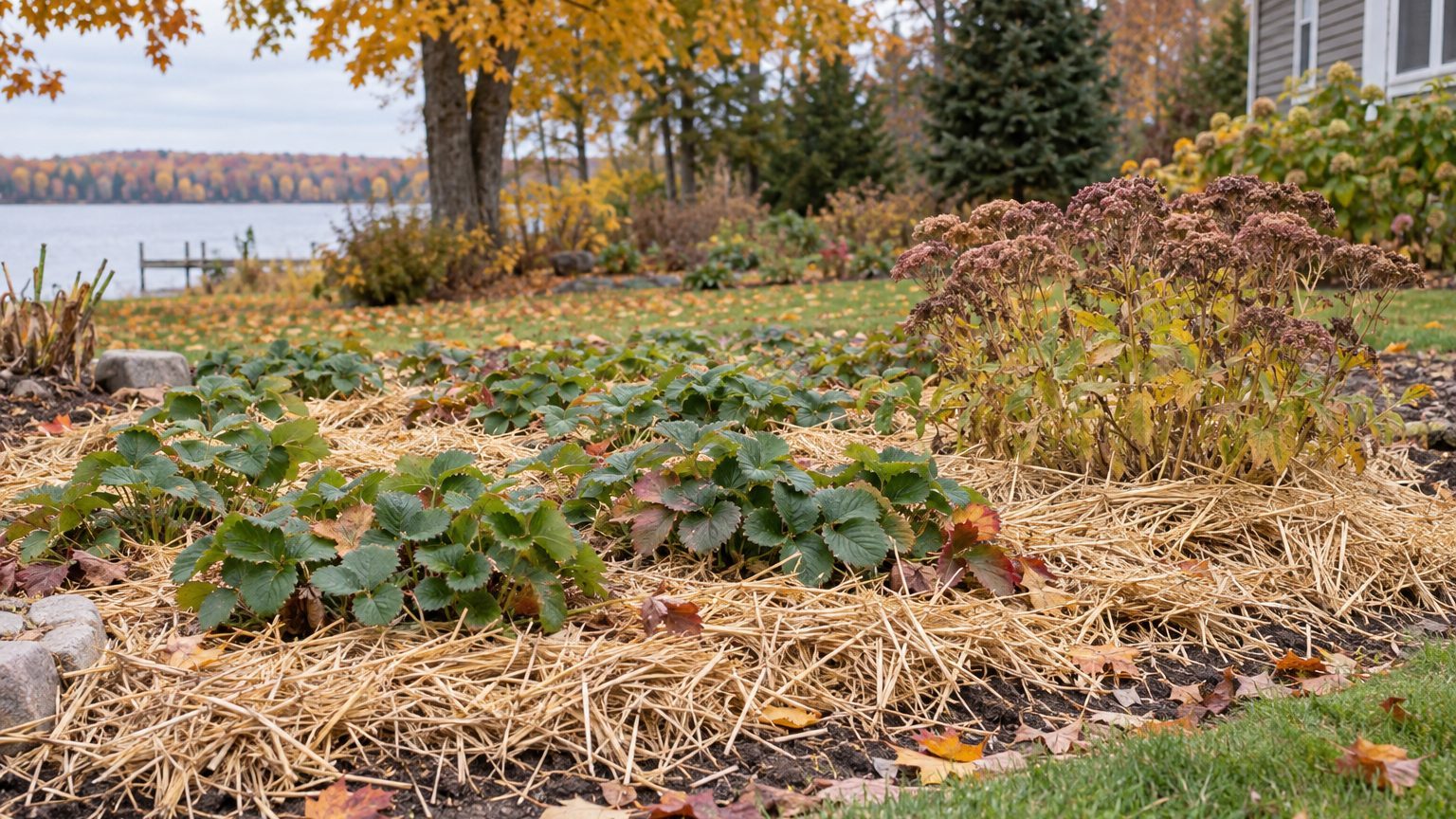

In the low desert around Phoenix, there is no winter mulching date. The ground doesn’t freeze, and NOAA lists the frost-free season there as 365 days. Mulch goes down for moisture and weed control whenever a bed needs it, with frost cloth kept handy for a rare cold night. In the high country around Flagstaff, the northern rule applies: mulch after the ground starts to freeze, not before. Your elevation decides which rule you follow. The calendar doesn’t.
When to put winter mulch down in Arizona
The rule behind the northern habit
Winter mulch is not a blanket. Gardeners in cold climates spread it to keep soil frozen, not to keep it warm. A bed that freezes, thaws and freezes again pushes shallow roots and crowns upward, and a layer of straw or shredded bark evens out those swings. That is why timing runs backward from what most people expect. Mulch spread while the soil is still warm traps heat and dampness against the plant and gives rodents a cozy place to settle. It works only once the ground has begun to freeze.
Low desert: nothing to wait for
Arizona doesn’t fit one answer. The USDA Plant Hardiness Zone Map (2023 edition, built on the average annual extreme minimum temperature) gives a statewide range of 4b-10b. A range that wide can’t carry a dated recommendation, so the reference here is Phoenix. According to NOAA’s 1991-2020 Climate Normals, the mean daily minimum of Phoenix’s coldest month is 45.3°F. That is well above freezing. NOAA’s daily records also show Phoenix touching 32°F in only 6 of 30 springs, and there is no reliable fall freeze at all (NOAA NCEI, station USW00023183).
So frost heave isn’t a concern in the low desert, and neither is a winter rodent condo built into a mulch pile. A frost-based planting calendar would be fiction here. What limits gardens in the low desert is summer heat, which stops fruit set for months. Mulch still earns its place, but for other reasons: it holds moisture in soil that dries fast, it keeps weeds down, and it can be pulled over a plant on the one or two nights a season that dip toward freezing. As freeze protection, winter mulch is not needed in the low desert.
High country: after the ground starts to freeze
Flagstaff and the rest of the high country are a different climate and do freeze hard. Here the window opens after the first fall frost, once the soil itself has begun to freeze, and not on the day the first frost hits. Frost chills the air and the soil surface first, and soil takes longer to follow. The colder or higher your site, the earlier that first frost arrives, so the window opens earlier too. For your own site’s frost range, see First and Last Frost Dates in Arizona. Mulch after the first hard freezes have started to chill the soil, and before the ground locks up solid.
| Criterion | Low desert (Phoenix) | High country (Flagstaff area) |
|---|---|---|
| Does the ground freeze? | No; coldest-month mean daily minimum is 45.3°F | Yes, hard |
| What mulch does | Moisture, weeds, frost-night cover | Keeps soil frozen, prevents heaving |
| When it goes down | Whenever beds need it; no freeze to wait for | After the ground starts to freeze |
| Depth | Stay within 2 to 3 inches | Stay within 2 to 3 inches |
Strawberries
Why crowns suffer in the cold
A strawberry plant keeps its growing point, the crown, right at the soil surface. That is a poor place to be when soil freezes and thaws repeatedly. Each cycle can lift the crown a little, exposing roots to cold, dry air, and a crown with nothing over it takes the full force of a hard freeze. In the high country, that combination of heaving and bare cold is what winter mulch is for. The point is to hold the soil in one steady state, frozen, until spring. Straw does that well because it traps air and doesn’t pack down like wet leaves.
What to use and how deep
Use clean straw, meaning straw free of weed seed and not moldy. Hay carries seed and brings a weed problem in with it. Shredded leaves tend to mat into a wet sheet over the crowns. For depth, the reference I’d stand behind is the NC State Extension Gardener Handbook (chapter 11, Woody Ornamentals), which says: “A 2-inch to 3-inch layer of mulch suppresses most annual weed seeds and makes it easy to hand-pull any that do germinate.” That source is writing about weeds and woody plants, not strawberry beds, but the order of depth carries over and more is not better. For high-country beds, cover the crowns with clean straw inside that 2-inch to 3-inch range, after the ground has started to freeze.
In the low desert, the same straw does a different job. Strawberries there are grown through the cool months, and summer heat is the real obstacle, since it stops fruit set for months. A layer of straw between and around plants slows evaporation, keeps weeds from competing, and lifts berries off bare soil. It isn’t a winter measure, so it can go down at planting. Keep some extra straw or frost cloth near the bed. Phoenix reached 32°F in only 6 of 30 springs in NOAA’s records, so a cover-up night is the exception, but it does happen. For bed setup and variety choices, see Growing Strawberries.
Pulling it back in spring
Uncover when the plants wake up. In the high country, that means watching for new leaves, often pale yellow from growing under straw, pushing through the layer. Rake the straw off the crowns and tuck it between rows, where it still suppresses weeds and keeps fruit clean. Keep it close in case a late frost threatens open blossoms. In the low desert, there is nothing to pull back in the northern sense, but keep straw from piling against the crowns as warm weather returns, because trapped dampness is what rots them.
Perennials and borderline plants
Which perennials benefit depends on where in Arizona you garden, and the USDA 2023 map’s 4b-10b range shows how little one answer can cover. In the high country, perennials that sit near the edge of what their zone allows are the ones to mulch: young plants in their first winter, anything with a shallow crown, and plants moved in late fall. Established, hardy perennials often manage fine, though a ring of mulch still helps stabilize soil temperature around the roots.
For depth, the NC State Extension Gardener Handbook gives a second sentence worth quoting exactly, this one about trees and shrubs: “Provide a 3-inch layer of mulch to reduce water loss and maintain uniform soil moisture and temperature around roots.” Two sentences, two purposes, and they land on the same order of depth. Don’t push past 3 inches. Deep mulch is how a neat ring turns into a volcano, and a volcano holds water against the stem or crown where it doesn’t belong. The same logic applies whether the plant is a woody shrub or a perennial that dies back.
The shape matters as much as the depth. Spread the mulch in a ring around the plant, pulled back from the crown or stem, rather than a pile heaped on top. Leave a gap at the crown, a few fingers wide, so air moves and moisture doesn’t sit against the plant. Perennial herbs follow the same pattern, and Getting Perennial Herbs Through the Winter covers which ones need a ring and which prefer drier crowns. The mechanics of ring mulching are laid out in Mulching Without Killing the Plant.
In the low desert, “borderline” means frost-tender rather than cold-hardy. With a coldest-month minimum of 45.3°F at Phoenix, the risk is the rare night near 32°F, not a season of deep cold. A mulch ring there helps roots stay evenly moist, while the foliage needs a sheet or frost cloth on the night itself. Mulch won’t protect leaves above the soil line from a clear, still, cold night. Cover the top of the plant, and let the ring protect what’s underneath.
What goes wrong
Mulching too early, or too deep
The most common error is spreading mulch while soil is still warm. In the high country, the plant sits in damp, insulated soil that never gets the signal to slow down, and crowns can rot. The warm, sheltered layer also attracts voles and mice, which will happily nest in it and chew crowns and bark over winter. The fix is patience: wait until the ground has started to freeze. Too much depth causes a similar problem. Beyond the 2-inch to 3-inch range, mulch stays wet and keeps air from the roots, and a thick pile against a stem can rot the bark. In the low desert, the mistake is thinking the northern ritual applies. There is no frozen ground, so there is no frost-heave to prevent and no winter rodent habitat to worry about. Mulch there for moisture, and don’t pile it on crowns.
Mulch that mats, and mulch left on too long
Flat, wet layers of whole leaves are a classic mat. They seal the surface, hold water against crowns, and turn slimy. Straw and coarse shredded material stay loose. If you find a layer that has packed down, fluff it with a rake, or replace it.
The last mistake is forgetting to uncover. Strawberry crowns smothered under straw as spring warms will rot or stay weak and pale. Pull mulch back from crowns as soon as new growth shows, then keep the straw nearby in case a late frost threatens. In the high country, that means watching the plants, not a date. In the low desert, where Phoenix saw 32°F in only 6 of 30 springs, check beds whenever the weather warms and keep mulch loose around the plant bases.
Common questions
Do I need to mulch strawberries for winter in Phoenix?
Not for freeze protection. Phoenix’s coldest-month mean daily minimum is 45.3°F, and NOAA lists the frost-free season as 365 days. Straw between plants is still useful for moisture and weeds, and cloth ready for a cold night is cheap insurance.
When should I mulch in Flagstaff or elsewhere in the high country?
After the first fall frost, once the ground itself has started to freeze, and before it is frozen solid. Mulching earlier invites rot and rodents. Higher and colder sites see their first frost earlier, so their window opens earlier too. The Arizona guides cover how conditions change from one part of the state to another.
How deep should winter mulch be?
Stay within 2 to 3 inches. NC State Extension says “A 2-inch to 3-inch layer of mulch suppresses most annual weed seeds and makes it easy to hand-pull any that do germinate,” and recommends “a 3-inch layer” around trees. Deeper layers hold moisture against crowns and stems.
Is straw or hay better for strawberries?
Clean straw. Hay usually carries weed seed, which will sprout in the bed. Leaves can mat into a wet layer over the crowns. Even clean straw needs pulling back from the crowns once growth resumes in spring.