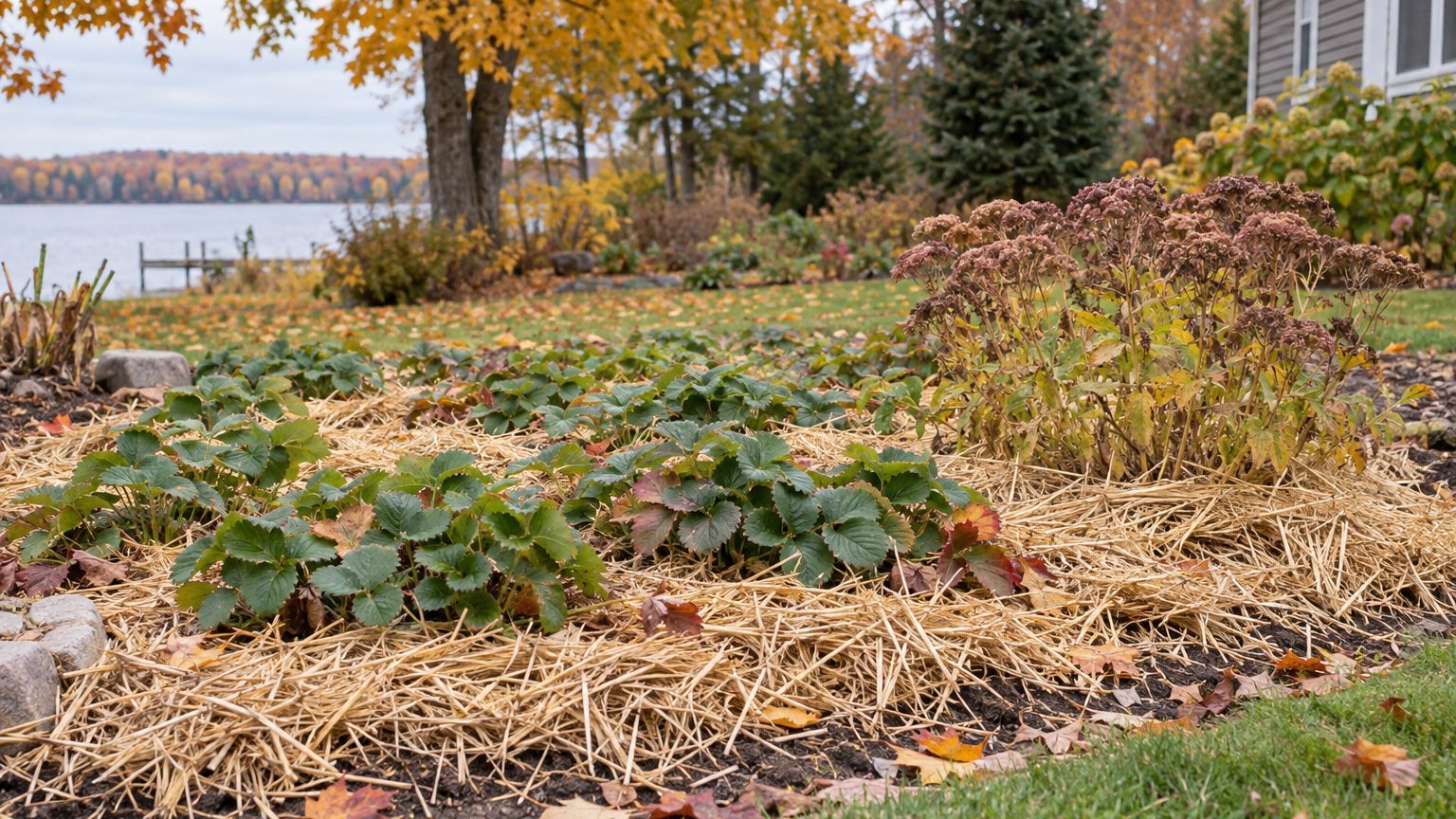

Along the coast and across Southern California, winter mulching has no deadline. In Los Angeles, no freeze occurs in an average year, so there is no frozen ground to protect. Where winters do freeze, in Northern California, the Central Valley and the Sierra, mulch goes down after the ground starts to freeze, not before. Strawberries and borderline perennials follow the same split.
When to put winter mulch down in California
Start with the number that decides everything. According to the NOAA NCEI 1991-2020 Climate Normals, the mean daily minimum of the coldest month in Los Angeles is 49.1°F. NOAA’s daily records (NCEI annual and seasonal normals) show zero days at or below 32°F in 30 years, and the frost-free season is listed as 365 days. Soil does not freeze under those conditions, so the northern ritual of waiting for a frozen crust and then tucking plants in has nothing to apply to.
Coastal and southern California: no freeze, so no freeze deadline
Where the ground never freezes, winter mulch is a moisture and weed tool. California’s real gardening constraints in these areas are heat, drought and water restrictions, and a layer of mulch cuts evaporation from the soil surface. NC State Extension’s Gardener Handbook states the order of depth plainly: “A 2-inch to 3-inch layer of mulch suppresses most annual weed seeds and makes it easy to hand-pull any that do germinate.” Weeds are the other reason to mulch here, since cool-season weeds keep growing all winter in a frost-free yard.
So the timing question flips. You don’t wait for a date. You mulch when the bed is weeded and watered, whether that is fall, winter or whenever you plant. Doing it before the summer heat returns is the only soft deadline worth keeping.
Northern California, the Central Valley and the Sierra: wait for the ground
Here the counterintuitive rule applies. Winter mulch is not a blanket meant to keep roots warm. Its job is to keep the soil frozen, so plants aren’t pushed up and dropped again by repeated thaws. Put it down too early, while the soil is still warm and damp, and you build a cozy, wet shelter that invites crown rot and rodents.
Mulch after the ground starts to freeze, not after the first frost; where no freeze occurs, there is no deadline. In practice, the window opens a stretch after your first fall frost, once the nights have been cold enough that the top layer of soil is stiffening. The window closes before the deepest cold of midwinter. A first frost on a clear October night, followed by a warm week, doesn’t count.
The colder your site, meaning farther north or higher in elevation, the earlier the first fall frost arrives, and the earlier the mulching window opens with it. A Sierra yard will be mulching well before a valley yard. To anchor your own window, look up your local range on First and Last Frost Dates in California and count forward from there.
Hardiness zones won’t settle this for you. The USDA Plant Hardiness Zone Map 2023 lists California’s zones as 5a-11a, built on a single variable: the average annual extreme minimum temperature. A range that wide means no statewide date can be right. Use your own zone and your own first frost.
| Where you garden | Does the ground freeze? | What winter mulch does | Timing |
|---|---|---|---|
| Los Angeles and frost-free coast and south | No freeze in an average year (NOAA) | Holds moisture, suppresses weeds | Whenever the bed is prepared |
| Northern California and the Central Valley | Freezes occur; severity varies by site | Frost-night cover, moisture, weeds; soil-freezing logic only on the coldest sites | After the first frost, once soil is cooling or stiffening |
| The Sierra and other cold, high sites | Yes | Keeps frozen soil frozen, prevents heaving | After the ground begins to freeze |
Strawberries
What a freeze does to the crown
A strawberry plant keeps its growing point, the crown, right at the soil surface. That makes it more exposed than most perennials. In a place where the soil freezes and thaws repeatedly, the swelling and shrinking of the ground can push the crown upward and leave roots exposed to drying air. Bare cold alone can also injure crowns and flower buds when nothing covers them.
The fix is a loose blanket of clean straw, laid on after the ground has begun to freeze. “Clean” matters. Straw full of grain heads sprouts in the bed, and you spend spring pulling a wheat lawn out of your berry patch. Straw also stays fluffy where whole leaves tend to mat into a wet sheet that smothers crowns.
For depth, FACTS give no strawberry-specific figure, but NC State Extension’s general guidance is a 2-inch to 3-inch layer. Staying inside that range is a sound ceiling. Cover the crowns lightly and evenly, and don’t pile straw deeper to be safe. More is not better, and thick mulch holds water against the plant. Our Growing Strawberries page covers planting and renewal if your bed is due for it.
Mild-winter beds: a different job
In Los Angeles, with that 49.1°F coldest-month minimum, strawberries don’t go dormant under snow and they don’t face heaving. Straw there does three things: it slows evaporation, which matters when water restrictions limit irrigation; it keeps fruit off bare soil; and it holds weeds back. Tuck it around the plants and keep it off the crowns, because a soggy blanket over the growing point is a rot risk in a mild, damp winter.
Where a freeze is possible but short, as on some Northern California and Central Valley sites, keep a bale or a few bags of straw on hand. On a forecast frost night, spread it over the plants. Rake it back in the morning if the day warms.
Uncovering in spring
Straw left on too long works against you. Pull it back off the crowns when new growth starts to push in spring, once the hardest freezes have passed for your site, and leave it as a clean mat between the plants to keep berries off the soil. If new leaves come up pale and flattened under the straw, you waited too long. The colder the site, the later this step falls, since last spring frosts come later at higher elevations and farther north. Keep the straw nearby for a few weeks in case a late frost threatens open blossoms.
Perennials and borderline plants
Start with what the number says. A coldest-month minimum of 49.1°F in Los Angeles means hardiness is not the question there; nothing in an ordinary yard is being tested by cold. That is the NOAA figure for the reference station only. The USDA zone map covers the whole state with a range of 5a-11a, so a plant that is borderline in one California yard is comfortably hardy in another. Check your own zone against the plant’s rating before you decide it needs winter protection.
Plants that tend to earn a mulch ring in colder parts of the state are the Mediterranean woody herbs and others rated close to your local limit: rosemary, lavender, sage, thyme. They are far more likely to suffer from cold wet soil than from cold air alone, so drainage matters as much as mulch. Our page on Getting Perennial Herbs Through the Winter goes into which ones to protect and which to leave bare.
The shape of the mulch matters as much as the material. A ring around the crown, not a pile on it, is the rule. Mulch heaped against stems holds moisture where bark and crowns need air, and it makes a tidy home for rot and for rodents. Leave a bare gap of soil around the base wide enough that you can still see the crown, and spread the mulch outward from there in a doughnut shape. The general technique is explained in Mulching Without Killing the Plant.
Depth comes from the same NC State source. For beds, the 2-inch to 3-inch layer quoted above applies. For woody plants, the handbook adds: “Provide a 3-inch layer of mulch to reduce water loss and maintain uniform soil moisture and temperature around roots.” Those two sentences carry different purposes, weed suppression and moisture, but they land at the same order of depth. Keep the ring no deeper than 3 inches and off the crown itself. Don’t extend it upward, because a deep mound is how a ring becomes a volcano.
In the frost-free parts of the state, the same ring still earns its place. It trims watering and shades the soil from heat, which is the stress those plants face. In colder inland and mountain sites, apply it on the same schedule as strawberries: after the ground has started to freeze, and pulled back from the crown as spring growth begins.
What goes wrong
Mulching too early is the most common mistake in the cold parts of California. Soil still warm from fall plus a thick layer on top means a damp, insulated environment, and crowns start to soften. You’ll see mushy bases and a sour smell when you lift the mulch. The prevention is patience: wait for the ground to begin freezing, and use your local first-frost range as the starting line, not the finish.
Matted mulch is the second. Whole leaves, wet grass clippings and fine bark compress into a sheet that sheds air and holds water. Under it, plants rot in a mild, wet winter and cannot breathe. Loose straw, or leaves that have been shredded, avoids it. If a layer has already packed down, fluff it with a rake rather than adding more on top.
Rodents come next, but only where the ground truly freezes. In the colder part of the state, voles and mice treat thick mulch as winter housing and chew crowns and bark from underneath. Keep the layer within the 2-inch to 3-inch range, hold it back from stems, and don’t mulch until the cold has set in, so nothing has time to move in. None of this applies to a frost-free yard in Los Angeles, where there is no frozen ground to push animals into your beds.
Forgetting to uncover is the quietest mistake. Pull mulch back off crowns when spring growth resumes, because plants buried under it come up thin, pale and late, and strawberry crowns held under straw into warm weather are prone to rot. In the frost-free regions, check mulch near stems at least once through the wet season, since it can drift or pile up on its own and start collecting moisture against the plant.
Common questions
Do I need to mulch strawberries for winter in Los Angeles?
Not for cold protection. NOAA data show no freeze in an average year there and a coldest-month minimum of 49.1°F. A straw layer still helps with moisture and weeds, as long as it is kept off the crowns.
Should I mulch right after the first frost?
No. In the parts of California that freeze, wait until the ground itself begins to freeze, which comes after the first frost, not with it. A frost followed by a warm spell is too early.
Can I use leaves or wood chips instead of straw?
Chips work well in a ring around woody perennials, as long as they stay off the stems. Whole leaves mat and are a poor choice over strawberry crowns; shredded leaves are better. Clean straw remains the usual pick for strawberries because it stays loose.
How deep should winter mulch be?
NC State Extension gives 2 inches to 3 inches for beds and 3 inches around woody plants. Those quotes come from a North Carolina source, not a California one, so treat them as the upper limit and don’t go deeper. Your local Extension office can tell you whether your soil and climate call for less.