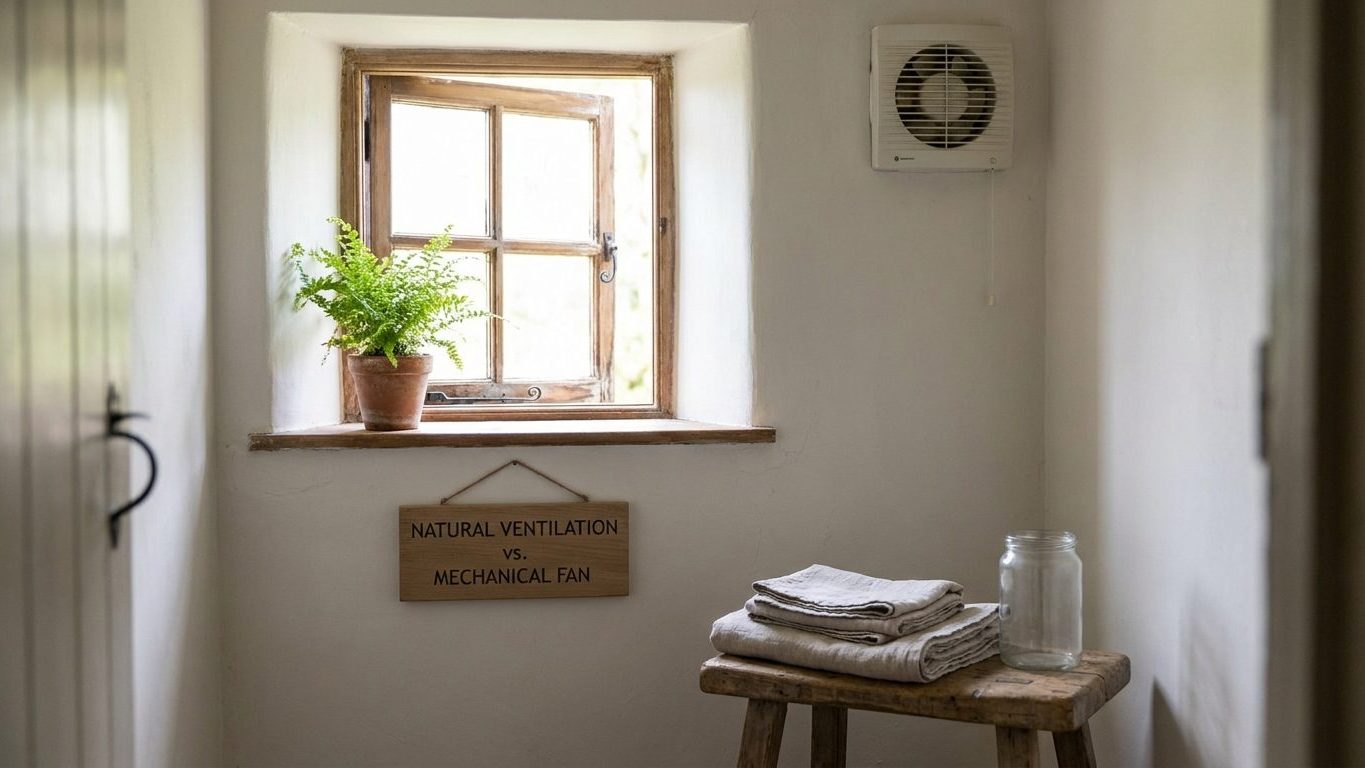

Windowless bathrooms show up constantly in houses built before mechanical ventilation was common, and plenty of owners assume that missing window is a code violation waiting to be flagged. It isn’t automatically one. A bathroom can skip the window entirely if a fan moves enough air outdoors, on its own schedule, without needing any glass in an exterior wall at all. Check your bathroom fan’s rated airflow before assuming the room needs a window cut into a wall.
The code gives you two ways, and only two

The 2021 International Residential Code, section R303.3, sets a hard number for bathroom ventilation, and it gives you exactly two paths to reach it. The natural path calls for an openable area of at least 1.5 square feet, or 3 square feet of glazed area with half of that area able to open. Either version has to lead outside, not into a hallway or an attic space.
That area is measured on the part of the window that actually swings, slides or cranks open, not on the pane of glass around it. A large fixed window with a small operable vent at the bottom counts only the vent. A skylight with no hinge counts for nothing under this rule at all, no matter how much daylight it lets into the room, because R303.3 is written around moving air, not around brightness.
The second path is mechanical, and it’s written into the code as an exception to the first: 50 CFM of intermittent airflow, or 20 CFM continuous, discharged outdoors. This is the option that lets a bathroom in the middle of a house, with no exterior wall anywhere near it, pass without a single pane of glass. The fan has to move that much air and it has to dump it outside the building envelope, not into the attic or a wall cavity.
The lighting requirement isn’t ventilation
Section R303.1 sets a separate requirement, met by an artificial light fixture in the room. It sits right next to the ventilation rule in the code and gets confused with it constantly, probably because a window has historically done both jobs at once. It doesn’t have to keep doing both. A bathroom lit by a single ceiling fixture and ventilated by a fan alone satisfies R303.1 and R303.3 independently of each other, and neither rule cares what the other one requires.
Why an openable window rarely ventilates a bathroom in practice
The natural ventilation path in the 2021 International Residential Code assumes something the code itself can’t enforce: that the person in the bathroom actually opens the window. A bathroom with 1.5 square feet of openable area meets the letter of R303.3 no matter how often that sash actually gets cracked. The number describes the size of the opening, not how it’s used, and those two things diverge constantly in real houses.
Cold climates make the gap worse. A window opened during a hot shower in January cools the room fast, fogs up, and gets shut again within a minute by anyone standing there dripping wet. Screens meant to keep bugs out also slow the air moving through the gap, and a lot of bathroom windows sit above a tub or right next to it, which means opening one wide enough to matter means opening it right into the spray.
Privacy closes windows too
A bathroom window that opens onto a neighbor’s yard, a shared driveway, or a street-facing wall gets left shut regardless of what the code allows for it. This isn’t a code failure. Section R303.3 measures the opening that exists, not the one that gets used, which is exactly why the code offers the mechanical path as an equal alternative rather than as a fallback. A fan wired to run whenever the light switch is on, or on its own timer, moves air on a schedule that doesn’t depend on anyone remembering to crank a window open with wet hands.
The half-opens rule for glazed area exists for a related reason. A 3 square foot window where only half of that glazed area can open still leaves a fixed pane doing nothing for airflow, so the code writes the requirement around the operable half rather than the whole pane. That same gap between what’s installed and what actually moves air is what makes a properly vented fan the steadier choice, even in a bathroom that already has a legal window sitting in the wall. Trapped humidity from a shower is also what breaks down caulk lines around a tub faster than anywhere else in the house, a wear pattern covered in Caulk or Grout? Where Each One Goes, and Why It Cracks.
What 50 CFM intermittent means for a room with no window
Intermittent and continuous describe two different ways of running the same fan, and the 2021 IRC sets a different minimum for each. 50 CFM intermittent covers a fan that runs while the bathroom is in use, usually tied to the light switch or a humidity sensor, and shuts off afterward. 20 CFM continuous covers a fan sized to run all day at low speed, a common choice in a bathroom used constantly, like a primary bath off a bedroom, where nobody wants to hear a fan click on and off every time someone walks in.
Either number satisfies the exception written into R303.3, and the code doesn’t rank one above the other. What it does require, in both cases, is that the air actually leaves the building. A duct that terminates in the attic, in a soffit that dumps back under the eave, or in a wall cavity doesn’t meet the mechanical path regardless of how much air the fan itself is rated to move.
Where this number stops being universal
The 2021 International Residential Code is a model code. It only governs a bathroom once a state, county or city has formally adopted that edition, and a lot of jurisdictions adopt it with local amendments that change details the model version doesn’t touch. Some places are still enforcing an earlier edition entirely. Nothing in the facts behind this page points to an exception written into the model code beyond the mechanical alternative already described, and inventing one here would be a good way to fail an inspection on a technicality nobody warned you about. Whatever edition and amendments apply to a specific address is a question for the local building or code enforcement office, not for the model code text alone.
Checking what your bathroom already has

Start with whatever opening the bathroom already has before deciding it needs anything new. If there’s a window, measure the sash that actually swings, slides, or cranks, not the frame around it. Multiply its width by its height in feet to get square footage, and compare that against the 1.5 square foot threshold for a purely openable window, or work out the glazed area and the operable half if it’s a larger window with a smaller vent.
Reading the fan instead of guessing at it
A bathroom fan should have its rated airflow printed on a label inside the housing, usually visible once the grille is unclipped, given in CFM. That number is what gets compared against 50 CFM intermittent or 20 CFM continuous, not the fan’s physical size or how loud it sounds. A large, noisy fan can be rated well under 50 CFM, and a small, quiet one can clear it easily.
| What to check | Where to measure | What it’s compared against |
|---|---|---|
| Openable window area | Width x height of the operable sash only | 1.5 sq ft openable, or 3 sq ft glazed with half operable |
| Fan airflow rating | Nameplate inside the fan housing, in CFM | 50 CFM intermittent or 20 CFM continuous |
| Duct termination | Follow the duct from the fan to where it exits the building | Must discharge outdoors, not into attic or wall cavity |
If installing or upgrading a fan means running new circuit wiring, that’s also a good moment to check the outlets already in the room. A bathroom fan and a bathroom outlet sit under different sections of the code, and the outlet rules covered in Bathroom Outlets: GFCI, and the 36-Inch Rule come up often on the same job. None of these measurements tell you on their own whether the room passes. They give you the numbers to bring to the local building department, which is the office that makes the actual call for a given address.
The interior bathroom that fails on the fan, not the window
An interior bathroom, the kind with no exterior wall at all, has no natural path available to it under the 2021 IRC. Its entire compliance rests on the mechanical option, which means an undersized or badly ducted fan isn’t a minor deficiency in that room. It’s the only ventilation the room has any legal claim to.
What shows up first
At inspection, a fan rated under 50 CFM intermittent or 20 CFM continuous, or one ducted into an attic instead of outdoors, is a straightforward fail with no window to fall back on. In daily use, before anyone measures anything, the signs show up as condensation that doesn’t clear after a shower, a mirror that stays fogged for a long stretch, and paint or drywall tape starting to lift near the ceiling. Over years, that moisture load works into places a window-equipped bathroom would have vented out, softening drywall behind the fan housing and feeding mold in spots nobody looks at until a remodel opens the wall.
None of that requires guessing at whether a specific bathroom is failing. It requires pulling the fan’s nameplate CFM, tracing the duct to its outdoor termination, and taking both to the local building department or a licensed HVAC contractor who installs to that jurisdiction’s adopted edition of the code. That’s a shorter conversation than most homeowners expect, and it settles the question this page can’t answer for a specific address: what the rule actually is there.
Common questions
Does a bathroom fan have to vent outside, or can it go into the attic?
It has to discharge outdoors under the mechanical option in the 2021 IRC’s section R303.3. A duct that ends in the attic, even a well-insulated one, doesn’t meet that requirement, because it just moves the moisture problem from the bathroom ceiling to the attic sheathing instead of removing it from the building.
Can a skylight that doesn’t open count as the window a bathroom needs?
Not under the natural ventilation path in section R303.3, because that rule is written around openable area, and a fixed skylight has none. A skylight can still satisfy the separate lighting requirement in section R303.1 without doing anything for ventilation.
If my bathroom already has a working fan, do I still need a window?
No requirement in the 2021 IRC ties the mechanical option to also having a window. A fan rated at 50 CFM intermittent or 20 CFM continuous and ducted outdoors is a complete path on its own under section R303.3, entirely separate from the natural option.
Is the lighting fixture required in a bathroom the same rule as the fan or window?
No, lighting is covered separately under section R303.1 of the 2021 IRC and is met with an artificial light fixture. It has nothing to do with the airflow numbers in R303.3, and meeting one doesn’t automatically satisfy the other.