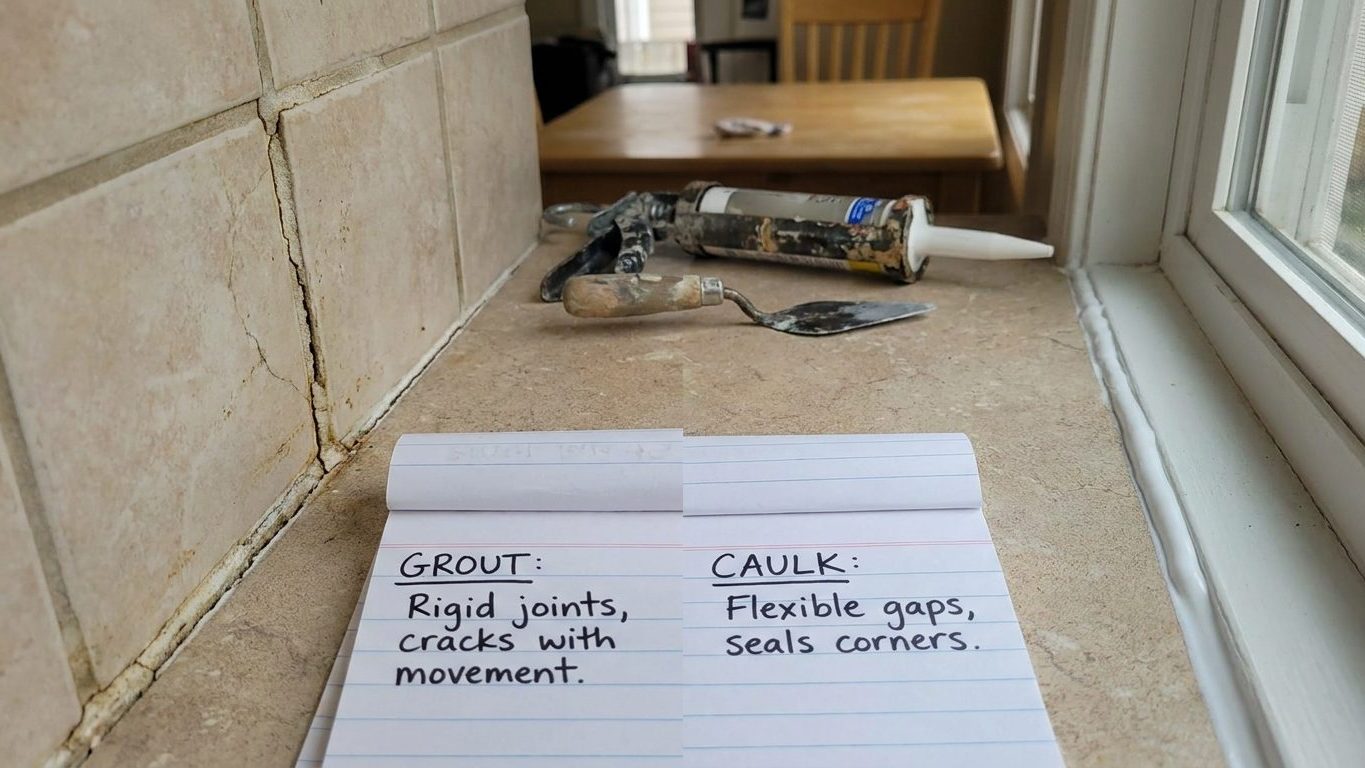

The crack running along the corner of your shower isn’t a grout failure. It’s grout sitting where a flexible sealant belongs, and regrouting it only buys you another season before it splits again. Every inside corner, every wall-to-floor line, and every spot where tile meets a different plane needs caulk, not grout. Walk your bathroom now and press a fingernail into each corner joint: if it doesn’t give at all, that’s the joint that keeps failing.
The rule: grout the field, seal the corners

Interior floors need movement joints every 20 to 25 feet, and every 8 to 12 feet where the floor sees sunlight or heat, according to TCNA EJ171. That spacing is measured across the open field of tile itself, not from the walls inward, and it has nothing to do with how far apart your individual grout lines happen to fall between tiles.
The rule that follows from it is simple. Grout fills the joint between tiles across a flat plane. A flexible sealant takes over anywhere that plane changes or interrupts itself. Every change of plane, wall to wall, wall to floor, and around the room’s perimeter, takes a flexible sealant instead of grout, per TCNA EJ171 and ANSI A108.01. That covers the inside corners of a shower stall, the line where wall tile meets a tub deck, and the gap where floor tile meets a threshold or a cabinet toe-kick.
In a kitchen backsplash, the field is the flat run of wall tile behind the counter. In a bathroom, it’s the shower floor and the flat runs of wall tile inside the stall. Everywhere else, at the perimeter where wall tile meets counter, tub, or floor, at inside corners where one wall of tile turns into another, and at any movement joint spaced through a large floor, the material changes to sealant.
Grout is a rigid cementitious or epoxy material, built to lock tiles at a fixed spacing and hold it permanently. A sealant is built to do the opposite: stretch and compress as the surfaces on either side of it move independently, then return close to its original shape. Fill a corner with grout and you’ve asked a rigid material to do a flexible one’s job, and that’s the version of failure this whole page is about.
What a change of plane does that a flat surface does not
A flat run of tile moves as one piece. The substrate underneath, whether it’s cement board over a wood subfloor or a mortar bed over concrete, expands and contracts together as temperature and humidity shift, so every tile in that field moves in roughly the same direction at roughly the same rate. Grout can bridge that movement because there isn’t much difference in it from one tile to the next.
Two planes, two different structural elements
A corner is a different physical situation. Two planes meet at an angle, wall and wall, or wall and floor, and each plane is carried by a different structural element that reacts to load and moisture on its own schedule. The wall might be framed with lumber that shrinks a little as it dries out over its first year. The floor might be a concrete slab that expands and contracts with the seasons at a different rate entirely. Where those two planes intersect, the joint isn’t asked to flex in one direction. It’s asked to accommodate two surfaces pulling slightly apart, or pushing slightly together, along different axes. Grout has essentially no give for that kind of motion. It doesn’t bend, and it doesn’t compress. It cracks.
That’s the physical reason TCNA EJ171 and ANSI A108.01 draw the line at every change of plane rather than at some fixed distance the way the field-joint rule does. It isn’t about how far apart the corner sits from another corner. It’s about two independent structural elements meeting at an angle, and that condition exists at every corner regardless of the room’s size. A small half-bath has exactly the same corner condition as a hundred-square-foot great room floor.
Why sealant survives where grout doesn’t
A flexible sealant, typically a silicone or siliconized acrylic formulated for tile work, is built to stretch and compress repeatedly without losing its bond to either surface. It moves with the joint instead of resisting it, which is the entire reason it holds up in a location where grout, doing the same job, would fail within a year or two.
Movement joints in the field, and where they go
Inside the open field itself, TCNA EJ171 calls for a movement joint every 20 to 25 feet in an ordinary interior floor, and every 8 to 12 feet where the floor is exposed to direct sunlight through a window or sits over a heat source such as a radiant system. That tighter spacing exists because sunlight and embedded heating both cycle a floor through a wider temperature swing than an interior floor away from a window ever sees. If you’re planning a heated bathroom floor, that spacing decision has to happen before the tile goes down, alongside the electrical and GFCI planning covered in Electric Underfloor Heating.
These field joints run across the direction of expected movement and get filled with the same flexible sealant used at the corners, never grout. The perimeter rule applies at the same time: every wall-to-floor line around a tiled room’s edge counts as a change of plane, whether or not the floor is large enough to also need field joints partway across it.
- Perimeter: every wall-to-floor line around the room
- Inside corners: every wall-to-wall line where tile turns a corner
- Field joints: every 20 to 25 feet across an ordinary interior floor
- Tighter field joints: every 8 to 12 feet where the floor sees sun or heat
On a typical bathroom floor, which rarely runs 20 feet in any direction, the field-joint spacing seldom comes into play at all. It matters most in larger continuous runs of tile, an open kitchen and living area on one slab, a sunroom with floor-to-ceiling glass, or a hallway that runs the length of a house. In those rooms, the layout has to account for a movement joint’s location before the first tile is set, because cutting one in after the grout has cured means removing a straight line of finished tile to put it right.
TCNA EJ171 and ANSI A108.01 are industry reference standards, not law by themselves. Whether they apply to a given renovation as an enforceable requirement depends on how the local building code has adopted them, and adoption varies by city and county, often through amendments a jurisdiction has made to its own plumbing or building code. Check with your local building department, or with the tile contractor’s written specification, before assuming a given spacing is mandatory on your project.
Recognizing a corner that was grouted instead of sealed

Check the inside corners of a shower stall or tub surround, the line where floor tile meets a wall, and any long run of floor tile anywhere in the house. Every inside corner and every wall-to-floor perimeter line is a place to look.
Press a fingernail, or the corner of a plastic scraper, into the joint at each spot. Caulk gives a little and springs back. Grout is hard the instant you touch it and won’t compress at all. A hairline crack running the length of a corner, even a thin one, is usually the clearest sign that the joint was filled solid rather than sealed flexibly, because grout has nowhere to go when the two planes shift even slightly.
- Locate the joint: every inside corner, every wall-to-floor line, and any joint crossing an open floor
- Test it: press gently with a fingernail or plastic scraper, not a screwdriver
- Read it: gives and springs back means sealant, hard and unyielding means grout
- Look along it: a continuous hairline crack usually marks a rigid joint under stress
The most common mistake is checking only the obvious, high-traffic corners, like the two inside corners of a shower, and assuming the rest of the room follows the same material. A bathroom floor that meets a cabinet toe-kick, a closet threshold, or a window sill has the same change of plane at each of those edges, and each one deserves the same check. Finding one corner grouted and another sealed in the same room doesn’t automatically mean a defect. It can mean the original installer got the wet-area corners right and someone patched a different corner years later with whatever tube of grout was on hand. Whatever you find, note the location and bring it to your local building department or a licensed tile contractor rather than deciding on your own whether it needs to come out.
The cracked line that comes back every year
A corner filled with grout instead of sealant doesn’t fail once. It cracks, someone regrouts it, and it opens again in roughly the same spot, because the underlying planes are still moving the same way they always did. Regrouting treats the symptom and leaves the cause, a rigid material sitting where a flexible one belongs, completely unchanged.
Once that hairline crack opens, water reaches behind the tile at exactly the point where two surfaces already meet imperfectly. In a shower or tub surround, that means moisture getting into the wall assembly every time the joint sits open, which is how a small cosmetic crack turns into a much larger repair behind the wall. A bathroom that already struggles to clear humidity, one without a window relying on a fan to do all the work, has less margin for a failed joint to dry out between uses. If ventilation in that room is already a question mark, Does a Bathroom Need a Window, or Is a Fan Enough? walks through what a windowless bathroom actually needs.
This is also why the sealant is treated as a replaceable part, not a repairable one, according to TCNA EJ171. It’s matched to the grout’s color when it’s installed, but it’s a different material with its own service life, and the fix for a failed or discolored sealant joint is to cut it out and replace it, not patch it or bead more caulk over the top. When you find a corner that was grouted instead of sealed, the fix runs the same direction: remove the grout from that joint and replace it with a proper sealant. For anything beyond a single corner, or if the cracking looks like it points to a larger movement problem in the structure, a licensed tile contractor or your local building department is the right call before you reach for a caulk gun.
Common questions
Can I just caulk over grout that’s already cracked?
Not for long. Caulking over cracked grout leaves the rigid material underneath still bonded to both sides of the joint, so it keeps pulling against the new caulk every time the corner moves. The grout needs to come out of that joint, not just get covered.
Does epoxy grout flex enough to skip the caulk in the corner?
No. TCNA EJ171 and ANSI A108.01 draw the line at every change of plane regardless of which grout is used in the field, cementitious or epoxy. Epoxy grout resists staining and chemicals better than cement-based grout, but it’s still a rigid material once cured, so the corner still needs a flexible sealant.
My shower corners have never cracked. Do they still need caulk instead of grout?
The rule applies at the change of plane whether or not a crack has shown up yet, per TCNA EJ171 and ANSI A108.01. A corner can look fine for years before enough movement accumulates to crack rigid grout, so no visible crack isn’t the same as the joint being built correctly. A licensed tile contractor can check what’s actually behind your tile if you want a definite answer.
How often does bathroom caulk need to be replaced?
There’s no fixed interval in the facts covered here, and it depends heavily on the product used and how much movement and moisture the joint sees. What is established is that it’s a replace-not-repair item: once it cracks, discolors, or pulls away from either surface, the fix is removing it and running a fresh bead, not adding more caulk over the old.