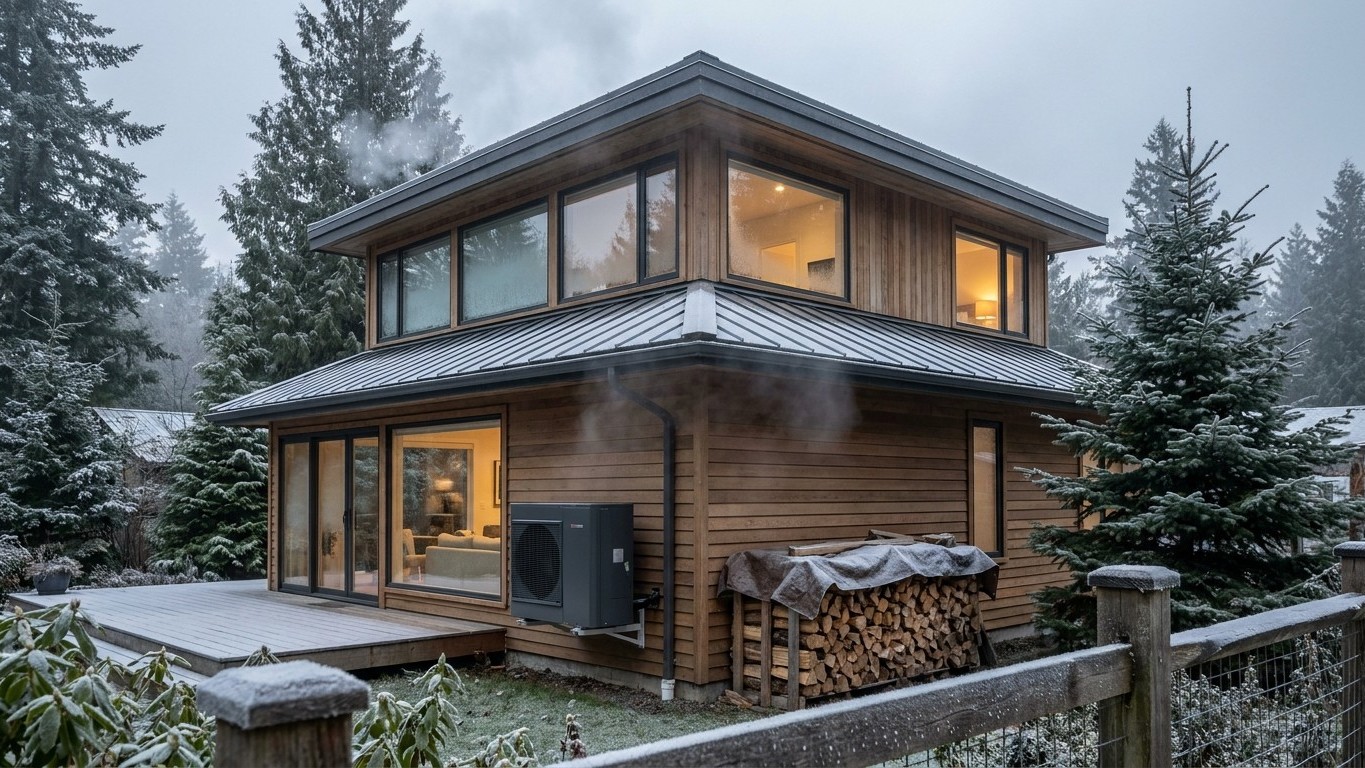

British Columbia’s coastal winters rarely feel brutal, but they’re long, damp, and they push heating systems to run for months at a modest, steady load rather than short brutal spikes. Here’s what that actually means for a house and a wood pile.
How cold it gets, and for how long

The mean daily minimum for the coldest month, based on the Vancouver reference station, sits at 33.5°F. That number matters more than any record-low headline because it describes the temperature a house sits at, night after night, for the bulk of the season. It’s not a deep freeze. It’s a persistent hover right around the freezing line.
That distinction changes how a home should be heated. A winter that drops to -10°F for a few weeks and then rebounds calls for a system built to handle sharp peaks: a furnace sized for cold snaps, backup heat for the rare extreme night. A winter that just sits near 33.5°F for four months straight is a different animal entirely. It’s less about surviving a crisis and more about efficiency over the long haul, because the heating season here is defined by duration, not depth. Knowing exactly When Does the Heating Season Start in British Columbia? helps homeowners plan wood deliveries and system tune-ups before that steady cold sets in.
Why steady cold changes the math
A furnace or heat pump in coastal BC isn’t working against -20°F air very often. It’s working against 30-something-degree air, over and over, for weeks on end. That favors systems that run efficiently at partial load, like heat pumps, which lose their advantage in extreme cold but perform well exactly in the range Vancouver-area winters occupy. Wood heat follows the same logic: a stove doesn’t need to blast out maximum BTUs on demand as much as it needs to hold a steady, moderate burn for hours without constant tending.
The practical upshot for anyone budgeting a winter’s heat, wood or otherwise, is that the season is a marathon. Four months of mild-but-persistent cold adds up to more total heating demand than people expect from a place that never posts dramatic low temperatures on the evening news.
What a cord of wood is worth here
A cord is a volume, not a weight, and that’s the detail that trips up most first-time buyers. It’s a stack measuring 4 feet by 4 feet by 8 feet, which works out to 128 cubic feet. Nothing about that definition says which species fills the stack, and that’s exactly why two “cords” can deliver very different amounts of heat. Dense hardwood packs more actual wood mass into that same 128 cubic feet than a softer species, and mass is what burns.
According to Michigan State University Extension, a cord of well-seasoned hardwood delivers about 20 million BTU. MSU frames that in terms a homeowner can actually use: one cord is roughly equivalent to the heat in 145 gallons of #2 fuel oil, or 215 gallons of LP gas. Given a heating season here that’s long but mild, that cord doesn’t need to fight off deep cold, it needs to keep contributing steady, moderate heat over a stretch of months, which is a reasonable ask for one well-stacked cord if it’s paired with other heat sources or a well-insulated space.
| Measurement | Value |
|---|---|
| Cord dimensions | 4 ft x 4 ft x 8 ft |
| Cord volume | 128 cubic feet |
| Heat output (seasoned hardwood) | about 20 million BTU |
| Fuel oil equivalent | roughly 145 gallons of #2 fuel oil |
| LP gas equivalent | roughly 215 gallons |
That 20 million BTU figure is an average, not a guarantee. Species and moisture content swing it substantially, which is exactly why the next section matters as much as the cord measurement itself.
How long wood takes to dry in British Columbia
Wood should be burned at 20 percent moisture or less. Green, freshly cut wood can sit above 60 percent moisture, which means well over half its weight, at first, is water. That water has to boil off before the wood produces any usable heat, and boiling it off costs energy that would otherwise be warming the house.
MSU Extension notes that split, green wood usually reaches that 20 percent target after one full summer of seasoning, provided it’s split and stacked so air can move freely through the pile. Left in rounds, or stacked tight against a wall with no airflow, it dries far slower regardless of how many months pass. Red oak is the named exception in MSU’s guidance: its cell structure makes it dry more slowly than most other species, so it needs more time than a single summer to reach a safe burning moisture level.
Given how damp and mild coastal BC winters run, humidity plays a real role in how fast a stack actually dries, and that’s worth factoring in locally rather than assuming a fixed calendar. Burning wood before it’s ready doesn’t just waste effort. It produces less heat per log, because energy that should be warming the room is instead evaporating water, and it drives up creosote buildup inside the flue. That creosote is the byproduct of incomplete combustion, and a heavier buildup means the chimney needs sweeping sooner and carries more risk between cleanings. None of that is a wood-heat problem, exactly. It’s a moisture problem wearing a wood-heat costume, and it’s entirely avoidable with a stack that’s been split, stacked with airflow, and given enough time.
Where to check before you buy
Everything above describes conditions around the Vancouver reference station, and British Columbia is enormous. Elevation, coastal exposure, and interior versus coastal climate shift both the cold and the humidity considerably from one part of the province to another, which means seasoning times and species availability won’t look identical everywhere.
Before buying wood or committing to a heating setup, check with the British Columbia Ministry of Agriculture and Food for guidance specific to your area, including which species are commonly available and how local conditions affect drying times. It’s also the right channel for current wood-burning restrictions, since those rules are set at the local or regional level and are revised from year to year based on air quality conditions. What applies this winter isn’t guaranteed to apply the next, so it’s worth a check each season rather than relying on last year’s rule.
What each heat source costs to run in British Columbia
At British Columbia’s average residential prices, this is what one million Btu of heat delivered into the house costs with each system (Canadian dollars). It compares fuels on the same unit: it is not a yearly bill, and it leaves out the price of the equipment.
| System | Cost per million Btu delivered |
|---|---|
| Electric resistance (baseboard, 100% efficient) | C$36.93 |
| Heat pump at 8.1 HSPF2 (seasonal COP about 2.4) | C$15.56 |
Cheapest to run in British Columbia: heat pump, C$21.37 less per million Btu than the electric resistance.
Prices: Hydro-Québec, 2025 Comparison of Electricity Prices in Major North American Cities. Efficiencies: ENERGY STAR criteria. A heat pump’s figure is a seasonal average; in the coldest weather its efficiency drops.