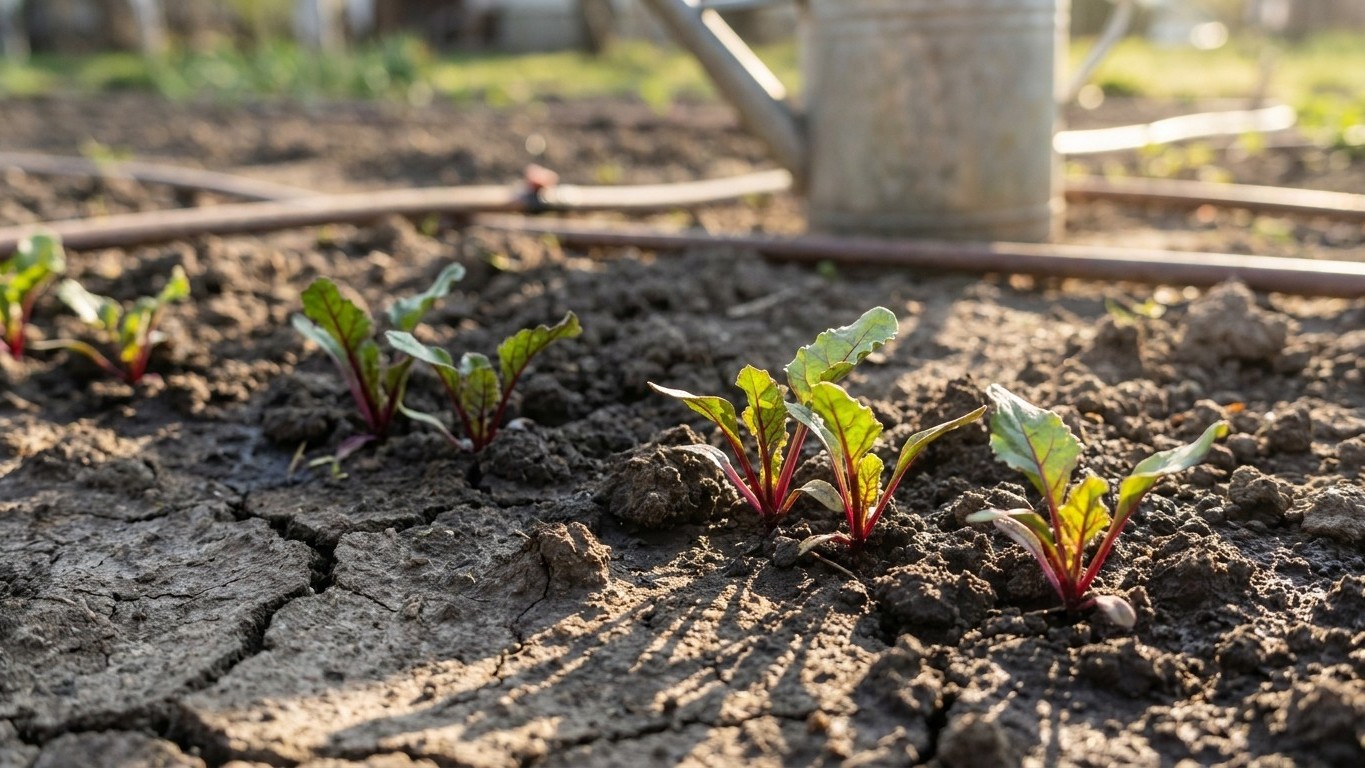

Beets in British Columbia face a shorter, cooler-edged list of leaf and root feeders than warmer growing regions get, and most of them show up at two predictable moments: right after seeding, when the row is still bare soil and tender cotyledons, and again once summer heat sets in and the canopy has filled out. Knowing which stage you’re in narrows the guesswork fast.
Which pests attack beet in British Columbia

The documented list for this territory, drawn from University of Idaho Extension and WSU Extension (the two services whose pest data cover the shared growing conditions along BC’s southern border), names twenty species across all garden crops. Beet is not the target crop for most of them.
The pests with a real reason to be in a beet bed are:
- Aphids
- Cutworms, and the armyworms grouped alongside them in the same source entry
- Flea beetles
- Grasshoppers
- Slugs
- Spider mites
- Wireworms
- Earwigs, split out from the “corn earworm and earwigs” entry
Well under half the documented list actually feeds on beet, and the rest is worth naming so a gardener stops chasing the wrong culprit. Cabbage maggot, imported cabbageworm, and the cabbageworm-and-loopers pair are brassica specialists that need cole-crop chemistry in the leaf, not a beet’s. Carrot rust fly stays on carrot-family roots. Onion maggot and onion thrips work only allium bulbs. Pea leaf weevil feeds on legume foliage. Colorado potato beetle and tomato hornworm need the potato family. Squash bug and the western spotted cucumber beetle stick to cucurbits, occasionally straying onto beans or corn but not beet greens. Brown marmorated stink bug goes after fruit and seed pods, not a root vegetable’s leaves or roots. Corn earworm, despite sharing a source line with earwigs, targets corn ears exclusively.
None of this means a gardener will see all eight of the relevant species in one season, or even one bed. It means these are the ones with documented biology that lines up with what a beet plant offers: soft seedling tissue, broad leaves, and a swelling root sitting in contact with soil-dwelling larvae.
When each one shows up, and what it does first
British Columbia’s growing season anchors to an average last spring frost of March 18 at the Vancouver Int’l A station, and that date is a midpoint, not a guarantee. One year in two, frost arrives later than that. Beets go in the ground as seed, not transplants, so every pest timeline below starts from the day the seed goes in, not from a nursery date.
Wireworms are the first threat, working underground before a seedling even breaks the surface. They chew into the seed itself or the emerging root, and the first sign is a gap in the row where nothing came up at all, not a chewed leaf.
Cutworms and their armyworm relatives follow within the first couple of weeks after emergence. A cutworm severs the stem right at the soil line overnight, so a gardener finds a seedling toppled and lying flat with no leaf damage otherwise, often several in a row snipped the same night.
Flea beetles arrive once the soil has warmed past that frost-free window and show up as a scatter of tiny round holes across the cotyledons and first true leaves, the classic shot-hole pattern that looks worse than it usually is on an established stand.
Earwigs work at night in that same early stretch, rasping ragged holes and notches into tender young leaf margins, then hiding in soil cracks or under debris by daylight, which is why the damage is obvious but the pest itself is rarely seen in the act.
Slugs track BC’s cool, wet spring conditions closely, feeding on seedling leaves and the shoulders of young roots in damp weather and leaving a telltale slime trail that no insect leaves behind.
Aphids build up later, as the canopy matures, clustering on the undersides of leaves and along stems, curling new growth and leaving a sticky residue.
Grasshoppers and spider mites are the mid-to-late-summer arrivals, grasshoppers chewing ragged notches from leaf edges inward as populations build, spider mites showing up as a fine stippling and eventual bronzing on leaves during hot, dry stretches.
Telling the damage apart from everything else
A beet bed can look damaged without a single insect involved. British Columbia’s dominant garden soil, a Brunisol running a median pH near 5.8 with roughly 52 percent sand, 38 percent silt, and 10 percent clay, drains well but holds nutrients loosely, which shows up as pale, thin leaves that have nothing to do with a pest.
Two failures get confused constantly, and they aren’t the same thing. Water stress in the first six weeks after seeding pushes a beet to bolt, sending up a seed stalk instead of building a root, while heat above 85 F combined with water stress later in the season makes the root itself turn woody and fibrous. Bolting is an early-season failure; woodiness is a late-season one. Treating either as a pest problem wastes time looking for an insect that was never there.
| What you see | Likely cause | What tells you which |
|---|---|---|
| Seedling toppled, stem severed at soil line | Cutworm | Clean cut, no leaf chewing, often several plants in a row |
| Small round holes across young leaves | Flea beetle | Shot-hole pattern, worse on seedlings than mature plants |
| Pale, uniformly small leaves, slow growth | Soil pH or nutrient limitation | No chewing marks or holes anywhere on the plant |
| Seed stalk shooting up early | Water stress in the first six weeks | No insect present; root is thin and premature |
| Woody, fibrous root at harvest | Heat plus water stress later in the season | Foliage intact; the problem is only in the root texture |
| Slime trail, ragged leaf margins | Slug | Trail visible in morning; damage worse after rain |
A soil test through a provincial lab settles the nutrient question far faster than guessing from leaf color, and it’s the only way to know whether that 5.8 median pH is close to what’s actually in a given bed.
What actually works here, and what is a waste of time
A floating row cover set down at seeding, before any pest has found the row, blocks flea beetles, earwigs, and egg-laying adults far better than anything applied after the first bite mark shows up. Once damage is visible, the insect responsible has often already moved on to the next plant or gone underground, and a cover at that point protects nothing.
Handpicking works for slugs and earwigs if it happens in early morning or evening, when both are active on the leaf surface rather than hidden. A board or shingle laid flat near the row gives slugs a daytime hiding spot that makes them easy to collect and remove the next morning.
Crop rotation reduces wireworm and cutworm pressure over several seasons, since both overwinter in soil and build up wherever the same root crop or lawn-turned-garden bed sits year after year. It does nothing in the season it’s applied, which is the main reason gardeners give up on it too early.
Amending with no more than 1 inch of composted organic matter per 100 sq ft keeps a sandy Brunisol from drying out between waterings, and steady moisture through those first six weeks is a bigger lever against bolting than any pest treatment discussed here. Piling on more compost than that doesn’t help beets and can create the damp surface litter that slugs prefer to hide in.
What doesn’t work is spraying without an identification. A treatment aimed at aphids does nothing to a wireworm working underground, and a product timed for cutworms misses flea beetles by weeks. This site doesn’t name products or active ingredients for that reason: what’s registered for use on beet changes, and only the local extension service can confirm what’s currently allowed.
Where to check this for your own county
The pest list above comes from two services, University of Idaho Extension and WSU Extension, because their documented pest data covers growing conditions that extend into southern British Columbia’s climate. What’s confirmed at that broader scale is not the same as what’s actually in one garden, and a provincial or regional agriculture office is the right next call for a local read.
Pest pressure inside a single province varies by elevation, rainfall, and even which side of a valley a garden sits on. A coastal bed dealing with slugs all spring may never see the spider mite pressure that shows up in a drier interior valley by midsummer, even though both gardens sit in the same province and draw on the same documented list.
A regional extension office, a provincial agriculture ministry contact, or a local Master Gardener program can confirm what’s actually active in a given area this season and what’s registered for use against it. Bring a sample or a clear photo of the damage rather than a guess at the insect’s name. A soil test through the same channel answers the pH and drainage questions this page can only generalize about, since the Brunisol figures here describe a province-wide median, not any one backyard.
Common questions
Do beets in British Columbia Need row covers all season?
No. The highest-value window is at seeding through the first few weeks of growth, when cutworms, flea beetles, and earwigs do the most damage to small plants. Covers can come off once the beets have several true leaves and a stronger stem.
Is a bolted beet safe to eat?
That’s a food-quality and taste question, not a pest question, and this page only covers insect damage and its causes. A bolted plant has redirected energy into a seed stalk instead of the root, which is a growth-stage issue tied to early water stress, not to any pest on this list.
Can I use the same row cover for beets that I use for other root crops?
Physically, yes, but timing matters more than the cover itself. Since pests like carrot rust fly aren’t documented as beet feeders here, a cover schedule built around a different crop’s pest calendar may go on too early or too late for what’s actually threatening the beets.
Why do I see wireworm damage some years and not others?
Wireworms live in soil for multiple years before reaching the damaging larval stage, so pressure often tracks what a bed grew previously, particularly lawn or grass sod turned into garden space. A regional extension office can speak to local buildup patterns better than a general provincial list.