
Watering rules in British Columbia mean two things at once: the physical practice of giving plants deep, infrequent soakings instead of daily sips, and the local bylaws that decide which days and hours you’re allowed to run a hose. These same principles carry over to Watering Pots and Containers in British Columbia, where drainage and soil volume change the timing even more. With a mean last spring frost around March 18 and a first fall frost near November 10 at Vancouver’s official station, many coastal gardens get roughly eight frost-free months where watering matters.
How much, how often

Deep and infrequent beats daily and shallow, every time. A quick five-minute sprinkle each evening feels productive, but it only wets the top inch or two of soil. Roots follow the water, so they stay shallow, close to the surface where summer sun bakes the ground hard and turns a dry week into a crisis. A deep soak, done less often, pushes moisture six to eight inches down and pulls roots with it, into cooler, more stable ground that buffers a missed watering day far better.
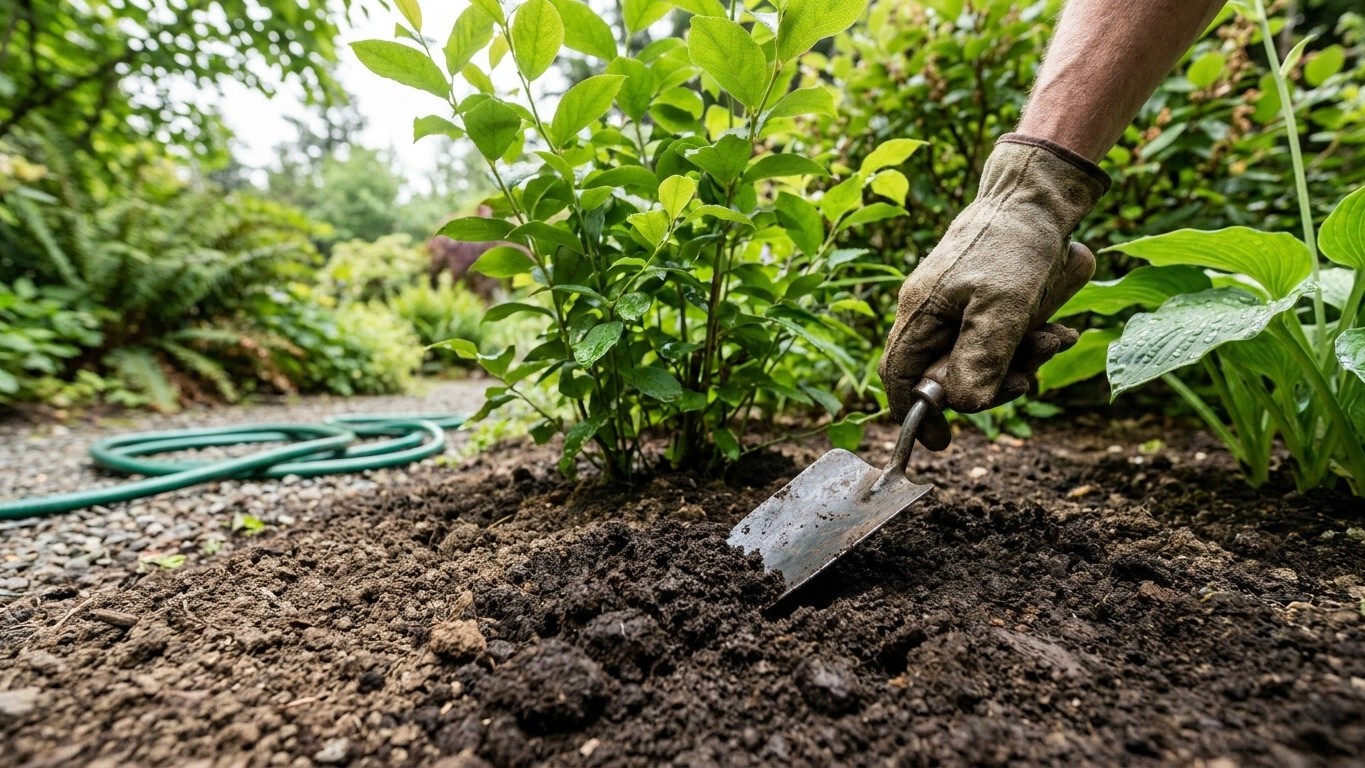
The trick is knowing when the soil actually needs it, rather than watering on a fixed calendar. Push a finger, or better, a garden trowel, about two inches into the soil near the base of the plant. If it comes out dry and crumbly at that depth, it’s time to water. If it’s still cool and slightly damp, wait. This one habit does more to prevent both drought stress and root rot than any watering schedule you could print out.
Adjusting for BC’s ground and its dry summers
British Columbia’s growing regions swing from sandy, fast-draining benches in the Okanagan to heavier clay-loam flats in the Fraser Valley and parts of Vancouver Island. Sandy ground holds very little water, so it asks for shorter, more frequent soakings, often every three to four days in peak summer. Heavy clay is the opposite: it can hold a week’s worth of moisture, but watering it again before it has actually dried out drowns roots and starves them of oxygen. Clay should also never be dug, tilled, or heavily walked on while still wet, since that compacts it into something closer to concrete.
The reference station at Vancouver International Airport records an average of zero days a year at 90°F or hotter, which tells you the immediate coast rarely faces the scorching afternoon stress that pushes many US gardens into emergency watering. That number is specific to one station, though, and it does not describe the whole province. The Okanagan, the Thompson-Nicola region, and other interior valleys run far hotter and drier in summer, and their gardens need a more aggressive watering rhythm than anything a coastal normal would suggest. Much of populated southern BC, coastal and interior alike, still gets very little rain in July and August, which is the real reason Watering Through a Dry Spell in British Columbia is a matter of irrigation, not a wait for the sky to help.
Turn all of that into a repeatable routine:
- Test before you water: push a trowel two inches into the soil at the plant’s root zone; only water if it’s dry at that depth.
- Water in the morning: before mid-morning heat and wind arrive, so less is lost to evaporation before roots can use it.
- Aim at the soil, not the leaves: use a soaker hose, drip line, or the base of a watering can, since wet foliage overnight invites fungal disease.
- Soak until moisture reaches six to eight inches deep: for sandy soil, repeat every three to four days in summer; for clay, wait seven to ten days and confirm the topsoil has dried before soaking again.
- Skip a cycle after real rain: if the past week delivered a genuine soaking rain, hold off and retest the soil before turning the hose back on.
Restrictions and rules
Watering restrictions are common across British Columbia, and they are set locally, not provincially, which means the actual rule for your yard depends on your municipality or water district, not on a single provincial bylaw. Metro Vancouver, the Capital Regional District on Vancouver Island, and Okanagan communities have all used stage-based watering restrictions in past dry summers, typically limiting outdoor watering to certain days of the week or certain hours, and tightening further as reservoir levels or stream flows drop. These stages, and the specific days allowed, change from year to year and even within a single summer, so nothing printed today should be treated as this year’s rule.
Where to check before you set a timer
Because so much of populated southern BC gets little rain through July and August, restrictions are more likely here than in wetter parts of Canada, and they’re worth checking before you install an automatic irrigation timer or plan a new garden bed. Your local water utility or municipal website is the authoritative source for current stage and allowed days. For broader agricultural water-use guidance at the provincial level, the BC Ministry of Agriculture and Food publishes resources aimed at growers, though it does not set municipal watering-day bylaws. If you’re on a well or a private water system rather than municipal supply, restrictions may not apply to you directly, but many rural water associations in dry interior valleys run their own conservation rules during low-flow summers, so it’s worth asking rather than assuming.
Using less
Cutting water use in a BC garden doesn’t require replacing plants or ripping out beds. A handful of habits, done consistently, save far more water than any single expensive upgrade.
- Mulch, two to three inches deep: a layer of bark mulch, wood chips, or shredded leaves over exposed soil slows evaporation dramatically, which means the soil you just tested and soaked stays moist days longer, especially useful through the dry stretch of a coastal or interior BC summer.
- Drip irrigation or soaker hoses: because water goes straight to the root zone instead of spraying into the air or onto pathways, drip systems typically lose far less to evaporation and runoff than an overhead sprinkler, and they pair naturally with the deep-soak, test-first routine described above.
- Group plants by water need: putting drought-tolerant natives and Mediterranean herbs in one bed and thirstier vegetables or annuals in another means you’re not overwatering the tough plants just to satisfy the needy ones next to them.
- Work organic matter into the soil: compost dug into sandy soil helps it hold water longer between soakings, while the same compost worked into heavy clay improves drainage and structure, addressing the exact two problems described above from opposite directions.
- Collect rain where it’s legal: one inch of rain falling on a 1,000-square-foot roof yields roughly 600 gallons, which is a real amount of free water. In much of southern BC, that rain arrives heavily through fall, winter, and spring, meaning a barrel fills fast in the shoulder seasons but can sit nearly empty by mid-July, right when the garden needs it most. A barrel is a useful supplement for spring watering and container plants, not a full substitute for summer irrigation.
Common questions
Do I need to water every day in a BC summer?
No. Daily watering usually does more harm than good by keeping roots shallow. Test the soil at two inches deep and water only when it’s actually dry there, which for most established garden beds means every few days rather than every day.
Are watering restrictions the same across the whole province?
No. Restrictions are set by individual municipalities and water utilities, not by a single provincial rule, so the allowed days and hours in Metro Vancouver can differ entirely from those in the Okanagan or on Vancouver Island. Check your local water provider’s website for the current stage.
Is British Columbia’s climate the same everywhere for watering purposes?
Far from it. The coastal normal of zero days a year above 90°F, recorded at Vancouver’s airport station, describes a mild, rarely scorching summer, but interior valleys like the Okanagan and Thompson-Nicola run much hotter and drier, and need a noticeably more frequent watering schedule.
Can I rely on a rain barrel through the whole growing season?
Not on its own. A barrel fills quickly during the wetter fall-to-spring months but can run dry by mid-summer, right when demand peaks, since an inch of rain on a typical roof only produces around 600 gallons. Treat it as a supplement to drip irrigation and mulch, not a replacement for a hose.