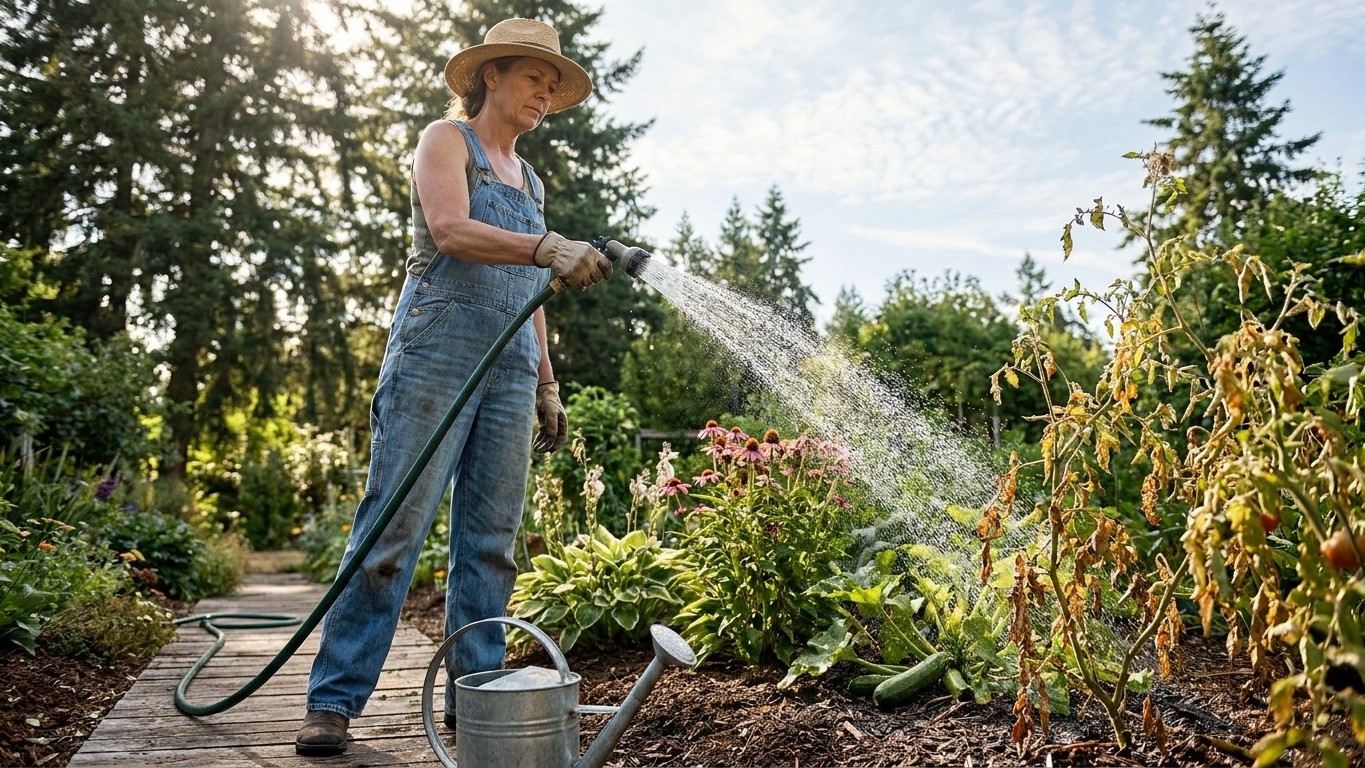

Vancouver’s reference station gets just 1.4 inches of rain in July, its driest summer month, and averages 0.0 days a year at or above 90F. That pairing tells a gardener something specific: the heat load here is mild, but the sky still won’t carry a garden through July on its own, so a watering can or a hose still has to fill most of the gap.
What changes here

A vegetable bed or a perennial border wants roughly an inch of water a week to keep growing without stress. Spread July’s 1.4 inches evenly across the month’s roughly 4.4 weeks, and the sky delivers about 0.3 inch in an average week. That leaves close to 0.7 inch that has to come from a hose or a can, week after week, for the whole month. That’s not a rounding trick or a guess dressed up as a range; it’s what 1.4 inches divided across July’s weeks actually works out to.
The 0.0 days-above-90F figure matters just as much, though it points the other direction. This is not a region where afternoon heat cooks a bed dry by evening the way it does in the interior valleys of other provinces. Evaporation here is gentler, and a soil that’s been watered deeply in the morning is more likely to still be damp two or three days later. That’s the local trade-off: the rain deficit in July is real and has to be answered, but the low heat load means the answer doesn’t need to be aggressive or daily.
Soil changes the arithmetic again
The same 0.7-inch weekly shortfall behaves differently depending on what’s under the mulch. On a sandy plot, water drains through within a day, so that 0.7 inch is better delivered in two smaller sessions than one big one. On heavy clay, the same amount can sit in the root zone for the better part of a week, which means a gardener on clay ground may not need to add water every single week of July, only when the soil itself says it’s dry. Neither soil type is stated for this territory in general terms here, which is exactly why the finger-and-trowel check described below matters more than any fixed schedule.
How to water when it matters
Deep, infrequent watering at the base of the plant, done in the morning, is the method that fits British Columbia’s summer pattern: low heat, a genuinely dry July, and soil that (whatever its texture) benefits from a slow soak rather than a quick surface splash. Each part of that method does a specific job. Deep watering pushes moisture down where roots actually are instead of just wetting the top layer. Morning timing lets any leaf moisture dry off in daylight rather than sitting overnight, and it gives water time to soak in before the day’s evaporation, modest as it is here, gets going. Watering the base rather than the leaves keeps foliage dry, which matters more in a coastal climate prone to damp, fungus-friendly mornings than in a drier one further inland.
Knowing when to water starts two inches down, not at the surface. A finger pushed into the soil, or a trowel turned to check, tells the real story: the top half-inch can look bone dry an hour after watering while the root zone underneath is still damp, or the opposite can be true after a light shower.
- Push a finger two inches into the soil near the plant’s base before deciding to water at all; if it’s still cool and damp, wait a day and check again.
- When it’s dry at that depth, water slowly at the base until the top 6 to 8 inches of soil are moist, aiming for the equivalent of about 0.7 inch of supplemental water in a typical July week as a starting point.
- On sandy ground, split that amount into two shorter soakings a few days apart rather than one large one, since sand won’t hold it long.
- On heavy clay, water once and then hold off until the two-inch check shows dryness again, since clay can carry a soaking for several days and overwatering it invites rot.
- Water in the early morning whenever the schedule allows, so any splashed foliage has hours of daylight to dry before evening.
Treat that 0.7-inch weekly figure as a place to start, not a rule. The only way to know if it’s right for a given bed is the finger test repeated over a couple of weeks; a plot that stays damp at two inches on that schedule is getting too much, and one that’s dry a day or two early needs a touch more.
What goes wrong
“I water a little every day, just to be safe”
A light daily sprinkle wets the surface and stops there, training roots to stay shallow where they’re exposed to whatever heat and drying does occur. In a low-heat climate like this one, the damage shows up more slowly than in a scorching interior garden, but the mechanism is the same: roots that never have to reach down become the roots most vulnerable the one week a real dry stretch hits.
“I water in the evening after work”
Evening watering, especially overhead, leaves foliage wet through the cool, humid coastal night, which is close to ideal conditions for fungal disease to take hold. This is one mistake that costs more here than in a hot, dry interior climate, precisely because coastal humidity already favors mildew and blight; adding wet leaves overnight tips the balance further.
“It rained, so I skipped watering”
A passing shower can wet only the top half-inch of soil while the root zone stays dry, especially if the rain fell fast during a summer thunderstorm rather than as a slow soak. The sky isn’t a reliable narrator here; a finger check after any rain settles the question a lot better than assuming.
“I watered deep, so I didn’t bother with mulch”
Skipping mulch means the sun, modest as it is in this climate, still pulls moisture back out of bare soil faster than a mulched bed loses it. Given how few extreme-heat days this region sees, mulch’s biggest job here isn’t blocking scorching sun, it’s slowing the evaporation that still happens on ordinary warm days, stretching the interval between waterings.
Local help
For crop-specific guidance and irrigation scheduling suited to British Columbia’s growing regions, the province’s agriculture and food ministry is the starting point: BC Agriculture and Seafood. Watering restrictions vary by municipality and water district and change from year to year, so check current rules with the local water provider before setting a summer schedule.
Common questions
Does British Columbia really need supplemental watering if it rains so much overall?
Yes, at least in July. The 46.8-inch annual total hides a dry pocket: July alone drops to 1.4 inches, well short of what an actively growing bed needs in a month.
Is heat stress a big risk for BC gardens?
Not by the numbers at the reference station, which averages 0.0 days a year at or above 90F. The bigger risk in summer is drought stress from low rainfall, not heat stress from extreme temperatures.
How do I know if my soil is sandy or clay-heavy?
A simple squeeze test works: damp soil that crumbles apart easily tends toward sand, while soil that holds a ribboned shape when squeezed leans toward clay. That distinction should guide how often, not just how much, to water.
Should I water on a fixed schedule all summer?
No. June and August average slightly more rain than July (2.12 and 1.45 inches respectively), so the two-inch finger check, not a fixed calendar, should decide each week’s watering.