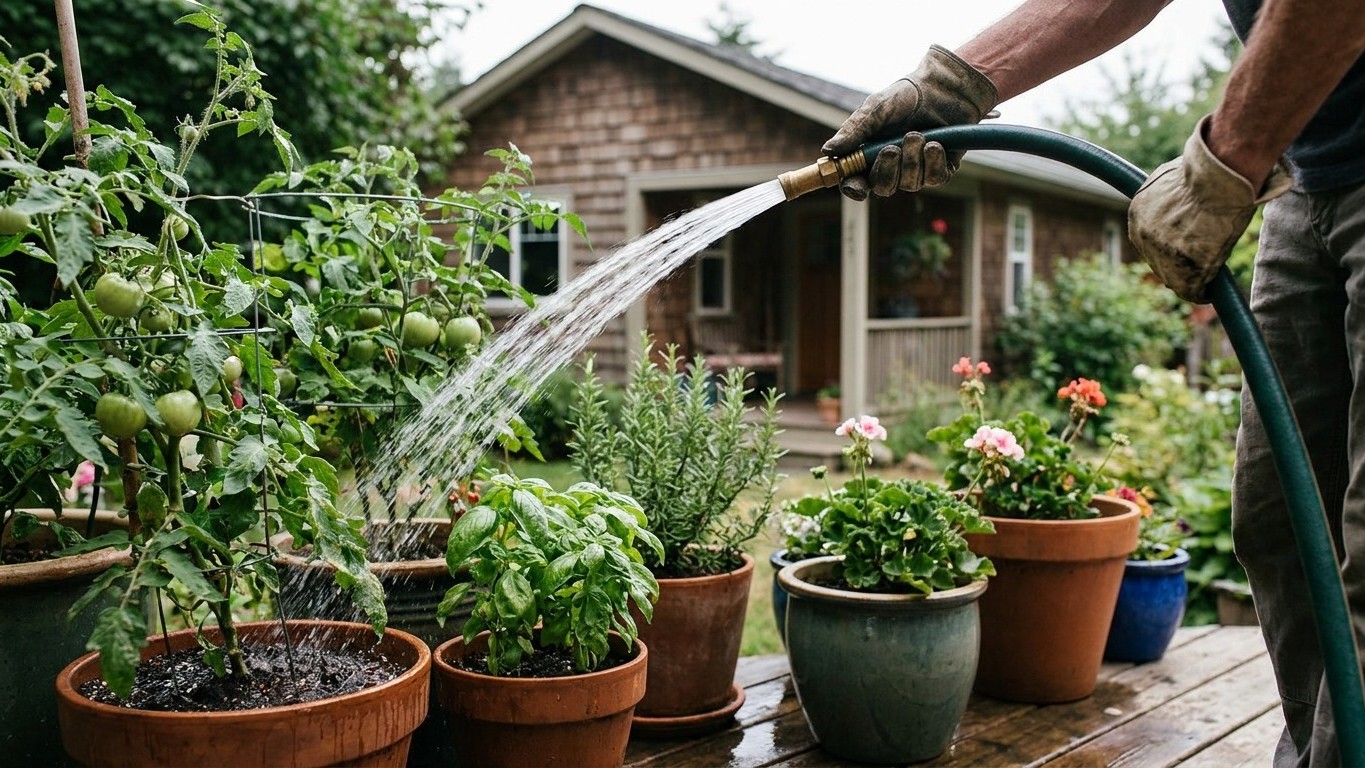

British Columbia’s coast gets more summer rain than most of the American West, but its driest month still leaves a real gap between what falls from the sky and what a vegetable bed or container needs. Here’s the math that fills that gap, and the routine that keeps roots healthy without wasting water.
What changes here

July, the driest summer month at the Vancouver reference station, averages 1.4 inches of rain. The same station logs 0.0 days a year at or above 90F. Put those two together and you get a garden picture unlike almost anywhere else covered in this series: modest rainfall, but almost no heat load pulling moisture out of the soil or off a leaf’s surface. Watering here is less about racing evaporation and more about topping up a shortfall that never gets dramatic in either direction.
Run the arithmetic and it gets concrete. A vegetable bed or a bed of perennials wants roughly an inch of water a week to keep growing without stress. July’s 1.4 inches spread across a month works out to about 0.3 inch a week falling naturally. That leaves the gardener responsible for carrying the other 0.7 inch a week by hose or drip line, every week, through the driest stretch of summer. It’s not a large amount, but it’s also not zero, and skipping it for two or three weeks in a row is enough to stall a tomato plant or crack a carrot.
Soil texture changes how that inch behaves once it lands, even though the specific sand or clay content varies plot to plot across the province and isn’t something a regional average can capture. On a light, fast-draining soil, the water from a July rain or a hose session moves through the root zone within a day, so the 0.7-inch weekly top-up is often better split into two smaller waterings rather than one big one. On a heavier, clay-rich soil, that same inch can sit in the root zone for the better part of a week, which is a gift during a dry stretch but a liability if more water gets added before the ground has had a chance to drink it down. The absence of 90F days means that liability is real here in a way it isn’t in hotter states: without strong evaporation to dry things out, a heavy soil that gets watered on a fixed schedule rather than by feel can stay soggy for days.
How to water when it matters
The goal is to get water down where roots actually live, deliver it slowly enough that it soaks in rather than runs off, and do it at a time of day when the plant can use it before losing it. Deep, infrequent watering trains roots to grow downward chasing moisture, instead of staying shallow and brittle near a surface that dries out in hours. Watering at the base rather than overhead keeps leaves dry, which matters more than the thermometer suggests: BC’s mild summers and coastal humidity are exactly the conditions fungal diseases like powdery mildew and blight favor, wet foliage adds fuel. Morning watering gives the soil surface time to dry before evening, closing that same disease window, and it means less water is lost to daytime evaporation than a midday soaking would lose.
Here’s a routine that works with this region’s rain and heat pattern, checked against the reader’s own soil before it becomes habit:
- Check soil moisture two inches down with a finger or a trowel before watering at all; if it’s still damp at that depth, wait.
- Water early morning, before 9 a.m. if possible, so leaves and soil surface both have the day to dry.
- Apply water slowly at the base of the plant, roughly 1 inch total per week during July’s dry stretch, split into two sessions of about half an inch if the soil is light and fast-draining.
- On heavier clay soil, water once a week rather than twice, and skip the session entirely if the two-inch check still shows moisture.
- Add 2 to 3 inches of mulch around the base to hold that moisture in place between waterings.
The one-inch-a-week figure is a starting point, not a rule. A container on a sunny deck dries faster than a shaded garden bed even on the same street, and the only way to know for sure is that finger check before each watering.
What goes wrong
A daily sprinkle
A quick daily splash wets the top inch of soil and nothing more, which trains roots to stay shallow and camp out where moisture is unreliable. When a hot spell does arrive, even a mild one, those shallow roots have no reserve to draw on and the plant wilts fast.
Watering the leaves in the evening
Wetting foliage after work feels efficient, but leaves that stay damp overnight in BC’s cool, humid summer air are an open invitation to fungal disease. Morning watering gives leaves hours of daylight and airflow to dry before nightfall; evening watering gives spores hours of darkness to spread.
Trusting a passing shower
A summer shower can look like it did the job while only wetting the top half-inch of soil, especially on ground that’s already dry and slow to absorb. The only way to know is the same finger check used before any manual watering, not a glance out the window.
Watering a bed that hasn’t dried
This is the mistake that costs the most in a region with essentially no 90F days to dry things back out. On clay-heavy ground that already holds a week’s worth of rain, adding more water on a fixed schedule, rather than checking first, waterlogs the root zone and starves roots of oxygen. Without strong heat to pull that excess moisture back out, a drowned bed here can stay drowned for days.
Local help
For crop-specific guidance and current growing conditions across the province, the BC Ministry of Agriculture and Food is the starting point. Watering restrictions vary by municipality and water district and change through the season, so check with your local water provider for the rules that apply to your address before setting an outdoor watering schedule.
Common questions
Does British Columbia get enough summer rain to skip watering entirely?
No. Even in a wetter coastal climate, July’s 1.4 inches of average rainfall covers only about a third of what a typical bed needs each week during the driest stretch of summer.
Why doesn’t the lack of 90F days mean watering less matters?
Without high heat driving fast evaporation, water lingers in the soil longer, which helps during dry spells but also means overwatering mistakes go uncorrected by the sun and can waterlog roots for days.
How do I know if my soil is sandy or clay-heavy?
Squeeze a handful of moist soil: sandy soil falls apart immediately, while clay-heavy soil holds its shape and feels sticky. That texture should guide how often you water more than any general schedule.
Is morning or evening watering better for container plants specifically?
Morning, for the same reason it matters for garden beds: Containers dry out fast, and morning watering gives roots time to take up moisture before the day’s mild evaporation, without leaving foliage wet overnight.