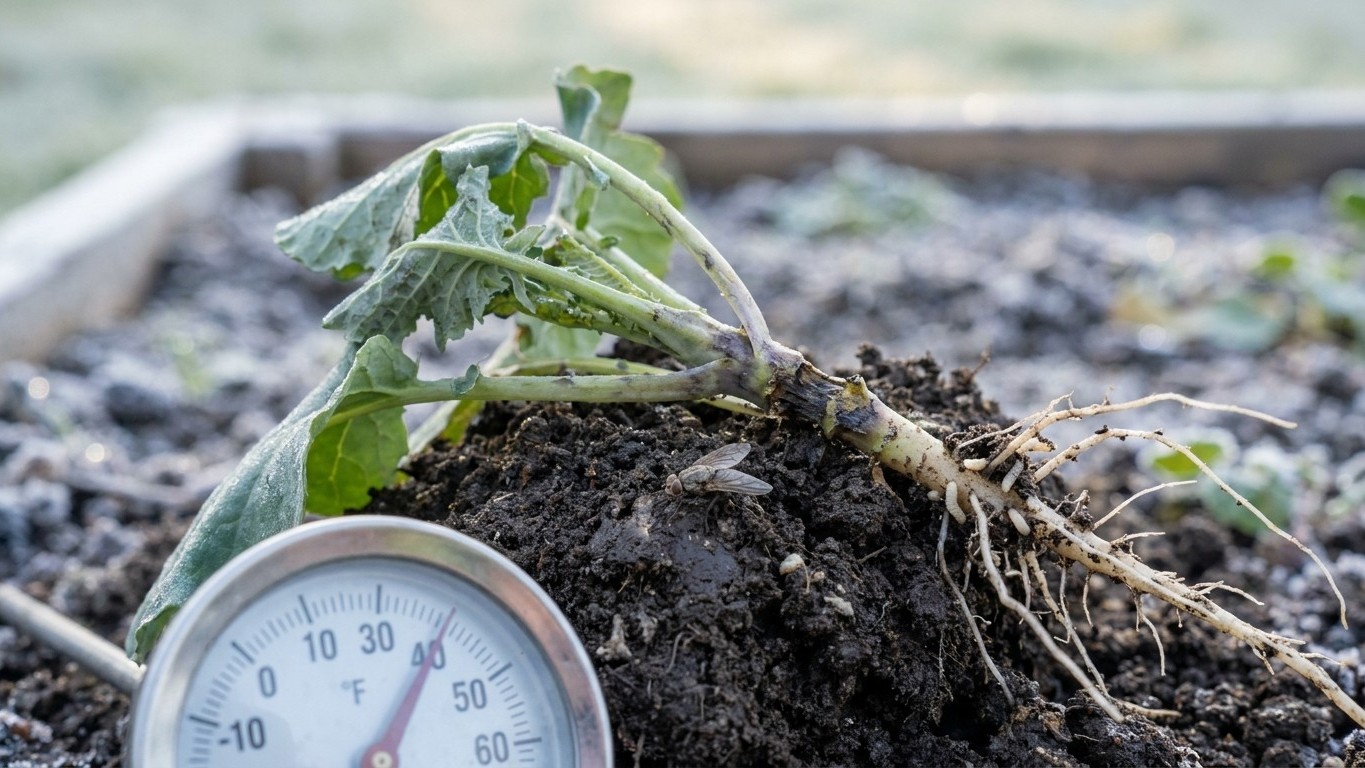

Cabbage maggot larvae start tunneling into brassica roots as soon as coastal soil hits 43°F, which in most of British Columbia’s Lower Mainland and southern Vancouver Island means late March to early April. Interior valleys lag two to four weeks behind. Stopping the damage comes down to timing your planting around that first spring fly emergence, blocking egg-laying with physical barriers, and rotating brassica beds so the pest can’t build up a resident population in your soil.
That’s the short version. The longer version, the one that actually saves your broccoli and radishes, requires understanding how this insect behaves differently depending on which corner of BC you garden in.
Life Cycle and Timing Across BC’s Climate Zones

The cabbage maggot (Delia radicum) is a small gray fly, barely a quarter-inch long, that lays its eggs at the base of brassica stems. The eggs hatch into white larvae that tunnel straight into roots, killing seedlings outright or leaving mature plants stunted and prone to rot. It’s the larval stage doing the damage, not the adult fly, which is why so many gardeners miss the warning signs until the plant is already wilting.
Adult flies emerge from overwintering pupae once accumulated soil-temperature degree-days (base 43°F) reach roughly 300 units. On the South Coast, that threshold typically falls between late March and mid-April. The Fraser Valley’s cool, moist spring soil is close to ideal for this insect, and growers there often see the heaviest first-generation pressure of anywhere in the province.
Vancouver Island runs on a similar clock, though sites right along the water sometimes see activity a week or so earlier than inland valley locations on the same island. The Okanagan and other interior valleys warm up faster in absolute temperature but often start from a colder late-winter baseline, so first emergence tends to land in mid-to-late April. Farther north, in the Peace River region, the growing season is short enough that many years produce only one full generation instead of the two or even three that coastal gardens can see.
That generational difference matters. A coastal garden might deal with a spring flight in April, a second in June or July, and a partial third generation in September on a mild year. An interior or northern garden might only need to defend against that one spring wave, which simplifies the calendar considerably.
Which Crops Are at Risk
Cabbage maggot isn’t picky about which brassica it attacks. Cabbage, broccoli, cauliflower, Brussels sprouts, kale, kohlrabi, turnip, radish, and rutabaga are all hosts. Radish and turnip, with their shallow, fast-growing roots, often show damage first and serve as an unintentional early-warning crop for gardeners growing multiple brassicas in the same bed.
Signs of Infestation Before the Plant Collapses
Wilting during the heat of the day, even when soil moisture looks fine, is usually the first visible clue. Pull one questionable plant and check the roots: cabbage maggot tunnels look like thin, brown, water-soaked scars running through the root tissue, sometimes with a few small white larvae still inside. Seedlings hit hard enough simply topple over, having lost the root structure holding them upright.
On mature plants, the damage is less lethal but still costly. Tunneled roots create entry points for soft rot bacteria, so a broccoli plant might survive the maggot itself but succumb to secondary rot a few weeks later, especially in BC’s wetter coastal soils where rot organisms are already abundant.
Yellow sticky cards placed at soil level near brassica beds starting in late March (coastal) or mid-April (interior) will catch adult flies before eggs even go down, giving you a heads-up on timing that’s more reliable than a calendar date alone, since spring temperatures vary year to year.
What Actually Stops Cabbage Maggot
No single tactic handles this pest on its own. The combination that works, backed by decades of extension research across cool, wet growing regions similar to coastal BC, layers physical exclusion, cultural timing, and targeted biological control.
Row Covers and Collars
Floating row cover, installed immediately after transplanting or seeding and sealed tight against the soil along every edge, remains the most reliable barrier. The fabric has to go down before adult flies are active in your area, and it has to stay sealed. A single gap of even a couple of inches gives the fly enough room to slip under and lay eggs at the stem base, defeating the whole purpose.
For transplants going into beds where row cover isn’t practical, stem collars work almost as well. A simple 4-inch square of cardboard, tar paper, or landscape fabric with a slit cut to the center and fitted snugly around the stem blocks the fly from reaching the soil surface right at the base of the plant, which is the only spot it cares about.
Timing Your Planting to Miss the Peak Flight
Delaying transplant dates by even two to three weeks past the predicted first flight can dramatically cut egg-laying pressure, since young seedlings with tender stems are far more attractive to egg-laying females than established plants with thicker, corkier stem tissue. Coastal gardeners who hold cabbage and broccoli transplants until early May, rather than rushing them out in late March, routinely report less damage, even without other controls.
The tradeoff is a shorter harvest window, which is why many BC growers split the difference: an early crop protected under row cover, and a main crop planted just after the first flight has tapered off.
Beneficial Nematodes and Natural Enemies
Applying Steinernema feltiae, a beneficial nematode species, as a soil drench around the root zone at transplanting has shown measurable reductions in larval survival in cool, moist soils, the exact conditions common across much of coastal BC in spring. The nematodes need consistently damp soil to move through and find their target, so a thorough watering-in after application matters more than the exact product used.
Naturally occurring parasitic wasps and rove beetles also take a toll on cabbage maggot populations in undisturbed soil. Heavy tilling between crops can actually work against you here by destroying the overwintering habitat these natural enemies rely on, so a lighter touch with cultivation in permanent garden beds sometimes pays off.
Crop Rotation and Soil Management
Pupae overwinter in the top few inches of soil right where the previous brassica crop grew. Rotating brassicas to a different bed for three to four years breaks that cycle, since adult flies emerging in spring have limited flight range and won’t necessarily find the new planting location on their own. This is one of the simplest, lowest-cost tactics available, and it’s also the one most home gardeners skip because BC’s compact urban and suburban lots don’t leave much room to rotate.
Removing and destroying (not composting) infested root debris right after harvest also cuts down on the overwintering population sheltering in your soil for next spring. Fresh manure or heavy organic mulch applied right at planting time can attract egg-laying females looking for moist, rich soil, so working compost in well ahead of transplanting, rather than right at planting, reduces that draw.
Regional Notes Worth Knowing
The Fraser Valley and Metro Vancouver, with their mild, wet springs, see the most consistent and severe pressure in the province, often across multiple generations in a single season. Gardeners here benefit most from strict row-cover discipline from planting through midsummer.
Vancouver Island and the Gulf Islands track closely with the mainland coast but with slightly milder winters, meaning overwintering survival rates for pupae can run a bit higher, translating to steady spring pressure even after a cold snap.
The Okanagan and Thompson-Nicola regions run drier and warmer, which slows larval development somewhat once temperatures climb into summer, but the spring flight is still the main event to plan around. The Peace River region and other northern interior areas get a reprieve from multiple generations, but the single spring flight there can be intense since the fly population isn’t spread across a longer season.
One detail that surprises a lot of gardeners moving to BC from other regions: cabbage maggot pressure here often has more to do with soil moisture and organic matter than with air temperature alone. A bed with heavy, poorly drained clay and lots of decomposing organic material will draw egg-laying flies even in a season with otherwise unremarkable spring weather, which is why two gardens three blocks apart in the same Fraser Valley town can have wildly different outcomes in the same year.