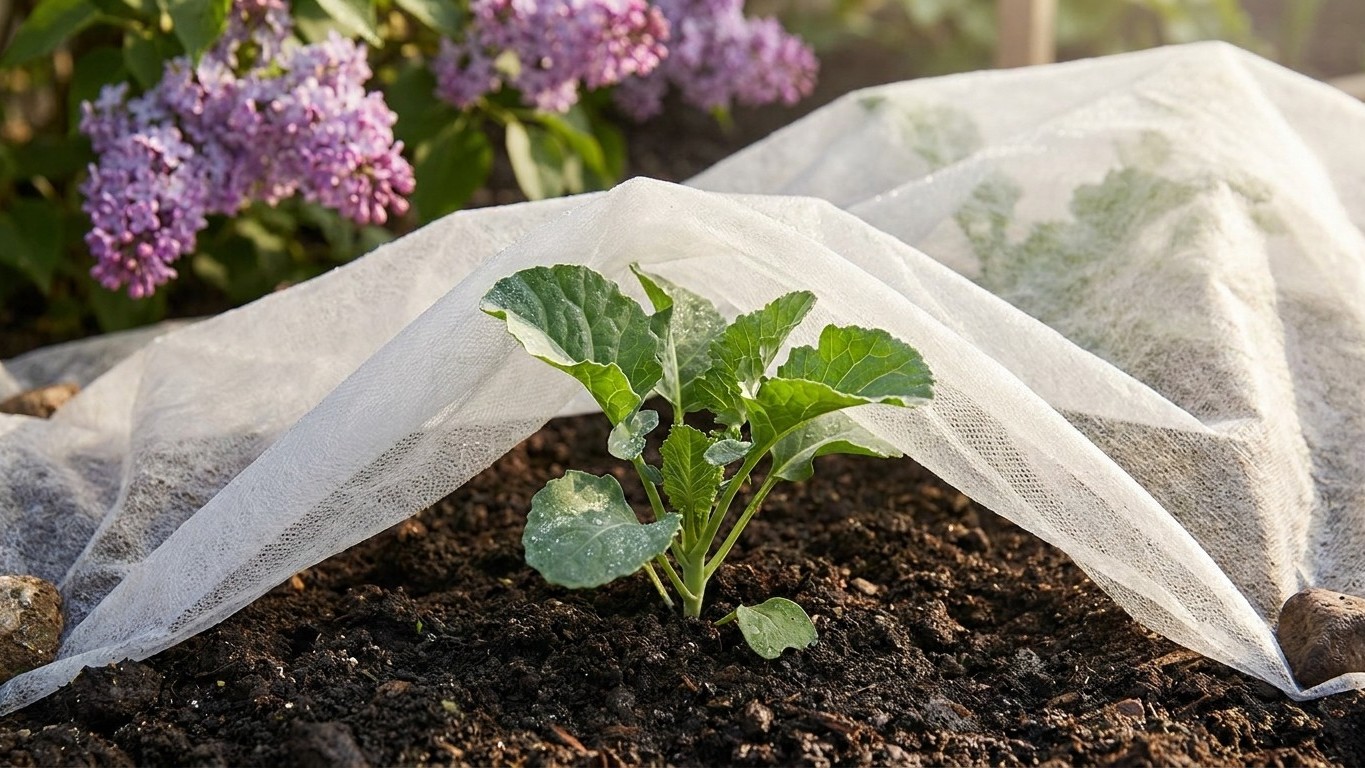

Cabbage maggot shows up in Manitoba gardens in two distinct waves each growing season, and the fix that actually works isn’t a spray, it’s a physical barrier installed before the first fly ever lands. Get the timing right and a floating row cover will keep this pest out of your brassica bed for the entire year, no chemicals required.
When cabbage maggot arrives in Manitoba

The adult fly (Delia radicum) overwinters as a pupa a few inches down in the soil, right where last year’s cole crops grew. It doesn’t wait for a calendar date. It waits for soil temperature, and in Manitoba that first emergence typically lines up with lilac bloom, usually somewhere in the second half of May across the Red River Valley and a bit later around Dauphin, The Pas, or other northern pockets where spring lags by a week or two.
That first flight is the dangerous one. Adult females mate within a couple of days of emerging and start laying eggs at the base of young transplants almost immediately, favoring the soft, freshly disturbed soil around a seedling stem. A single female can lay well over a hundred eggs in her lifetime, and she’ll keep going for two to three weeks before the flight tapers off.
A second, smaller flight tends to follow in July, and in a mild fall a third generation can sneak in through September, though damage from that late wave is usually minor since most crops are already sized up by then. Cool, wet springs push the first flight later; a warm, dry April can pull it forward by a week. Growers who watch degree-day accumulation rather than the date on the wall catch the window more reliably than those going off memory from last year.
Why timing matters more than the pest itself
Cabbage maggot damage is almost entirely a function of plant age. A transplant set out right as the first flight peaks can lose its whole root system before it ever gets going. The same variety planted three weeks later, once that flight has passed, often shows barely a scratch. This is the single biggest lever a home gardener has, and it costs nothing.
Spotting the damage before it’s too late
Above ground, an infested plant looks like it’s simply struggling: leaves turn a dull blue-gray or wilt in the heat of the day even when the soil is moist, growth stalls, and the plant may topple over with a light tug because the roots are gone. Pull one up and the diagnosis is obvious, tunnels riddle the taproot, and on radish or turnip the surface is often pocked with small brown scars even when the crop looks salvageable at first glance.
Cabbage, broccoli, and cauliflower seedlings are the most vulnerable because their root mass is small relative to the damage a maggot can do. Established plants tolerate light feeding and often push through it, which is why the transplant stage deserves the most protection. Rutabaga and turnip, grown for the root itself, show the cosmetic scarring that makes them unmarketable even when the plant survives.
Checking a few plants weekly during late May and June, gently scraping soil away from the stem base to look for small white eggs (they resemble tiny grains of rice tucked right against the stem) gives an early warning before larvae start tunneling. By the time wilting shows up above ground, the root damage is already done.
What actually stops cabbage maggot
Floating row cover, sealed at the edges with soil or landscape staples right from the day of transplanting, remains the most consistently effective barrier available to home growers. The fly can’t reach the stem to lay eggs if it can’t reach the plant at all. The cover needs to go on before the first flight, not after symptoms appear, and it needs to stay sealed since a gap of even an inch is enough for a fly to find its way underneath.
Delaying transplant dates by two to three weeks past the typical lilac-bloom emergence window sidesteps the worst of the first flight entirely. This works particularly well for cole crops that don’t mind a slightly compressed season, since Manitoba’s long summer daylight hours help plants catch up fast once they’re established.
Crop rotation matters more than most gardeners assume. Pupae overwinter in the same bed where brassicas grew, so moving cole crops to a different section of the garden for at least two years, ideally three, cuts the local emerging population dramatically. A four-year rotation across quadrants of a home garden is realistic for most backyard layouts and does more long-term good than any single-season treatment.
A few other tactics round out an effective approach:
- Collar barriers made from tar paper, cardboard, or purpose-made plastic discs fitted snugly around the stem at soil level block egg-laying without covering the whole plant, useful when a full row cover isn’t practical.
- Diatomaceous earth worked into the soil surface around the stem can deter egg-laying adults, though it needs reapplication after rain.
- Beneficial nematodes applied as a soil drench target the larval stage underground and have shown decent results in trial plantings, though they need moist, warmer soil to stay active.
- Sticky yellow traps placed at plant height near the bed help monitor when adult flight actually starts locally, which beats guessing from a generic calendar date.
- Sanitation, meaning pulling and destroying infested roots rather than composting them, keeps larvae from completing their cycle in your own soil.
Insecticide options exist and are labeled for Cabbage maggot in home gardens, but they’re most effective as a soil-drench applied at transplant, before eggs are laid, not as a rescue treatment once wilting shows up. By the time symptoms are visible, the larvae are inside the root and largely out of reach of anything sprayed on the surface. For most backyard situations, the physical and cultural methods above outperform chemical options anyway, without the added cost or handling concerns.
Companion planting: modest help, not a fix
Interplanting with strong-smelling herbs or flowers, like nasturtium or certain alliums, is often suggested as a deterrent. Research on this is mixed at best, and Manitoba’s cabbage maggot pressure is high enough in most gardens that companion planting alone rarely holds the line. Treat it as a minor supplement to row covers and timing, not a replacement for them.
Regional notes for Manitoba growers
Southern Manitoba, particularly the Red River Valley around Winnipeg, warms up earliest and typically sees the first flight arrive before growers farther north or at higher elevation. Gardeners near Brandon or Portage la Prairie usually track a week or so behind the valley, while northern communities can push emergence into early June in a cool year. Watching local lilac bloom, a classic and surprisingly reliable phenological indicator used across the Prairies, gives a more accurate signal than relying on a fixed date carried over from a gardening book written for a different climate zone.
Manitoba’s clay-heavy soils in much of the Red River Valley hold moisture and warm slowly in spring, which can actually delay pupal emergence compared to sandier, faster-draining soils elsewhere in the province. Gardeners on lighter soils near sandy ridges or river terraces may see cabbage maggot activity start slightly earlier than their clay-soil neighbors just a few miles away.
Home gardeners who’ve struggled with cabbage maggot for multiple seasons running often have a persistent local population built up in the same bed. In that situation, a full season of rotation away from any brassica crop, combined with row covers the following year, tends to break the cycle far more reliably than trying to out-treat it in place year after year.
Related guides
- Cabbage maggot in Ontario: When It Shows Up and What Stops It
- Cabbage maggot in Minnesota: When It Shows Up and What Stops It
- Cabbage maggot in New Brunswick: When It Shows Up and What Stops It
- Cabbage maggot in British Columbia: When It Shows Up and What Stops It
- Cabbage maggot in Oregon: When It Shows Up and What Stops It