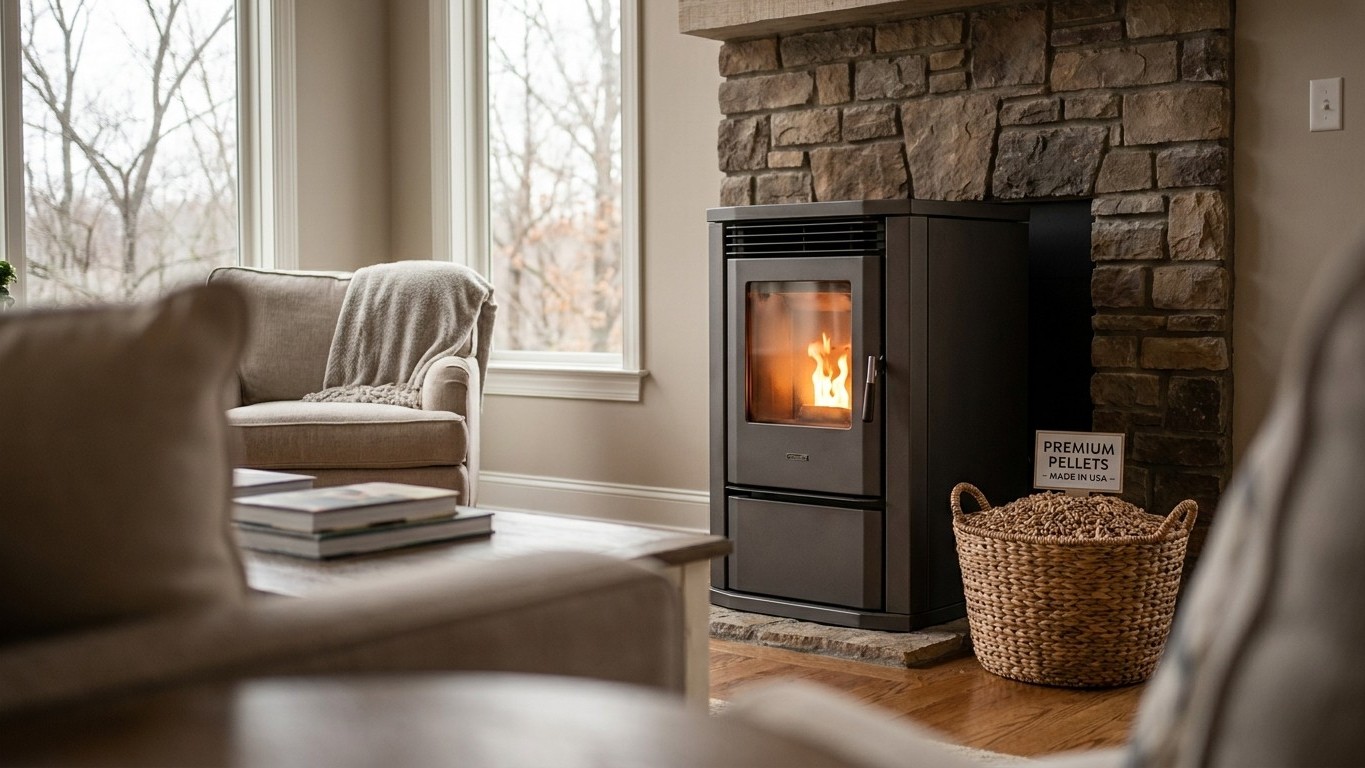

In Los Angeles and most of coastal California, a pellet stove earns its keep as comfort heat, not as the furnace replacement it might be in Denver or Minneapolis. The math behind that answer comes from degree-day data, and it also tells you when the season starts, how many bags to expect, and what happens if the power goes out mid-storm.
How hard the winter works here

Los Angeles International Airport, the reference station NOAA uses for Southern California climate normals, logs about 1,214 heating degree days a year, against 720 cooling degree days for summer. That number is low. Compare it to a Midwest city running 6,000 or more heating degree days, and you can see why a pellet stove installed in a Van Nuys living room does a fundamentally different job than the same appliance in Buffalo. Fewer degree days means the house loses less heat over the year, which means less fuel is needed to replace it.
But low doesn’t mean short. The heating season at LAX stretches across about seven months, starting in November (the first month whose normal mean temperature, 62.3°F, drops below the 65°F base NOAA uses to count degree days) and running through the mean climbing back above 65°F in June. December carries the heaviest load, at 232 degree days for the month, with January and February close behind at 227 and 207. That’s a long, mild season rather than a short, brutal one, and the two produce very different heating patterns even when the annual totals look similar on paper.
What that means in practice: a pellet stove here is best understood as supplemental heat, not a primary system. It’s the thing that takes the chill off a November evening, warms one room while the central system idles, or gives you a backup source when gas prices spike. Homeowners who buy a stove expecting it to replace their furnace for an entire winter, the way it might in a colder climate, often find themselves underwhelmed. Homeowners who buy it for atmosphere and supplemental warmth tend to be satisfied.
One more caveat matters more in California than in most states: this figure comes from one station, at sea level near the coast. A mountain town in the Sierra Nevada or the San Bernardino range, sitting a few thousand feet higher and well inland, can rack up degree days several times higher than LAX. If you’re heating a cabin in Big Bear or a house in the Tahoe basin, don’t use this number. Check the normals for a station closer to your own elevation and inland exposure before you plan a pellet budget around it.
How many tons a winter takes here
Nobody can hand you a tons-per-winter figure and have it mean anything for your specific house, because two homes in the same neighborhood can burn twice as much fuel as each other depending on how they’re built and how they’re heated. What you can do is work the chain of numbers that turns degree days into a shopping list.
A bag of pellets weighs 40 pounds. Fifty bags make a ton. From there, consumption tracks the heat your house actually needs to replace, which is exactly what the degree-day figure above measures. A house near the LAX station demanding roughly 1,214 heating degree days a year needs a fraction of the fuel a similar house in a 6,000-degree-day climate would burn, all else being equal. The trouble is that “all else” rarely is equal, which is why estimates before the fact stay rough.
- How well the house holds heat: an older place with single-pane windows and no attic insulation bleeds warmth fast, even in a mild climate, and burns through pellets faster than a tightly built or recently retrofitted home.
- Whether the stove is the only heat source or a supplement: in California, where 62% of homes report a furnace as their main heating equipment, a pellet stove is almost always working alongside that furnace rather than instead of it, which changes how many hours a day it actually runs.
- The setting it runs at: a stove left on a low, steady burn to take the edge off a room sips fuel compared to one cranked to high to heat a larger, drafty space.
Because those three variables swing so widely, no source publishes a tons-per-winter number by state or by city, and any figure you see quoted casually should be treated as someone’s personal experience, not a rule for your address. The one method that actually works: count the bags you burn through your first winter, note the thermostat settings and the rooms you were heating, and use that as your baseline going forward. One measured season on your own hearth beats every estimate built from someone else’s house. For a broader look at how consumption is typically calculated and what national averages suggest, see our guide on how many pellets a winter takes.
Buying and storing them in this climate
Timing matters more than most buyers expect. Heating demand at the reference station starts climbing in November, so the smart window to buy is before that month, not during it. Once a cold snap hits Southern California, even a mild one by national standards, demand for pellets spikes locally and shelves empty fast. Buying in late summer or early fall, when demand is at its lowest point of the year, tends to line up with the lowest prices too. Compare offers by price per ton, since bag counts and bag sizes vary enough between suppliers that a per-bag price alone can mislead you.
What California’s climate does to stored pellets
Pellets are compressed sawdust held together by the natural lignin in the wood, with no glue or binder. That construction is exactly why moisture is their enemy: dampness swells the wood fiber, breaks the bond, and turns a solid pellet into crumbling sawdust that won’t feed properly through an auger. Coastal California brings marine layer fog and high relative humidity for much of the year, even when rainfall itself stays low, and that damp coastal air can work its way into a garage or shed over weeks even without a drop of rain falling.
A concrete garage floor is a particular risk here. Concrete stays cooler than the surrounding air, and in humid coastal conditions that temperature difference can cause condensation to form on the slab, exactly the kind of moisture that wicks up into stacked bags from underneath. Pallets, tarps, and airflow off the floor matter as much in a mild coastal climate as they do in a rainy one; humidity doesn’t need a storm to do damage. Inland and desert parts of the state face less humidity risk but more dust and heat, which raises different storage questions. For the general rules on keeping pellets dry and intact through a full season, see our storage guide, and for what separates a quality bag from one that will jam your stove, our pellet quality guide.
What a winter outage means here
A pellet stove isn’t a wood stove with a hopper bolted on. It depends on an electrical supply to run the auger that feeds fuel into the firebox and the fan that pushes heat into the room. Cut the power, and the stove goes cold within minutes, no matter how full the hopper sits. That single fact separates pellet heating from traditional wood heating more than any other feature of the appliance, and it matters differently depending on how hard the winter outside is working.
At LAX’s reference climate, with heating demand this mild, a winter power outage rarely turns into a heating emergency. Losing the stove for an evening in December, the coldest month locally at 232 degree days, is an inconvenience: uncomfortable, but not dangerous, especially in a state where indoor temperatures rarely approach the extremes seen in colder regions during a blackout. That calculus shifts sharply for anyone heating a mountain or high-desert home outside the coastal reference zone, where an outage during a genuine cold snap is a different kind of problem entirely.
What do California households actually fall back on when the power or the stove is out? State data shows 62% rely on a furnace as their main heating equipment, and natural gas is the dominant fuel at 64%, with electricity at 20% and propane at just 2%. Fuel oil and kerosene aren’t reported as heating sources in the state at all, so this isn’t a state where backup heating strategies built around delivered fuel oil make sense. Most homes here have a gas furnace as the underlying system, with the pellet stove layered on top as supplemental warmth, which means an outage typically knocks out the blower on the furnace too if it’s not equipped for battery backup. Rather than guess at what your specific setup can handle, check the power requirements printed on your stove’s appliance label, and see our guide to heating through a winter power outage for how to plan around that dependency.