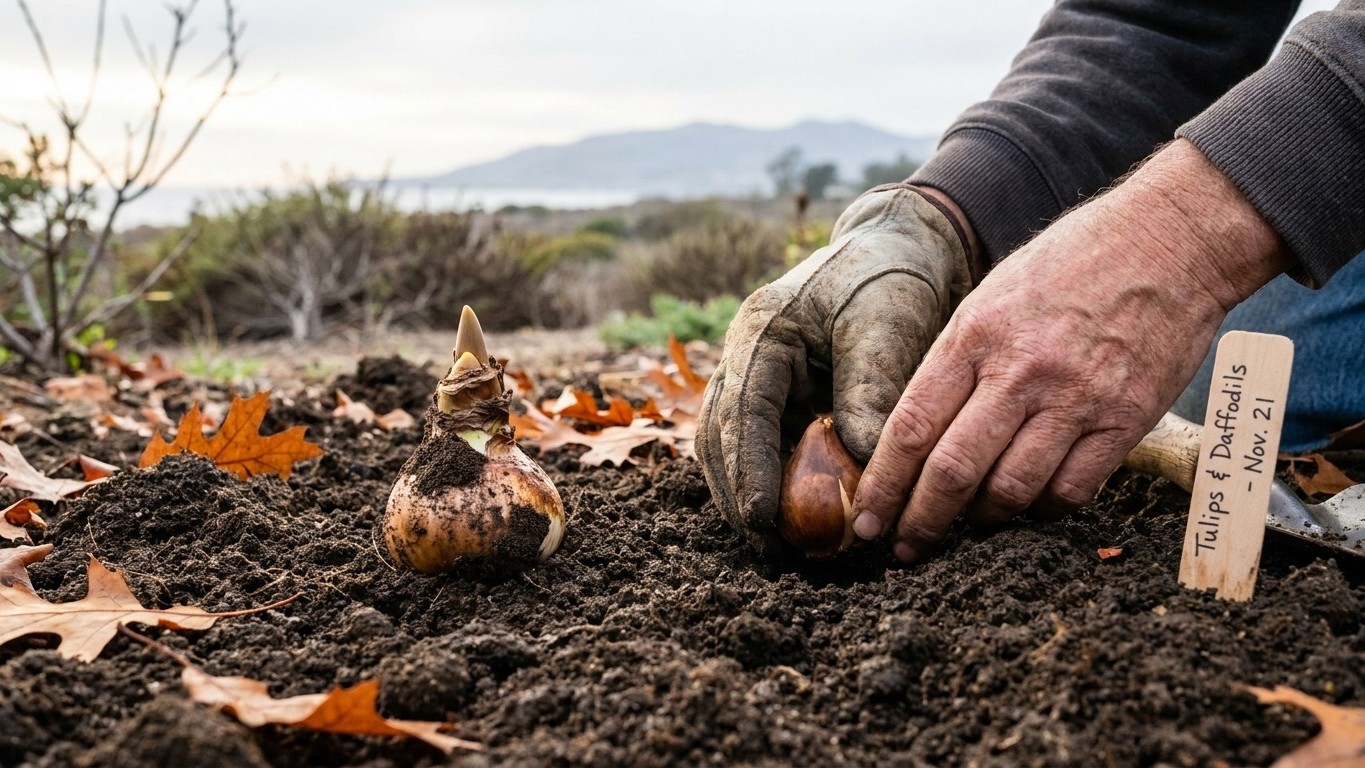

In most of California, planting bulbs in California has nothing to do with frost and everything to do with cold in a different sense: the six to eight weeks of chilly nights a bulb needs underground before it can flower. Coastal and Southern California rarely get that cold at all. The Central Valley, Sierra foothills, and northern counties usually do.
When to plant bulbs in California

Start with the reference point NOAA uses for this part of the state: the Los Angeles station. Climate Normals covering 1991-2020 show no computable frost date there at all. Thirty years of daily records show zero days at or below 32F, and the frost-free season is listed as the full 365 days of the year. That’s not a rounding quirk, it’s the climate: NOAA’s own data simply has nothing to compute a frost normal from.
That flips the standard bulb-planting rule most of the country follows, which is to get bulbs in the ground about six weeks before the ground freezes hard. Without a freeze to count back from, coastal and Southern California gardeners are planting against a different clock: soil temperature, not frost. The practical window runs once fall rains and shorter days cool the soil, typically November into December along the coast and in the Los Angeles basin. Push it earlier, into warm September or October soil, and bulbs can rot or push soft top growth that has nowhere useful to go. Wait too long, into a dry, warm December, and the bulb never builds the root system it needs before spring warmth arrives. For gardeners who can’t count on naturally cold enough soil, Growing Spring Bulbs in Containers in California offers a way to control that chilling period directly rather than leaving it to the ground, and Forcing Spring Bulbs Indoors in California is another option when the ground simply won’t cooperate.
Northern California and the Central Valley run on the old rule
The picture changes once you leave the coastal strip and the southern basins. The Central Valley, the Sierra foothills, and the far northern counties do freeze in a normal winter, and there the traditional guidance holds: plant roughly six weeks before the average first fall frost for your county. That average is exactly that, an average. Roughly half of all years land on one side of it and half on the other, so a planting date lifted from a state-level chart can leave a Central Valley gardener a week or two short in a cold year. Local frost records, not statewide ones, are what actually matter here, which is a point worth carrying into every other decision on this page.
Whether your winter is cold enough
This is the question that decides everything else, and it gets skipped more often than it should. A classic spring bulb, a tulip or a hyacinth in particular, doesn’t just tolerate cold, it requires it. Most need twelve to fourteen weeks with the soil sitting below about 45F before the flower bud inside the bulb will develop properly. Skip that exposure and the bulb still grows. It just grows leaves, or a flower stem so short it never clears the foliage. That threshold, the weeks and the 45F, is the number to hold onto no matter what bulb catalog or nursery display you’re looking at.
The measurement that tells you where you stand is the coldest month’s average daily minimum temperature, not the record low and not a rough guess. For the Los Angeles reference station, NOAA’s 1991-2020 Climate Normals put that figure at 49.1F. That’s above the 45F threshold, which means the coldest month here doesn’t reliably drop into the range a tulip or hyacinth needs, let alone hold it for twelve straight weeks. In practical terms, natural chilling in coastal and Southern California is close to zero weeks in an average winter.
That doesn’t rule bulbs like tulips out entirely, it just means the chilling has to happen somewhere other than the ground. Refrigerating bulbs for about twelve weeks before planting substitutes for the missing cold snap, and it works reliably if it’s done right. The bulbs need to sit at refrigerator temperature, away from apples, pears, or any ripening fruit, because the ethylene gas fruit gives off will kill the flower bud inside the bulb before it’s ever planted. Skip the pre-chill in a region running at 49.1F average minimums and the tulip bed is money spent on foliage.
| Bulb | Weeks of cold needed (below ~45F) | What coastal/Southern CA delivers naturally | Verdict |
|---|---|---|---|
| Tulip | 12-14 weeks | Near zero in an average winter | Pre-chill required, or skip it |
| Hyacinth | 12-14 weeks | Near zero in an average winter | Pre-chill required, or skip it |
| Crocus (Dutch types) | 8-15 weeks | Near zero in an average winter | Pre-chill required for reliable bloom |
| Daffodil | 12-16 weeks (some low-chill types less) | Near zero in an average winter | Marginal; low-chill varieties perform best without pre-chill |
Read that table by looking up your bulb, not by scanning the whole thing. If it’s not on the list of California-suited bulbs coming up next, the safer bet is a bulb that never needed a winter chill in the first place.
Which bulbs suit California
The bulbs that thrive here without a refrigerator or a mountain winter are almost all Mediterranean or South African natives, plants that evolved for wet, mild winters and dry summers, which happens to describe coastal and Southern California almost exactly. These don’t require a cold trigger to flower.
- Ranunculus (USDA zones 8-11): one of the best-suited bulbs for this territory, planted in fall for spring bloom.
- Freesia (USDA zones 9-11): naturalizes well along the coast and often returns for several years.
- Dutch iris (USDA zones 5-9): tolerates the mild winter without a chill requirement.
- Sparaxis (USDA zones 9-10): a reliable South African bulb for Southern California gardens.
- Watsonia (USDA zones 8-11): well matched to the coastal strip’s dry summers.
The bulbs that disappoint are the classic spring lineup sold everywhere every fall: tulips (hardy USDA zones 3-7), hyacinths (zones 4-8), and Dutch crocus (zones 3-8). Planted straight into the ground here without pre-chilling, tulips typically send up leaves with no flower, or a bud that never opens fully. The first fall, buyers often get a decent bloom on stored energy already in the bulb from the grower. It’s the second spring, when the bulb has to build its own flower bud in a Southern California winter, that the display quietly stops coming back.
None of these hardiness ranges are hard lines. A tulip near the edge of its zone can survive, even bloom weakly, in a shaded, cool microclimate, a north-facing bed against a wall, for instance, while the same bulb fails completely in an open, sun-baked yard two miles away. Zone maps describe averages across a wide area, not guarantees for one particular yard.
What digs them up here
Squirrels and voles aren’t random about what they take. It comes down to chemistry: daffodils and every bulb in the onion family, including alliums, contain compounds that make them bitter or mildly toxic to rodents, so they’re left alone. Tulips and crocus contain none of that natural defense, and both rank among the most reliably dug-up bulbs in any yard with a resident squirrel population.
That maps directly onto the bulbs from the sections above. Daffodils, where they’re grown here as low-chill varieties, sit on the safe list. So do alliums. Ranunculus, freesia, and the other Mediterranean and South African bulbs suited to California generally aren’t a squirrel’s first choice either, though they’re less studied for this than daffodils and tulips.
- Bulbs squirrels and voles take: tulip, crocus.
- Bulbs squirrels and voles leave alone: daffodil, allium and other onion-family bulbs.
One physical measure actually stops the digging: wire mesh, hardware cloth in a fine grade, laid flat over the planting bed and pinned down until the ground settles. Squirrels can’t get through it, and it costs a few dollars for a roll big enough to cover a bed. Repellent sprays, by contrast, wash off with the first watering or rain and need constant reapplication to do anything at all, which makes them a poor long-term fix compared with mesh.
Where to check for your own county
California spans multiple USDA hardiness zones, from 5a in the high Sierra to 11a along the far southern coast, and the figures in this guide are anchored to the Los Angeles reference station. A coastal San Diego yard, a Sacramento Valley farm, and a Tahoe cabin can each need a completely different planting calendar despite sitting in the same state.
The University of California’s Cooperative Extension, the state’s land-grant extension service, tracks local frost dates and soil conditions county by county, and its county offices are the resource built for exactly this gap. A planting window written for the state capital, or for Los Angeles as this guide is, can be off by three weeks or more once you move to a different elevation or distance from the coast. Checking with the local office before ordering bulbs saves the cost of a bed that was scheduled for the wrong climate from the start.