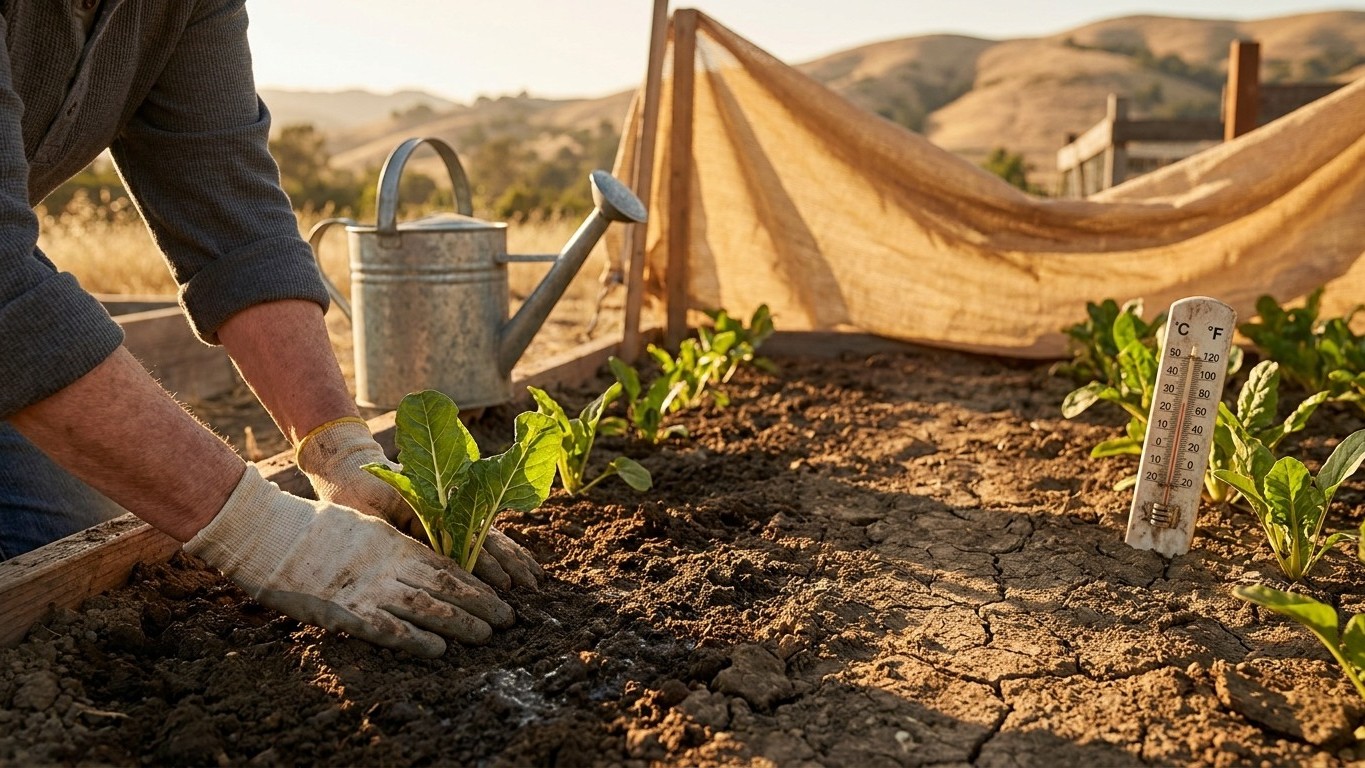

August in California splits into two very different gardens. Along the coast and through Southern California, where freezes essentially never happen, the limit isn’t cold, it’s heat, drought and whatever watering restrictions your district has posted. Inland in the Central Valley and up into the Sierra, the same month means shielding crops from triple-digit afternoons while quietly starting the seeds that will become the fall garden.
What goes in the ground in August

The state’s frost record makes the coastal and Southern California picture unusually simple: NOAA’s climate data for that reference station shows zero days at or below 32°F across three decades, with the frost-free season listed as a full 365 days. There’s no frost window to plan around there. The constraint is heat stress and water, not cold, so the question isn’t “will it freeze” but “will this seedling survive a 95°F afternoon before its roots take hold.”
That changes what “direct-sown” means this month. In coastal and Southern California gardens, bush beans, summer squash and quick greens like Swiss chard can still go into open ground if you water them in well and give afternoon shade for the first week. Root crops such as carrots and beets do better sown late in the month, once the ground has a chance to cool slightly toward evening. Corn is a gamble unless you’re planting a fast variety with enough weeks left before day length shortens.
Central Valley gardeners face the opposite problem: soil that’s baked hard and air that can sit above 100°F for days. Direct sowing tender crops now often fails outright from heat, not cold. The better move is transplanting in late afternoon or early evening, with a temporary shade cloth over new plantings, and saving direct seeding for the last week of the month when the worst heat spikes tend to ease.
Higher-elevation and Sierra gardens run on a much shorter clock. USDA’s Plant Hardiness Zone Map places parts of the state as cold as zone 5a, built on average annual extreme minimum temperatures, a very different reality from the frost-free coast. In those gardens, August is often the last realistic window for quick crops like radishes and loose-leaf lettuce before the season turns.
| Region | August constraint | What still goes in the ground |
|---|---|---|
| Coastal & Southern CA | Heat and drought, not frost | Bush beans, summer squash, chard, late-month carrots and beets |
| Central Valley | Extended triple-digit heat | Evening transplants under shade cloth; direct seed late month |
| Sierra & higher elevation | Short remaining season | Quick radishes, loose-leaf lettuce, last succession sowings |
What to start under cover
August is when California’s fall and winter garden actually begins, and it starts indoors or under shade cloth, not in the open bed. Brassicas like broccoli, cabbage and cauliflower, along with fall lettuce and the first winter greens, get sown into trays now so they’re stocky, well-rooted transplants by the time the worst heat has passed. Starting them directly in the ground in most of the state this month usually means losing them to heat before they germinate evenly.
Because coastal and Southern California don’t have a fall frost date to count back from (the same NOAA data that shows no spring freeze also shows no fall freeze at that reference station), the timing there runs off soil temperature and day length instead. The rule of thumb gardeners use: start brassica and lettuce transplants roughly six to eight weeks before you expect daytime highs to reliably drop out of the 90s, then move them into the ground once they have three or four true leaves.
In the Central Valley and Sierra, where an actual fall freeze does eventually arrive, the specific date isn’t published in the data available for this page, so the safer approach is checking your county’s typical first-frost range with UC ANR rather than guessing. Count backward from that local range, not from a statewide number.
Both failure modes show up every year. Start too early in a warm valley and the trays sit in punishing heat, bolting or turning leggy before they’re ever transplanted. Start too late and the seedlings hit the ground just as the short fall window closes, leaving them to limp through without enough growing time to mature before winter slows everything down.
What is ready to pick
August is the peak harvest month almost everywhere in the state, and the trick is picking often enough that the plants keep producing instead of stalling out. Tomatoes should come off the vine as soon as they color up fully, since leaving ripe fruit on the plant in heat invites splitting and sunscald. Peppers, summer squash and cucumbers all keep producing longer if you pick them small and often rather than letting a few oversized fruits hog the plant’s energy.
Sweet corn is ready when the silks have turned brown and dry while the husk stays green, a window that can close in just a couple of days in Central Valley heat. Melons signal ripeness by the stem: a cantaloupe that slips free with light pressure is ready, while watermelon relies on that dull thump and a yellowing underside where it rests on the soil.
Basil, along with other soft summer herbs, needs cutting back hard this month or it bolts to flower in the heat and turns bitter. In gardens that got an early start, the first fall greens sown under cover in July may already be big enough for a light baby-leaf harvest, giving the household something fresh while the tomato patch winds down toward September.
The jobs that matter this month
Water management is the job that decides everything else in August. Deep, infrequent watering that reaches down eight to ten inches builds stronger roots than a daily light sprinkle, and it matters more in a month when many California water districts post outdoor restrictions. A two- to three-inch mulch layer over beds cuts evaporation and keeps soil temperature down around root zones, which directly affects how well those fall transplants establish later in the month.
Pest scouting can’t wait either. Aphids and spider mites explode in dry heat, and hornworms can strip a tomato plant of leaves in a couple of nights if they’re not caught early. Checking the undersides of leaves every few days, rather than waiting for visible damage, is the difference between a quick hand-picking job and a lost plant.
Feeding needs a light touch right now. Heavy nitrogen on tomatoes, peppers and squash pushes leafy growth at the expense of fruit, exactly the wrong trade when plants are already trying to ripen a full load in stressful heat. A balanced, lower-nitrogen feed suits this stage better.
Succession sowing keeps the harvest from collapsing all at once. Dropping in a new round of bush beans or a short row of summer squash every couple of weeks, where the season allows it, spreads the harvest instead of concentrating it. And staking or caging sprawling tomato and melon vines before they collapse under their own weight saves a lot of bruised, rotting fruit later.
What not to do in August
The most common mistake is treating a hot afternoon as proof the soil is ready for tender seedlings. Air temperature and soil temperature aren’t the same thing, and in most of California this month the ground is already running hot enough that new transplants scorch rather than establish. Setting transplants out in the evening, with a few days of shade cloth to buffer them, avoids that shock.
Pulling shade cloth or row cover too early after a mild stretch is another classic error. A few cooler days don’t mean the heat is done, especially in the Central Valley, and plants that had just started adjusting to shade often burn hard when the cloth comes off during the next spike.
Overfeeding with nitrogen is the third trap. It looks productive, since the plant visibly grows, but it comes at the cost of fruit set on tomatoes, peppers and squash right when those plants need to be putting energy into ripening rather than foliage. A soil test, rather than a guess, is the better way to decide what a bed actually needs before adding anything.
Finally, ignoring local watering restrictions to save a struggling bed usually backfires. Deep, targeted watering at the root zone, done less often, keeps plants alive within most district limits far better than frequent shallow watering that wastes the allowance without reaching the roots that need it.
Checking this against your own county
A statewide August guide is a starting point, not an instruction sheet, and nowhere is that truer than in California. Elevation alone can shift a planting window by weeks between a coastal valley and a Sierra foothill town twenty miles inland, and the gap between Northern California’s freezing winters and the frost-free south means the same month calls for opposite strategies depending on where you garden. Before committing a bed to any of the above, check your county’s specifics through UC ANR, the state’s cooperative extension service, which keeps localized planting guidance and frost data by region.
Common questions
Does it ever freeze in California in August?
Not in coastal or Southern California, where NOAA’s climate normals show zero freeze days across three decades and a full 365-day frost-free season. Northern California, the Central Valley and the Sierra do experience freezes in winter, but August sits well outside any frost risk statewide.
What’s the single biggest risk to an August garden in California?
Heat stress combined with water restrictions, not cold. Triple-digit afternoons in inland areas can kill new transplants and stall fruit set faster than any pest, which is why shade cloth and deep watering rank above almost everything else this month.
Can I still plant tomatoes in August in California?
In most of the state, new tomato transplants set out in August won’t have enough remaining warm season to ripen a full crop before growth slows in fall. August is better spent maintaining existing tomato plants and starting fall brassicas and greens instead.
Why does California’s hardiness zone range span from 5a to 11a?
The USDA Plant Hardiness Zone Map is built on one measure, the average annual extreme minimum temperature, and California’s geography runs from frost-free coastline to high Sierra elevation within the same state. That’s why a single statewide zone number doesn’t exist, and why checking your specific county through UC ANR matters more here than in most other states.