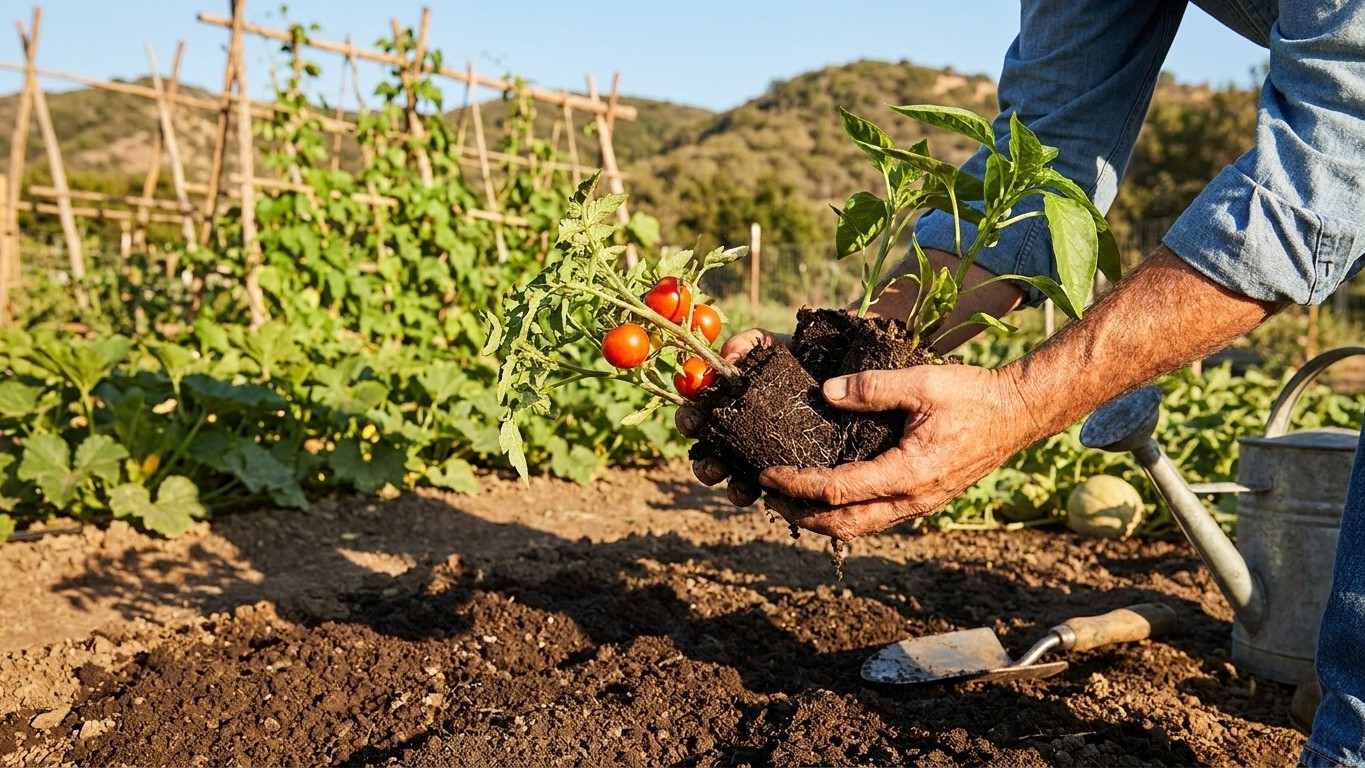

May in California means warm-season planting almost everywhere except the highest elevations, where soil is still cold and frost risk lingers into early summer. Tomatoes, peppers, squash, beans, corn and melons go into the ground this month across the coast, the Central Valley and the Bay Area. In the Sierra Nevada and other mountain communities, wait for soil to warm before committing tender transplants.
What goes in the ground in May

The decision this month rests on soil temperature, not the calendar page. Warm-season crops like tomatoes, peppers, eggplant, squash, cucumbers, melons and beans need soil consistently above 60 F to germinate or transplant without stalling. Along the coast and through the Central Valley, that threshold is usually well past by May, which is why nurseries in Fresno, Bakersfield and the Los Angeles basin are stocked with tomato and pepper starts by this point in the season.
Coastal and Southern California carry a distinct advantage here: NOAA climate normals for the region show no computable freeze date at all, with zero days at or below 32 F recorded over three decades and a frost-free season listed as 365 days. That means gardeners near the coast and in Southern California aren’t fighting frost in May, or in any month. The constraints there are heat, drought and water restrictions instead.
Northern California, the Central Valley floor and the Sierra foothills are a different story. These areas do freeze in a typical year, and higher elevations can see a lingering chill into May that makes tender transplants a gamble. If you garden above roughly 4,000 feet, hold off on corn, beans, squash and tomatoes until nighttime soil temperatures stabilize. In the meantime, direct-sow beets, carrots, chard, lettuce and other cool-tolerant crops, which handle a cool snap without much drama.
Sweet potato slips, basil and squash transplants can go in once soil has warmed in the Central Valley. Corn is best direct-sown once the soil has lost its early-spring chill, since it germinates poorly in cold ground regardless of air temperature. Melons and okra reward patience: both stall badly if set out even a week too early, so a gardener in Redding or Chico is often better served waiting into late May than rushing over Memorial Day weekend.
What to start under cover
In most of California, the frost math that governs Midwest and Northeast planting calendars simply doesn’t apply along the coast and in the south, since there is no last freeze date to count backward from. But that doesn’t mean seed-starting under cover has no place in May. Gardeners in the Central Valley and Sierra foothills still use it to get a jump on heat-loving crops before soil warms enough for direct seeding, and coastal gardeners use it to stagger tomato and pepper harvests across the season.
Start peppers and eggplant seeds indoors roughly eight weeks before you intend to transplant them outside, since both are slow to size up and resent being rushed. Tomatoes need closer to six weeks. In Sierra communities where soil stays cool into early summer, that timing often means starting warm-season seedlings indoors now for transplanting once the ground catches up, rather than waiting to direct-sow.
The two ways this goes wrong are familiar to every gardener who has started seed indoors. Start too early, without enough light or room to grow, and you end up with leggy, rootbound plants that sulk for weeks after transplanting. Start too late, and warm-season crops that need a long stretch of heat, like melons and winter squash, run out of season before they finish. Southern California and coastal gardeners have more room for error here since the growing window doesn’t close with a hard frost, but Central Valley and Sierra gardeners working toward a shorter effective season should track soil temperature rather than guessing.
Fall brassicas, meanwhile, can be started under cover late in the month in cooler coastal zones, since broccoli, cabbage and cauliflower prefer to mature in the cooler stretch of fall rather than the peak of summer heat.
What is ready to pick
May is a genuine harvest month across most of California. Strawberries hit their stride, especially along the coast where mild temperatures extend the picking window well past what warmer inland gardens see. Peas, planted in late winter, are typically finishing their run by mid-to-late May before heat pushes them to bolt, so this is the last real window to get sweet, tender pods rather than tough, starchy ones.
Lettuce and other spring greens are also winding down as temperatures climb, particularly in the Central Valley where a warm stretch can turn a bed bitter within days. Harvest heads and leaves promptly rather than letting them sit, and watch for the telltale stretching stem that signals bolting is imminent.
Artichokes, a California specialty grown widely along the central coast, are typically at peak production in May. Look for buds that are still tight and heavy for their size; once the bracts start to loosen and splay, the choke inside has usually toughened. Asparagus beds established in prior seasons are also producing steadily by now, though harvest should taper by early summer to let the plant build energy for the following year.
Citrus trees, which carry fruit through winter in much of Southern California and the Central Valley, are finishing their last rounds by May in most varieties. Check any remaining fruit for softness or off-color skin, both signs it has passed peak quality and should come off the tree.
The jobs that matter this month
Mulching earns its keep more in May than almost any other month in California, because it’s the single best defense against the moisture loss that starts accelerating as temperatures climb. A two-to-three-inch layer around vegetable beds and young transplants slows evaporation, moderates soil temperature swings, and reduces the watering burden that only grows heavier through summer. In a state where water restrictions are a recurring reality rather than an occasional inconvenience, this is not a cosmetic task.
Staking and caging need to happen now, before tomato and pepper plants sprawl into a tangle that’s far harder to correct later. A cage set after the plant has already flopped does little good and risks damaging roots and stems in the process.
Drip irrigation or soaker hose setups are worth installing or checking over this month if they aren’t already in place. Overhead watering in the heat of a Central Valley or Southern California summer wastes water to evaporation and invites fungal issues on leaves; drip systems put water at the root zone where it’s actually used.
Pest scouting matters more in May than earlier in spring, since aphids, whiteflies and early-season caterpillars are building populations on tender new growth. Checking the undersides of leaves weekly and catching an infestation early is far less work than dealing with a full-blown outbreak in June.
Succession sowing of quick crops like lettuce, radishes and bush beans keeps harvests coming rather than arriving all at once. In cooler coastal microclimates, lettuce can often be succession-sown right through summer; inland, it’s worth switching to heat-tolerant varieties or pausing until fall.
What not to do in May
The most common mistake in California gardens this month is trusting a warm afternoon over the soil thermometer. A string of 80-degree days doesn’t mean the ground six inches down has caught up, and setting out melons, peppers or basil into soil that’s still cool leads to stunted, sulking plants that often never fully recover even once conditions improve. This is a particular trap in the Central Valley, where air temperature swings widely between morning and afternoon even as soil temperature lags behind.
In the Sierra and other higher-elevation gardens, a mild stretch in early May can tempt gardeners to pull row covers and cold frames too soon. Since these areas do experience real freezes, unlike the coast and south, uncovering tender plants after one warm week is a gamble that a late cold snap can undo in a single night.
Overfeeding with nitrogen is another recurring issue, particularly on tomatoes and peppers. A heavy nitrogen application now pushes lush green foliage at the expense of flowering and fruit set, leaving gardeners with a big, leafy plant and a disappointing harvest. A balanced or lower-nitrogen fertilizer, applied once plants are established rather than at transplant, generally produces better results.
Overwatering newly-mulched beds is a subtler mistake. Because mulch keeps the surface looking dry, some gardeners water on the old schedule out of habit and end up drowning roots that no longer need as much. Check soil moisture a few inches down before watering rather than relying on how the surface looks.
Checking this against your own county
A statewide planting month is a starting point, not an instruction, and nowhere is that truer than in California. Elevation, coastal fog, and the sheer distance between the Oregon border and the Mexican border move planting windows by weeks in either direction. The USDA hardiness zone map places the state anywhere from zone 5a in the high Sierra to zone 11a along the frost-free coast and south, a wider spread than almost any other state carries under one name.
For a planting schedule tuned to your specific county, the University of California’s cooperative extension service at ucanr.edu publishes local guidance drawing on regional soil and climate data rather than a single statewide average.
Common questions
Does California ever get frost in May?
Coastal and Southern California don’t see frost in a typical year at all, with NOAA climate normals showing no computable freeze date for the region. Northern California, the Central Valley and the Sierra Nevada do experience freezes, and higher elevations can still see cold nights into May, so the answer depends heavily on where in the state you’re gardening.
Can I plant tomatoes outdoors in California in May?
In most of the state, yes, since soil has typically warmed enough by May for tomato transplants to establish well. In Sierra foothill and mountain communities where soil stays cooler longer, it’s worth checking soil temperature before transplanting rather than relying on the calendar alone.
What vegetables are ready to harvest in California in May?
Strawberries, peas, artichokes and spring lettuce are typically at or near peak in May, along with asparagus from established beds. Citrus is generally finishing its season by this point in most growing areas.
Why does the USDA hardiness zone matter for planting decisions?
The USDA Plant Hardiness Zone Map is built on one variable, the average annual extreme minimum temperature, and California spans an unusually wide range of it, from zone 5a in high-elevation areas to zone 11a along the frost-free coast. That spread means a planting guideline calibrated for one part of the state can be badly off for another, which is why checking local extension guidance matters more here than in more climatically uniform states.