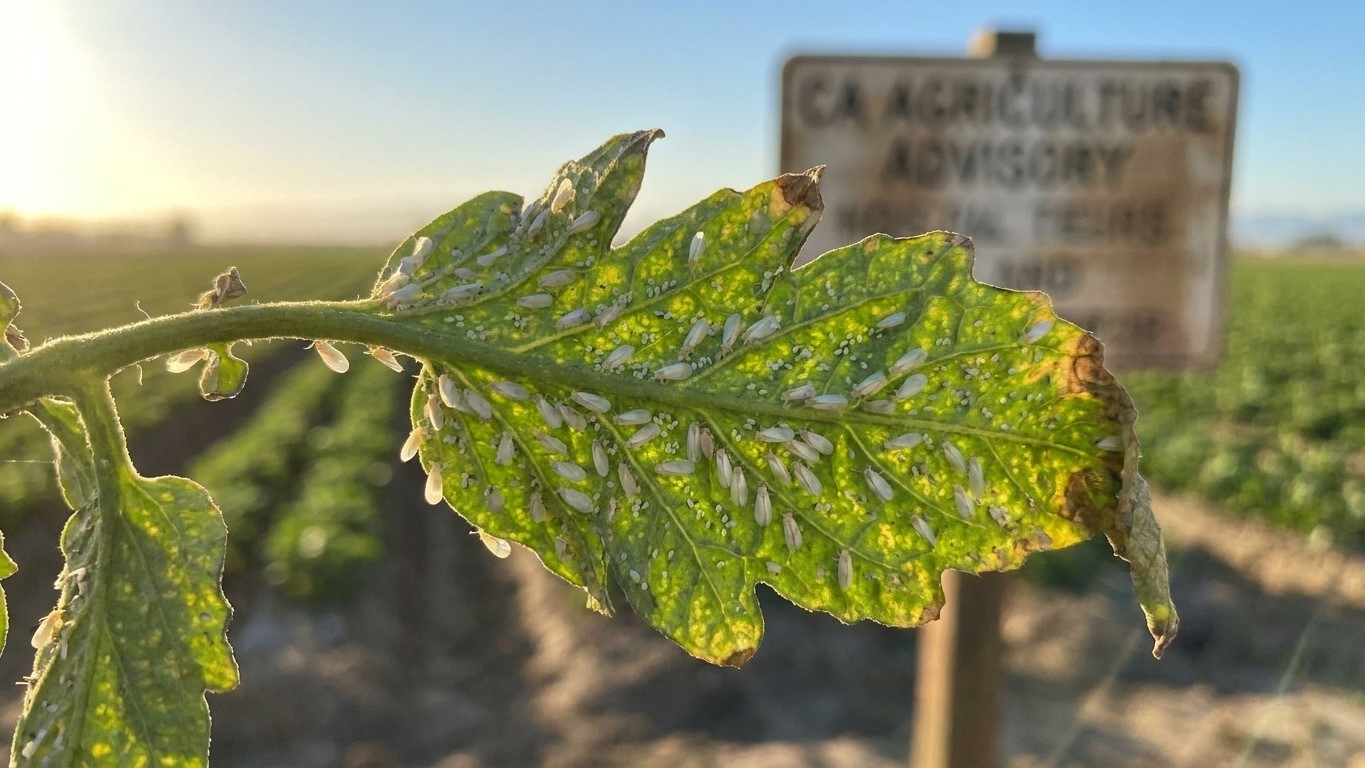

Whiteflies show up in California from late spring through fall in most regions, with populations peaking between August and October, and they never fully disappear in the desert valleys where winters stay mild. Stopping them takes a mix of early monitoring, biological control, and targeted treatments timed to when nymphs are most vulnerable, not when adults are swarming your tomato plants.
When Whiteflies Show Up, Region by Region

California’s size means whitefly season doesn’t run on one calendar. In the Central Valley, from Bakersfield up through Sacramento, whitefly numbers build through June and explode by late summer on cotton, melons, and tomatoes. Growers in Fresno and Kern counties have tracked this pattern for decades because silverleaf whitefly (Bemisia tabaci) became a major agricultural problem there starting in the early 1990s.
Southern California and the desert valleys, think Imperial Valley and Coachella Valley, run on a different clock. Winters rarely get cold enough to kill off whitefly populations completely, so you get overlapping generations almost year-round. Home gardeners in Palm Springs or El Centro dealing with sticky, yellowing leaves in February shouldn’t be surprised, even though that’s off-season everywhere else in the state.
Coastal cities like San Diego, Santa Barbara, and the Bay Area see a milder pattern. Fog and cooler summer temperatures slow reproduction, so infestations tend to be smaller but can still persist in greenhouses and on sheltered ornamentals like hibiscus and citrus year-round.
Species That Matter in California Specifically
Not every whitefly problem in the state is the same insect. Three species show up most often:
- Silverleaf whitefly, the dominant agricultural pest in the Central Valley and desert regions, notorious for transmitting plant viruses to melons, cotton, and vegetables.
- Greenhouse whitefly, common statewide in nurseries, home gardens, and on houseplants moved outdoors in warm months.
- Ash whitefly, once a serious urban tree pest on fruitless mulberry and pear trees in the 1980s and 90s, now largely kept in check by an introduced parasitic wasp.
That last one is worth a beat. Ash whitefly triggered outbreaks so severe in Southern California in 1988 that state agriculture officials fast-tracked a classical biological control program, releasing the parasitic wasp Encarsia inaron. It worked. Within a few years, ash whitefly dropped from a citywide nuisance to a background pest, which is the rare pest-control story with a genuinely happy ending.
Why California’s Climate Keeps Bringing Them Back
Whiteflies are cold-sensitive but heat-tolerant, which describes California’s growing regions almost perfectly. Adult whiteflies stop reproducing below roughly 50°F, but they don’t die off, they just slow down and wait out cooler stretches on weeds, ornamentals, and volunteer plants. The moment temperatures climb back into the 70s and 80s, egg-laying resumes within days.
Irrigation adds another layer. Whiteflies favor lush, nitrogen-rich new growth, and California’s irrigated cropland and landscaped yards provide exactly that kind of tender foliage through most of the year. A well-watered backyard vegetable garden in July is, from a whitefly’s perspective, an ideal nursery.
Wind patterns matter too. Adult whiteflies are weak fliers on their own, but they get lifted by wind currents and can travel miles between fields. That’s part of why Imperial Valley growers coordinate regional pest management, a single untreated field can reinfest neighboring farms within a season.
What Actually Stops Whiteflies
Control works best as layered defense rather than a single spray. Whiteflies build resistance to insecticides fast, and California’s agricultural whitefly populations have already shown reduced sensitivity to several older chemical classes, according to University of California pest management research.
Monitoring Before You Treat
Yellow sticky traps placed near susceptible plants catch adult whiteflies before populations explode, giving you a two-to-three week head start. Checking the undersides of leaves for the tiny, oval nymphs (they look like pale scale insects and don’t move) tells you whether an infestation is building even when you don’t see clouds of adults yet.
Biological Control
Several natural enemies already established in California do a lot of the work for free. Ladybird beetles, lacewing larvae, and several species of parasitic wasps in the genus Encarsia and Eretmocerus attack whitefly eggs and nymphs. Broad-spectrum insecticides kill these beneficials right along with the whiteflies, which is one reason heavy spraying programs sometimes make infestations worse in following seasons. Home gardeners can support this natural control by avoiding unnecessary pesticide use and planting flowering species like alyssum or dill nearby to feed adult parasitic wasps.
Horticultural Oils and Insecticidal Soaps
For home gardens and ornamental plantings, horticultural oil and insecticidal soap remain the most reliable low-toxicity options. They work by smothering nymphs and eggs, so thorough coverage of leaf undersides matters more than the product itself. Repeat applications every 7 to 10 days during active infestations, since these products don’t have residual killing power once they dry.
Reflective Mulch and Physical Barriers
Silver or aluminum-colored reflective mulch confuses adult whiteflies looking for a place to land, a technique used commercially in California melon and squash fields with documented reductions in virus transmission. Home gardeners can replicate this with reflective mulch film around the base of susceptible vegetables. Floating row covers, applied at planting and removed once plants flower, physically block adults from reaching young seedlings during the most vulnerable stage.
When Systemic Insecticides Make Sense
Severe infestations on high-value crops or ornamentals sometimes call for systemic insecticides, which the plant absorbs and which then kill insects feeding on its tissue. These carry real trade-offs, they persist longer in the plant, can affect pollinators visiting flowers, and contribute to the resistance problem if used repeatedly. University of California Integrated Pest Management guidance recommends reserving systemic treatments for situations where other methods have failed and rotating chemical classes to slow resistance buildup. Full details on current recommended materials and timing are available through UC IPM’s whitefly management guide.
Plants and Crops Most at Risk Across the State
Agriculturally, cotton, melons, cucumbers, tomatoes, and cole crops (broccoli, cabbage, and similar) take the biggest hits from silverleaf whitefly, particularly in the San Joaquin Valley and Imperial Valley. The virus transmission issue is often worse than the direct feeding damage, since infected melon and vegetable plants can show stunted growth and irregular ripening weeks after the whiteflies themselves have moved on.
In home landscapes, hibiscus, citrus, roses, and ornamental shrubs in the mallow family draw whiteflies most consistently, especially in Southern California and coastal cities where these plants stay green year-round. Vegetable gardeners statewide should watch tomatoes, peppers, and squash closely from midsummer onward, since sticky honeydew residue and sooty mold on leaves are usually the first visible sign, showing up before you spot the insects themselves.
Houseplants moved outdoors for the summer, poinsettias in particular, can carry greenhouse whitefly infestations back indoors in fall, which is why nursery stock inspection matters even for a single potted plant purchase.
A Practical Timeline for California Gardeners
Start monitoring with yellow sticky cards in April in the Central Valley and inland Southern California, or year-round in desert valleys. Watch for the first honeydew or sooty mold signs by June. Treat early infestations with insecticidal soap or oil rather than waiting for visible adult swarms, since by the time you see clouds of whiteflies lifting off a plant when disturbed, the nymph population underneath the leaves is already well established. Reduce nitrogen fertilizer slightly during peak season too, since the lush growth it produces is exactly what draws egg-laying females in the first place.
Late fall brings natural relief in most of the state as temperatures drop, but gardeners in the low desert regions should keep monitoring through winter, since that’s precisely when populations elsewhere are resting and reinfestation pressure from warmer zones can catch an unprepared garden off guard come spring.