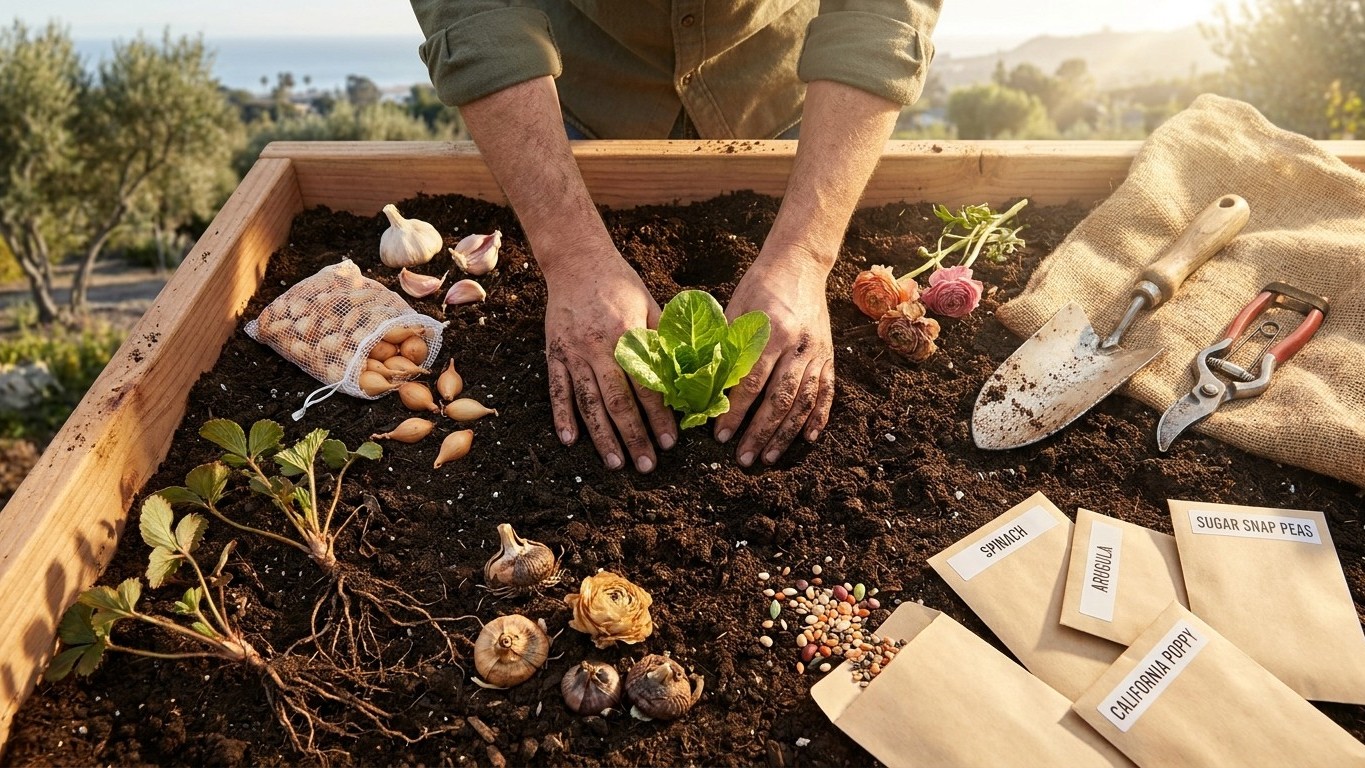

Most of California plants right through November, but which crops go in depends on which California you’re gardening in. Coastal and Southern California see no measurable frost in an average year, so cool-season vegetables, bulbs, and bare-root natives all go into open ground now. Northern California, the Central Valley, and the Sierra foothills have usually already had their first frost, which narrows the list to hardy greens, garlic, and dormant plantings.
What goes in the ground in November

The split that matters this month isn’t the calendar, it’s the freeze line. According to NOAA NCEI 1991-2020 Climate Normals, the coastal and southern parts of the state register zero days at or below 32°F across three decades of records, with a frost-free season listed as 365 days. That’s not a typo or a rounding trick: for gardeners in Los Angeles, San Diego, and much of the coastal strip, frost simply isn’t part of the planning. The constraints there are heat, drought, and water restrictions, not cold.
In that frost-free zone, November is one of the best sowing windows of the year. Lettuce, spinach, arugula, peas, beets, carrots, and radishes all go direct into the soil now, along with garlic cloves and onion or shallot sets for a spring harvest. Fava beans do well started this month too. It’s also prime bare-root and bulb season: ranunculus, anemone, and spring-flowering bulbs go in, and California natives like ceanothus, manzanita, and California poppy establish best when planted into cooling, still-moist soil rather than summer heat.
Northern California, the Central Valley, and the Sierra foothills tell a different story. These regions sit within USDA hardiness zones that run considerably colder than the coast, part of a statewide range of 5a to 11a on the USDA Plant Hardiness Zone Map, a system built entirely on average annual extreme minimum temperature. By November, first frost has usually already passed through these areas. That doesn’t mean the season is over. Garlic and shallots still go into workable ground for a summer harvest. Cold frames and low tunnels extend the window for hardy greens like spinach and mâche. Bare-root fruit trees, currants, and cane berries begin their dormant planting season here too, since they’re shipped and installed while leafless and inactive. If the ground has already locked up hard in the higher Sierra, forcing rhubarb crowns or chicory roots indoors is a reasonable substitute for outdoor planting.
What to start under cover
For colder California, starting seed under cover this month is counted backward from the last frost expected in spring, not from a fixed date on a seed packet. A gardener in the Sierra foothills or northern Central Valley who wants transplant-ready brassicas or onions by the time the ground opens up in late winter needs to count back the weeks a given crop needs to reach transplant size, then add a buffer for shorter daylight, which slows growth even under cover. Starting too early in a cold garage or unheated greenhouse produces leggy, rootbound seedlings that stall once transplanted. Starting too late means the transplant misses its outdoor window entirely and never catches up.
Along the coast and in Southern California, the arithmetic runs differently because there’s no frost date to count back from. Instead, cover crops like fava beans, bell beans, and clover go under row cover or cloches mainly to protect against wind and heavy winter rain rather than cold. Gardeners here can also start warm-season seedlings, like tomatoes and peppers, under cover late in the month for an early spring transplant, since the mild coastal climate allows a head start that colder regions can’t attempt until much later.
The two failure modes are the same no matter the region: sowing too early and ending up with weak, overgrown starts sitting in trays too long, or sowing too late and running out of the season the transplant was meant to fill. Watching germination speed under cover, not just the date, is the better guide.
What is ready to pick
Along the coast and in Southern California, harvest doesn’t really stop in November. Tail-end tomatoes and peppers can still be producing in the mildest microclimates, while fall-planted lettuce, arugula, and radishes from earlier weeks are usually ready to cut. Citrus is the real November story here: early mandarins and satsumas start coloring up and reach eating quality, a signal to start tasting rather than guessing by the calendar, since color alone can mislead with citrus.
In the Central Valley, Sierra foothills, and Northern California, outdoor harvest slows considerably once frost has passed through. Overwintered kale, leeks, and Brussels sprouts left standing in the garden actually sweeten after cold exposure, since the plant converts starches to sugars as a natural antifreeze. Cold frames extend a small harvest of greens through the month even where open beds have shut down. Indoors, this is a good stretch for sprouting seeds or growing microgreens on a windowsill, both of which finish in days rather than months and don’t depend on outdoor conditions at all.
Stored crops need a hands-on check now regardless of region. Winter squash should feel hard with no soft spots; a squash with a give under thumb pressure is starting to break down and should be used first. Stored potatoes and onions need a look for the ones going soft, sprouting early, or smelling off, since one rotting onion in a box can take down its neighbors quickly.
The jobs that matter this month
Dormant pruning is the headline job for deciduous fruit trees and cane berries once they’ve dropped their leaves, mostly relevant in the Central Valley, Sierra, and Northern California where trees actually go dormant. Pruning now, while the structure is visible and the tree isn’t actively growing, sets the shape and fruiting wood for the coming season with far less stress on the plant than a spring cut.
Seed ordering belongs on this month’s list too, in every region. Popular varieties of tomatoes, peppers, and specialty greens sell out of seed racks and catalogs well before spring planting season, and waiting until late winter to order often means settling for whatever’s left rather than what was actually wanted.
Soil work pays off now in a way it doesn’t later. Testing pH and amending with compost or lime gives amendments the winter months to break down and integrate before spring planting starts. Turning an existing compost pile, even a slow, half-finished one, keeps decomposition going through cooler weather instead of stalling out. In frost-free coastal and Southern California, this is also the moment to think about mulching around new plantings, since winter rains combined with bare soil invite erosion and weed germination in equal measure.
Practical maintenance rounds out the list: cleaning and sharpening pruning tools before the heavy dormant-pruning push, repairing raised beds or fencing while the garden is quieter, and planning next season’s crop rotation on paper rather than trying to remember it in spring. None of these jobs are flashy, but skipping them tends to show up as a worse harvest later.
What not to do in November
The most common mistake in Southern California and along the coast is treating a warm afternoon as permission to plant heat-loving crops like tomatoes, squash, or basil outdoors. Air temperature is a poor stand-in for soil temperature, and even a frost-free zone has soil that’s cooled enough by November to stunt or rot warm-season roots. Stick to the cool-season list for outdoor planting and save the warm-season seedlings for a protected start under cover instead.
In the Central Valley and Sierra foothills, the classic error runs the other way: uncovering row covers or cold frames too early after a mild stretch, only to have the next cold snap hit unprotected plants. A few warm days don’t mean winter is finished; leave protective covers in place until new growth is well underway rather than reacting to a single sunny week.
Nitrogen timing trips up gardeners statewide. Feeding a high-nitrogen fertilizer to fruit trees or perennials heading into dormancy pushes soft new growth that has no time to harden off before cold weather, making it more vulnerable, not less. Hold nitrogen back this month and instead let dormant plants rest; if feeding is needed at all, a balanced or phosphorus-leaning amendment supports root development without forcing top growth.
Checking this against your own county
A statewide picture is a starting point, not an instruction, and nowhere is that truer than in California. Elevation swings the freeze line by weeks between a Sierra foothill garden and a Central Valley floor garden just a short drive away, and the difference between coastal fog belts and inland valleys can shift planting windows even within the same county. Before finalizing a planting plan, check conditions against the University of California Agriculture and Natural Resources extension service, which publishes region-specific guidance closer to what’s actually happening in a given county’s soil and weather.
Common questions
Does frost ever hit coastal or Southern California in November?
According to NOAA NCEI 1991-2020 Climate Normals, no freeze occurs in an average year along the coastal and southern parts of the state, with the frost-free season listed at 365 days. Gardening limits there come from heat and water availability, not cold.
Can I still plant tomatoes in November in California?
Only under cover, and only as a head start toward spring. Outdoor soil, even in frost-free zones, is too cool this month for tomato roots to establish well; direct planting outdoors risks stunted or rotted transplants.
Is it too late to plant garlic in November?
No. Garlic goes into the ground this month across nearly all of California, whether coastal, Central Valley, or Sierra foothill, as long as the soil is workable. It’s one of the most reliable November plantings statewide.
What’s the single most valuable job to do in a California garden this month?
For colder regions, dormant pruning of fruit trees while they’re leafless sets up the entire next fruiting season. For frost-free coastal and Southern California, getting cool-season vegetables and bare-root plants into the ground now, while soil is workable and rain is returning, does the same job.