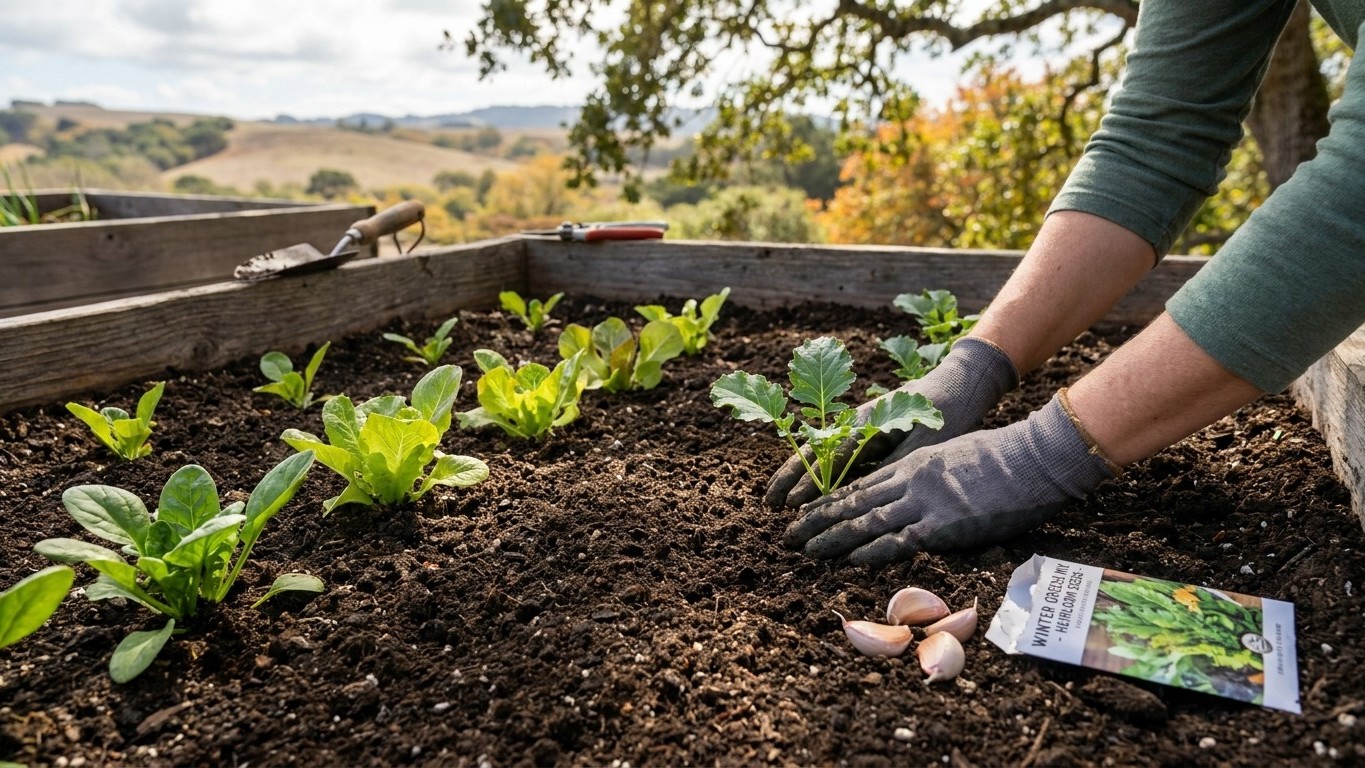

October is prime planting season across most of California. Along the coast and in Southern California, where no freeze occurs in an average year, gardeners keep sowing cool-season vegetables and set out native perennials with no frost date to dodge. In the Central Valley foothills and the Sierra, first frost is closer, so the window narrows to hardy greens, alliums and peas rather than anything tender.
What goes in the ground in October

The decision here comes down to soil temperature and elevation, not a date on a calendar. Coastal and Southern California stations show zero days at or below 32 F across three decades of records, with a frost-free season effectively running the full year (NOAA NCEI 1991-2020 Climate Normals). That means the constraints for those gardeners are heat, drought and water restrictions, not frost timing. But Northern California, the Central Valley floor and especially the Sierra foothills do freeze, sometimes as early as this month, so the same crop list does not apply statewide.
Where frost is not a factor, October direct-sows well: lettuce, spinach, arugula, kale, chard, broccoli, cauliflower and cabbage all settle into soil that is still warm from summer while air temperatures drop enough to keep them from bolting. Carrots, beets, radishes and turnips go in as root crops with plenty of season left. Garlic and shallots belong in the ground now almost everywhere in the state, since both need the cool months ahead to build roots before bulbing in late spring. Sweet peas and English peas can be direct-sown as nights cool.
October also happens to be the state’s best month for planting natives, shrubs and young fruit trees, because the cool season ahead lets roots establish without summer heat stress, particularly in years when fall rain arrives on schedule. Gardeners in the Sierra or higher foothills, closer to USDA zone 5a-6a conditions, should shift that list toward frost-tolerant crops only and consider row covers or cold frames if a first freeze looks close.
| Region | Frost status | Best October plantings |
|---|---|---|
| Coastal & Southern CA | Frost-free in an average year | Greens, root crops, alliums, natives, peas |
| Central Valley | Occasional light frost by late fall | Same list, watch soil temps closing in on frost |
| Sierra & higher foothills | First frost can arrive this month | Garlic, hardy greens, peas; cover tender starts |
What to start under cover
The arithmetic for starting seed indoors depends on where in the state you garden, not on a fixed October date. Along the frost-free coast and south, the count backs off from the point where summer heat finally breaks rather than from a freeze, since there isn’t one. In the Sierra and higher foothills, count backward from the local first fall frost: seedlings need roughly six to eight weeks of growth before they go outside, so if frost is approaching, this is close to the last practical starting point for anything meant to be transplanted this season.
Trays and flats are the right place right now for succession batches of lettuce and brassicas, so there’s always a next round ready when the current bed is harvested. Onions grown from seed for spring bulbing also do well started under cover this month, giving them a long head start before they go into the ground.
Two mistakes show up every year. Starting too early in warm coastal or valley conditions produces leggy, rootbound plants sitting in trays too long because the ground outside is still occupied by summer crops. Starting too late in the mountains means seedlings never size up before the ground locks into frost, leaving nothing worth transplanting. Matching the sowing date to your own elevation, not a statewide average, is what separates the two outcomes.
What is ready to pick
October harvest in California often means two seasons overlapping in the same bed. Late tomatoes, peppers, winter squash and melons are finishing their run just as the first fall greens sown in late summer become ready to cut. Winter squash is ready when the rind resists a thumbnail press and the stem has dried and hardened; in the Sierra and foothills, get it in before the first frost, since a hard freeze on the vine shortens its storage life.
Tree fruit rounds out the month in much of the state: apples, pears, persimmons and pomegranates are commonly at or near peak in October depending on variety and region. Where garlic and onions were harvested and cured earlier in the season, this is a good month to go through storage and pull anything showing a soft spot or sprouting early, before it spreads to the rest of the batch.
Cut-and-come-again greens sown in late summer, lettuce, arugula, chard, keep producing through the month with light, regular harvesting rather than one large cut. Checking stored crops weekly rather than monthly catches problems while they’re still limited to a single bulb or squash instead of a full bin.
The jobs that matter this month
Soil preparation now pays off before winter rains arrive: working compost into beds ahead of the season’s first real moisture lets it break down and feed the soil rather than sitting on top, dry, until spring. Mulching serves two purposes at once this time of year, holding moisture as irrigation tapers off and buffering soil temperature swings between warm days and the season’s first cool nights.
Staking and support for fall crops that will grow tall, peas especially, needs to happen before the vines sprawl and tangle, since untangling them later damages roots. Irrigation rhythm should shift as evapotranspiration drops with shorter days; the mistake most gardeners make is leaving summer’s watering schedule running on autopilot into a month when plants simply need less.
Pest scouting matters more in October than it gets credit for. Cabbage worms and aphids find new brassica transplants fast, and catching an infestation on a two-week-old seedling is far easier than after it’s colonized the whole bed. Clearing spent summer vines, especially anything that showed disease, reduces the amount of overwintering pathogen sitting in the bed through winter.
California’s fire season overlaps with October in much of the state, so clearing dry vegetation and maintaining defensible space around structures belongs on this month’s list alongside garden chores, particularly for foothill and rural properties. For gardeners in colder pockets already thinking about dormancy, this is also the month to order bare-root fruit trees and cane fruit for winter planting, sharpen and clean tools before storage, and turn compost piles one more time before cooler weather slows the process down.
What not to do in October
The most common mistake statewide is treating California’s mild fall as uniformly frost-free. It genuinely is along the coast and through the south, where records show no freeze in an average year. But applying that assumption to a Sierra foothill garden or a Central Valley cold pocket means tender warm-season starts get caught by a frost nobody planned for. Check your own elevation and recent local frost history rather than borrowing the coastal pattern.
Overwatering as temperatures drop is the second recurring problem. Soil that needed daily water in August holds moisture far longer in October, and a summer irrigation schedule left running into fall invites root rot in crops that don’t need that much water anymore.
Feeding fall crops with a high-nitrogen fertilizer at this point in the season pushes leafy growth at the expense of root and bulb development, exactly the wrong trade for carrots, beets, garlic and onions that need to be building underground right now. A balanced or lower-nitrogen feed suits this stage better.
In colder pockets, uncovering row covers or cold frames too early after a stretch of mild weather is a classic error. A single warm week doesn’t mean frost season is over, and tender transplants left exposed after an early uncovering can be lost to one cold night that follows right behind it.
Checking this against your own county
A statewide October guide is a starting point, not an instruction sheet, especially in a state that spans USDA hardiness zones 5a through 11a. Elevation changes frost timing by weeks over a short drive, coastal fog moderates temperatures that inland valleys don’t get, and the gap between Northern California and the far south can mean entirely different planting windows in the same month. Before committing a bed to any of the crops above, check current conditions and planting guidance through the University of California’s statewide extension service at ucanr.edu, which breaks recommendations down by county and region.
Common questions
Does it ever frost in Southern California in October?
Records for the region show no days at or below 32 F in an average year, with the frost-free season effectively covering the full calendar. Gardeners there plan around heat and water availability rather than frost.
Can I still plant tomatoes in October in California?
In frost-free coastal and southern areas, warm-season transplants can sometimes continue, but soil is cooling and days are shorter, so growth slows and yields drop compared with spring planting. In the Central Valley and Sierra, October is past the window for new tomato transplants; the focus shifts to cool-season crops instead.
Is October too late to plant garlic in California?
No. October is close to the ideal window in most of the state, giving garlic enough cool-season time to establish roots before it needs to bulb up in late spring. Waiting much longer shortens that root-establishment period.
Why does the same month look so different across California?
The state spans USDA hardiness zones 5a to 11a, an unusually wide range for one state, driven mainly by elevation and distance from the coast. A coastal garden and a Sierra foothill garden can be dealing with entirely different frost realities in the same week of October.