
California potato patches face a short but real pest list, and where you garden decides most of it. UC Agriculture and Natural Resources documents pests that feed on potato foliage, roots and tubers across the state, but coastal and Southern California gardens run frost-free while the Central Valley, Sierra foothills and Northern California freeze most winters. That climate split changes which pests overwinter, how fast they build up, and when to start checking leaves and soil.
Which pests attack potato in California

UC Agriculture and Natural Resources documents eleven pests across California’s home vegetable gardens: aphids including the melon aphid, brown garden snail and slugs (Cornu aspersum), corn earworm (Helicoverpa zea), cucumber beetles, earwigs, leaffooted bugs, root-knot nematodes, spider mites, stink bugs, tomato hornworm (Manduca sexta and quinquemaculata), and whiteflies. That’s the full list UC ANR tracks for the state’s gardens, and it spans many different crops, not just potato.
Sort through it and the potato-relevant pests narrow fast. Corn earworm targets developing corn ears and occasionally tomato fruit; it has no reason to visit a potato hill where there’s no ear or fruit to bore into. Cucumber beetles are cucurbit specialists, drawn to squash, melon and cucumber blossoms, not potato foliage. Leaffooted bugs feed on developing fruit, tomatoes, pomegranates, nuts, a texture and target potato plants don’t offer. Stink bugs share that same preference for ripening fruit and pods, which rules them out of a crop grown for its underground tubers.
That leaves seven pests actually worth watching in a California potato patch: aphids (including the melon aphid), brown garden snail and slugs, earwigs, root-knot nematodes, spider mites, tomato hornworm, and whiteflies. Root-knot nematodes are the one to take most seriously, because they attack the tuber itself, not just the leaves, and by the time stunted plants show up above ground the damage below is already done. Tomato hornworm belongs on this list because potato is a solanaceous crop like its more familiar cousin, and the caterpillar strips foliage from both with the same appetite.
Earwigs are the pest gardeners most often blame for damage they didn’t cause. They feed on soft seedling tissue and new sprouts, but a mature potato plant with tough foliage rarely interests them. The decisive move is checking which growth stage, tender seedling or mature plant, is actually chewed before assuming earwigs are to blame, because several other pests on this list leave similar-looking holes.
When each one shows up, and what it does first
Timing in California potato patches splits along the same line that defines the state’s climate: coastal and Southern California gardens are frost-free, so pest pressure follows the local irrigation and heat calendar rather than a spring freeze date. Northern California, the Central Valley and the Sierra foothills freeze most winters, which pushes planting later and compresses the pest calendar into one warm stretch.
Aphids, including the melon aphid, are usually the first sign of trouble, clustering on the undersides of young leaves within the first weeks after sprouts break the soil surface and leaving a sticky honeydew residue that sooty mold later colonizes. Spider mites follow a similar early timeline but favor hot, dry weather, so they build up fastest once the canopy fills in and daytime heat climbs, tiny stippled or bronzed patches on leaves are the first clue.
Brown garden snail and slugs work at the other end of the clock. They feed at night or in early morning, so ragged holes in leaves that appear overnight with no insect in sight during the day are the signature, and they’re most active right after irrigation or rain keeps the soil surface damp. Earwigs follow that same damp, dark preference and target the softest new growth right after emergence, before foliage toughens.
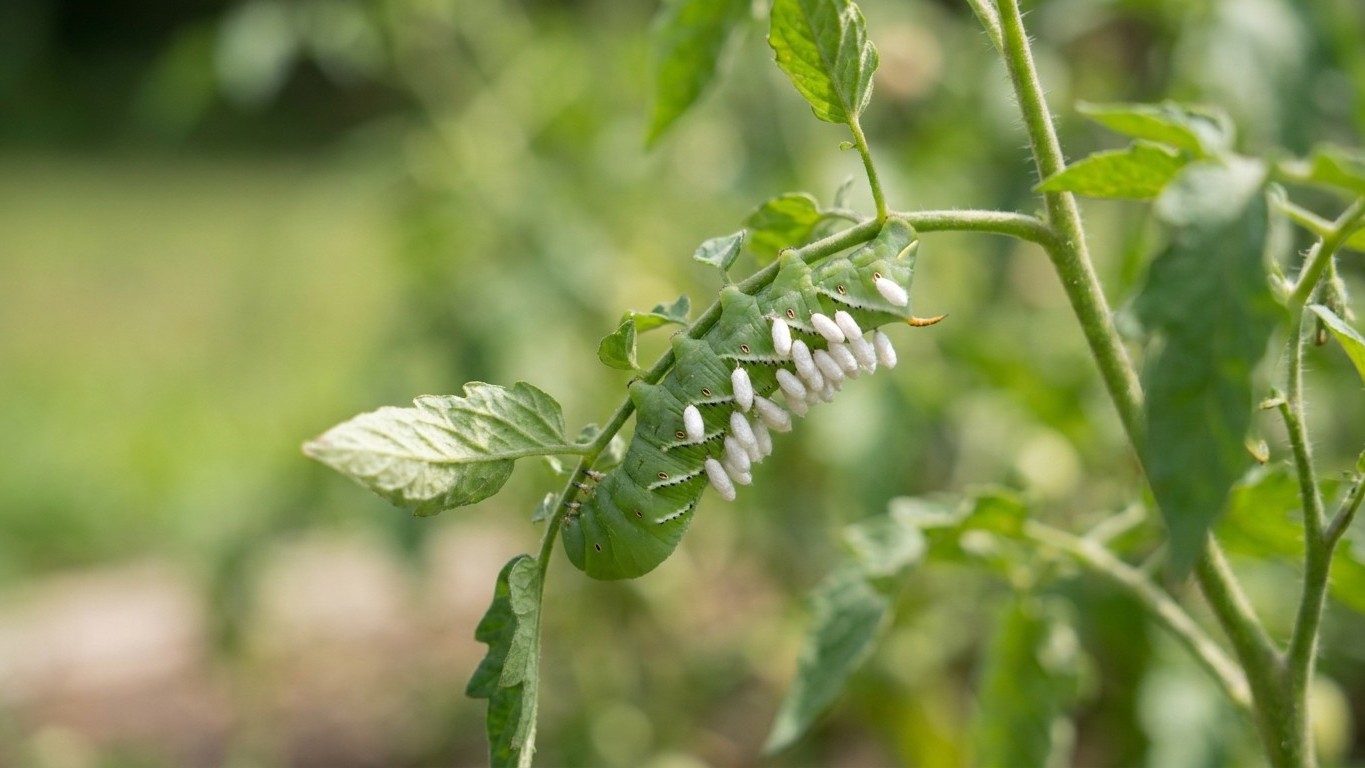
Tomato hornworm shows up later, once plants have built a full canopy, and the first evidence is usually dark droppings on leaves below a stripped section, the caterpillar itself is often harder to spot than the damage it leaves overnight. Whiteflies build up gradually through the warm months; the first sign is a small cloud of tiny white insects fluttering up when a leaf is disturbed, followed by yellowing and honeydew.
Root-knot nematodes give no early warning above ground, the first visible clue is a general lack of vigor, stunted or wilted plants during the heat of the day, that mimics drought stress. By the time galled, misshapen tubers turn up at harvest, the population has already been building in the soil for a full season.
Telling the damage apart from Everything else
Not every ragged leaf or stunted plant in a California potato patch is a pest. Heat stress, uneven irrigation and simple nutrient shortages produce symptoms that look a lot like insect damage, and treating for a bug that isn’t there wastes a growing season that’s often shorter than gardeners think.
| What you see | Possible pest cause | What actually distinguishes it |
|---|---|---|
| Stippled, bronzed leaves | Spider mites | Fine webbing on leaf undersides; tap a leaf over white paper and look for tiny moving specks |
| Ragged holes, chewed edges overnight | Brown garden snail and slugs | Silvery slime trails on soil or leaves; damage present in the morning with no insect visible by day |
| Sticky residue, curled new leaves | Aphids or whiteflies | Visible clusters on leaf undersides; whiteflies flutter up when disturbed, aphids don’t |
| Stunted, wilted plants despite regular watering | Root-knot nematodes | Confirmed only by digging a plant and checking roots and small tubers for knots or galls |
| Stripped foliage, dark droppings on leaves | Tomato hornworm | Caterpillar frass on lower leaves even when the caterpillar itself is hard to find |
Some of the most common look-alikes have nothing to do with insects at all. Yellowing between leaf veins while the veins stay green usually points to a nutrient shortage, not a pest, and no amount of pest control fixes that. Wilting in the afternoon heat that recovers by evening is often drought stress rather than nematode damage; the overnight recovery is the tell. Irregular brown blotches that spread across a leaf, rather than starting as chewed holes, usually point to a fungal or bacterial disease. Torn or bruised stems near the soil line, with no chewing pattern, more often trace back to a hoe, a stake or foot traffic than to any pest on this list.
None of these signs replace an actual look at the plant in front of you, and when damage doesn’t clearly match one pattern, that’s the moment to bring a sample, or a clear photo, to a local extension office rather than guessing.
What actually works here, and what is a waste of time
California’s growing season length, frost-free on the coast and in the south, freezing in the north, Central Valley and Sierra foothills, shapes which controls are worth the effort. On a short season, timing and physical barriers do more work than any spray, because a pest population that peaks after tubers are already sizing up doesn’t need chasing.
Physical barriers stop the two pests that do the most damage before they start. Copper tape or a ring of coarse, sharp material around young plants keeps brown garden snail and slugs off soft new growth, and it works best installed at planting, before leaves emerge, rather than after damage is already visible. Handpicking snails, slugs and hornworm caterpillars in early morning or evening, when they’re active and visible, removes them without any product at all, and for a small home garden it’s often enough on its own.
Row covers protect seedlings from earwigs and early aphid colonization, but they need to come off once plants flower, or they’ll block Pollination. Consistent, even irrigation does double duty: it reduces the plant stress that draws in aphids and spider mites, and it keeps soil moisture steady enough that root-knot nematode symptoms don’t get confused with drought stress.
What wastes time is spraying on a calendar instead of on a symptom. Broad treatments applied before a pest is actually present kill off the natural predators, ladybugs and lacewings among them, that would otherwise keep aphid and spider mite numbers in check, which often makes the next generation worse, not better. Root-knot nematodes can’t be treated after the fact in a home garden bed at all; the real leverage is rotating out of solanaceous crops for a season and starting the next planting with certified, disease-free seed potatoes rather than pieces saved from a previous harvest. Any product decision beyond these physical and cultural steps belongs to a local extension office, which knows what’s actually registered for use in California this season.
Where to check this for your own county
UC Agriculture and Natural Resources is the authority behind every pest named on this page, and its county-level Cooperative Extension offices are where a statewide list turns into an answer for one specific garden. A pest documented for California overall doesn’t mean it’s active in a particular yard this month; presence shifts block by block depending on microclimate, irrigation and what’s growing next door.
The single most useful step before treating anything is calling or visiting the county extension office and describing, or bringing in, the actual damage, rather than matching a symptom to a list from a website. Extension staff and Master Gardener volunteers see what’s active in that specific county in real time, which is information no statewide page can offer.
The frost-free coast and Southern California, and the freezing Central Valley, Sierra foothills and Northern California, aren’t just different climates, they’re different pest calendars. A county office in a frost-free coastal area tracks pressure that builds continuously through a long warm season, while a Central Valley or foothill office tracks a shorter, more compressed window bounded by winter freezes. Neither pattern applies uniformly across the state, and a gardener an hour’s drive from either reference point can see meaningfully different timing.
Bringing a physical sample, a damaged leaf, a few insects in a sealed container, gets a faster and more accurate answer than a description alone. Most county offices also keep current guidance on what’s registered for use in California, which changes over time and isn’t worth guessing at from a general gardening page. Start there before buying anything.
Common questions
Do all California gardens need to worry about the same potato pests?
No. UC Agriculture and Natural Resources documents these pests statewide, but frost-free coastal and Southern California gardens run a longer, continuous pest season, while the Central Valley, Sierra foothills and Northern California see pest activity compressed into a shorter, frost-bound window.
Can saved potato pieces from last year’s harvest be replanted?
Uncertified seed potatoes carry a real risk of virus, since disease can persist in the tuber without obvious symptoms. Starting each planting with certified seed potatoes avoids introducing a problem that no pest control step can fix later.
Is it worth spraying preventively before any pest is visible?
Generally no. Treating before a pest is confirmed present tends to remove the natural predators, like ladybugs and lacewings, that keep aphids and spider mites in check, which can make the next generation of pests worse rather than better.
What’s the fastest way to confirm root-knot nematode damage?
Above-ground symptoms, stunted or wilted plants, look like drought stress and give no clear early warning. The only reliable confirmation is digging up a plant and checking the roots and small tubers directly for knots or galls, ideally with help from a county extension office.