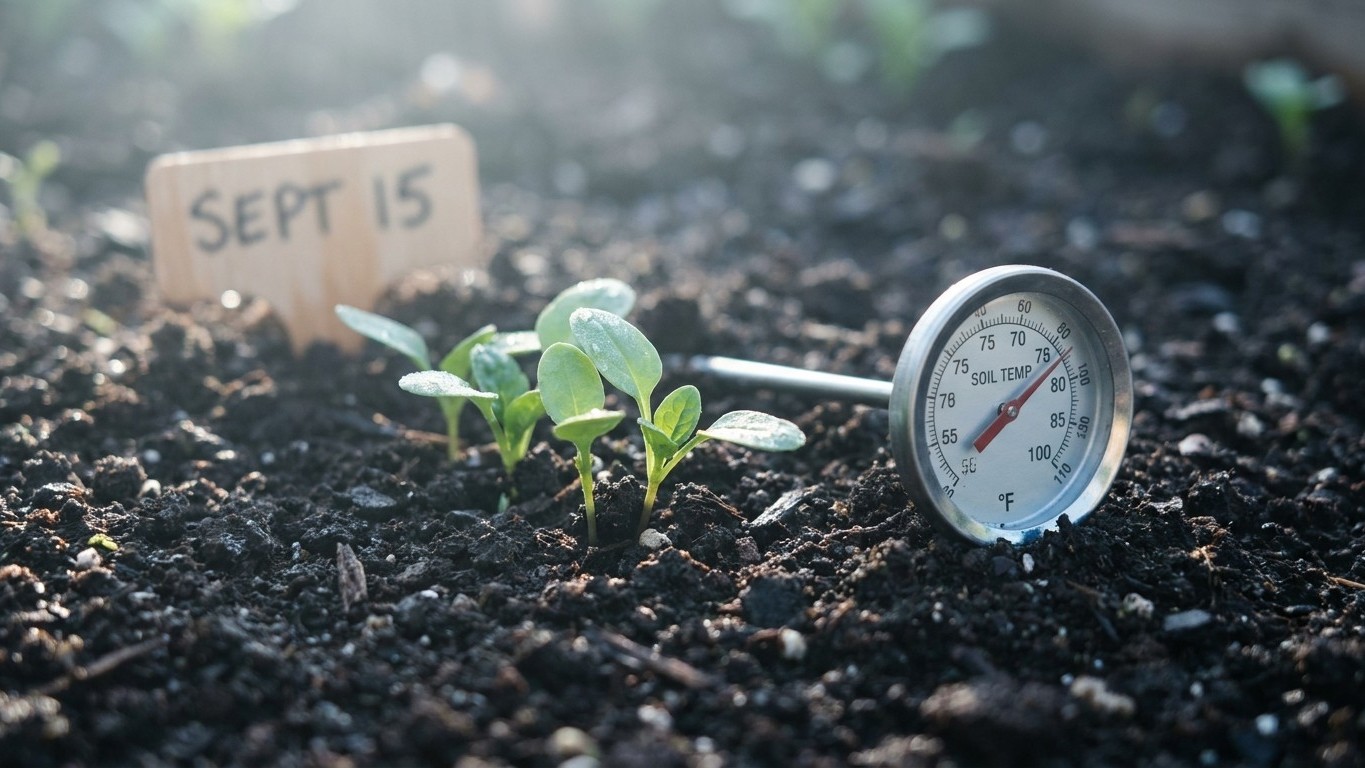

In coastal and Southern California, autumn spinach goes in the ground once soil temperatures fall back below 80°F, typically in September or October, counted 50 to 75 days ahead of the winter harvest date you want. This region almost never freezes, so the sowing window isn’t set by frost at all. It’s bounded by warm soil on one side and by the return of long, bolt-triggering days on the other.
The short answer
At the reference station near Los Angeles, the longest day of the year delivers 14 hours and 16 minutes of daylight. That figure does more work than most transplanted gardeners expect, because spinach bolts under long days almost as reliably as it bolts under heat. A mild coastal summer here doesn’t buy extra growing weeks. Day length alone is enough to push the plant into flower, whether or not the thermometer ever gets uncomfortable.
That’s the detail that trips up people who moved from a colder climate expecting California’s mild coast to be forgiving on cool-season crops. It isn’t heat that shuts spinach down here. NOAA’s climate normals put the mean number of days reaching 90°F or higher at just 2.4 per year at the reference station, which is a trivial heat load by national standards. Summer along this stretch of coast rarely gets brutally hot. But the calendar keeps moving regardless of temperature, and once daylight stretches past roughly 14 hours, spinach starts flowering on schedule.
So the honest answer to what limits spinach here is day length, not heat. That’s a useful distinction because it changes how you plan. If heat were the obstacle, shade cloth or a partly shaded bed might stretch the season. Day length doesn’t respond to shade cloth. The plant is reading the clock, not the thermostat, and no amount of afternoon shade changes how many hours of light fall on the garden between sunrise and sunset.
Inland California is a different story, and it’s worth saying plainly rather than blending the two together. The Central Valley and interior valleys run far hotter summers than the coastal station referenced here, so gardeners there are fighting both drivers of bolting at once: long days and genuinely severe heat stacked on top of each other. Along the coast and through the Los Angeles basin, day length alone does most of the damage, and the mild summer temperatures are almost beside the point. That’s a subtle but important difference if you’re comparing notes with a gardening friend two hours inland.
How long the spring window really is
Standard guidance for spinach is to sow it 2 to 3 weeks before the last spring frost, since the seedlings tolerate cold better than heat. Working that rule against the actual climate record for coastal and Southern California produces a strange result, and it’s worth walking through step by step.
- Find the frost date to count back from. NOAA’s 1991-2020 climate normals for the reference station near Los Angeles record no computable frost date at all. Thirty years of daily records show zero days at or below 32°F, and the frost-free season is listed as the full 365 days of the year. There is no last-frost date here to subtract two or three weeks from, because there’s no first frost to begin with.
- Recognize what that removes as a constraint. In a location with a real frost date, the start of the spring window is fixed by the calendar and can’t move earlier without risking a freeze. Along this coast, that boundary simply doesn’t exist, so the earliest sowing date is set by soil workability and gardener patience rather than by any risk of frost damage.
- Apply the heat ceiling instead. Spinach grows well only where temperatures stay under 75°F, and that threshold is also where bitterness starts creeping into the leaves. With mean days above 90°F sitting at just 2.4 per year at the reference station, the region has long stretches of the cool season where daytime temperatures comfortably stay under that ceiling.
- Add the day-length limit back in. Even without frost and without much extreme heat, daylight still climbs toward the 14-hour-16-minute mark as spring advances, and that alone triggers bolting regardless of temperature.
- Put it together. The practical result is a spring window that runs through the heart of winter and into early spring, considerably longer and earlier than in a location bound by an actual last-frost date, closing only when lengthening daylight starts pushing the crop toward flower.
The autumn crop, and when the soil lets you sow
Fall is where coastal and Southern California spinach growing gets interesting, because the obstacle flips entirely. Instead of frost ending the season, two separate mechanics govern when autumn sowing actually works.
The soil is still too warm
Utah State University Extension notes that spinach seed germination drops off once soil temperatures climb above 80°F, and that’s the real gatekeeper for a fall crop here. Air temperatures along the coast rarely spend many days above 90°F, averaging only 2.4 such days a year at the reference station, but soil holds heat longer than the air does. Late summer soil in this Mediterranean climate can sit warmer than the mild air temperatures suggest, which means gardeners often need to wait past the point where the weather itself feels cool enough for fall planting. Checking soil temperature directly, rather than trusting the air, is the more reliable move.
Utah State University Extension also names four spinach varieties commonly grown for fall crops: Bloomsdale, Melody, Teton, and Olympia. The extension publishes no comparative data on their days to maturity, bolt resistance, or heat tolerance, so there’s no basis here for recommending one over another. What matters more than variety choice is timing the sowing to when soil has actually cooled.
The frost that ends the season
In most of the country, fall spinach planting is scheduled backward from the first frost, since that freeze eventually kills the crop. That calculation doesn’t apply along this coast. The same NOAA climate normals that show no last-frost date in spring also show no first-frost date in fall: zero freezing days across three decades of records at the reference station. The autumn season isn’t ended by frost here at all.
What ends it instead is the calendar working in reverse. The only planting guidance published by Utah State University Extension for a fall harvest is to sow 50 to 75 days before the date you want to pick the crop. Aim for a harvest during the shortest, coolest days, roughly the December-January stretch, and counting back 50 to 75 days lands sowing in September or October, right around when late-summer soil finally drops back below that 80°F germination ceiling. Miss that soil-cooling window and germination struggles regardless of how mild the air feels.
Common questions
Does Southern California ever get a frost that kills fall spinach?
Not according to the climate record. NOAA’s 1991-2020 normals for the reference station show zero days at or below 32°F across thirty years, with the frost-free season listed as the full year. Fall spinach here isn’t ended by freezing weather at all.
Can spinach be grown through summer along the California coast?
No. Even though summer heat is mild by national standards (averaging only 2.4 days a year above 90°F at the reference station), summer daylight reaches 14 hours and 16 minutes on the longest day, well past the point where day length alone triggers bolting.
Is Northern California or the Central Valley governed by the same rules?
No, and generalizing the Los Angeles-area data statewide is a mistake. Northern California, the Central Valley, and the Sierra foothills experience real winter freezes that the coastal and Southern California record doesn’t show, and Central Valley summers run far hotter than the 2.4 days above 90°F seen at the coastal reference station.
How exactly should I time a fall sowing?
Utah State University Extension’s only published rule is to sow 50 to 75 days before your target harvest date. For a harvest during the cool, short days of winter, that points to a September or October sowing, once soil temperature has dropped back under the 80°F mark that limits germination.