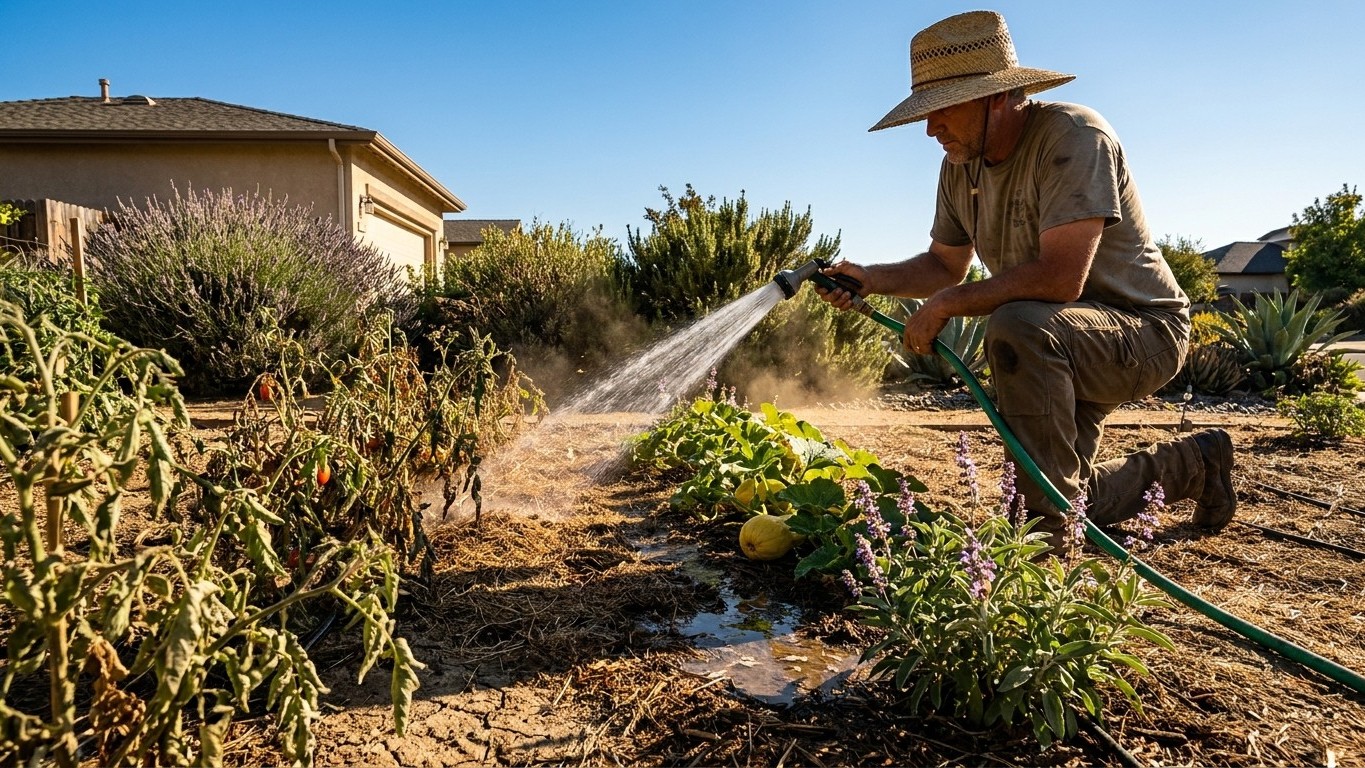

California’s summer weather leaves almost nothing for a garden to drink, and the sun makes up the difference fast. At the Los Angeles reference station, days of 90F or hotter average only 2.4 a year, but that number hides a huge state: inland and desert gardens bake far longer, while coastal beds stay mild. What every California gardener shares is a summer with essentially no rain to count on and a watering schedule that has to fill the gap alone.
What the climate asks of you

Start with what the data actually says about heat here: at the Los Angeles reference station, the average is 2.4 days a year at 90F or above (NOAA NCEI Climate Normals, 1991-2020). That’s a mild number, and it belongs to a coastal station, not the whole state. Inland valleys and desert gardens run through stretches of 90F-plus weather that a coastal number like this doesn’t capture at all, so treat 2.4 as a floor, not a ceiling, for how hot your own yard gets.
The second figure that matters isn’t a rainfall total. It’s the frost record: at the same reference station, NOAA’s 30 years of daily data show zero days at or below 32F, and the frost-free season is listed as the full 365 days. Coastal and Southern California gardens simply don’t freeze in an average year. That single fact reorganizes the whole growing calendar. There’s no last-frost date to wait out in spring and no first-frost date to race against in fall. The limits on what you can grow, and when, come from heat and water instead.
That’s the real shape of a California summer for a garden: virtually no rain to rely on, heat that ranges from mild near the coast to intense inland, and no frost window forcing a pause. A garden bed generally wants around an inch of water a week during the growing season, and that need only intensifies for anything grown in pots, since Watering Pots and Containers in California demands even closer attention than in-ground beds. In a California summer, the sky isn’t supplying meaningful amounts of that inch, in most of the state, in most weeks. Watering Through a Dry Spell in California becomes a matter of routine rather than exception, and the gardener is the irrigation system, full stop, with the only real variable being how much heat your particular yard has to answer for.
Why the reference city matters
The USDA Plant Hardiness Zone Map puts California anywhere from zone 5a to zone 11a, one of the widest ranges of any state (USDA Plant Hardiness Zone Map, 2023, based on 1991-2020 normals). A zone number picked at random off that range tells you almost nothing. A Los Angeles garden and a Sierra foothill garden aren’t playing the same game, even though they’re both “California.” Check your own zone before you plan watering or planting around any statewide figure, and lean on your local UC Cooperative Extension office for a number tied to your actual location.
How much, how often
Deep and infrequent beats shallow and daily, every time. A quick daily sprinkle wets the top inch of soil and nothing else, which trains roots to stay near the surface, right where the sun bakes them hardest. A long, slow soak that reaches six to eight inches down pushes roots deeper, into soil that stays cooler and holds moisture longer between waterings. That depth is also what buys you the flexibility to skip a day when the heat isn’t extreme.
The test for whether it’s time to water isn’t the calendar, it’s the soil. Push a finger, or better, a trowel, two inches into the ground near the plant’s base. Dry at that depth means water now. Still damp means wait. This single check does more to prevent both underwatering and the overwatering that rots roots than any fixed schedule ever will.
Soil texture changes the math on top of that. Sandy soil drains fast and holds little, so it needs shorter, more frequent soakings to keep up. Heavy clay holds a week’s worth of water in reserve, but watering or working it while it’s already wet suffocates roots and compacts the structure, sometimes for a full season. Know which one you’re standing on before you set a schedule. With a summer that delivers close to no rain in its driest stretch, no California garden is coasting on the sky. Every garden here is on irrigation, and the only question is how deep and how far apart.
- Check soil moisture two inches down with a finger or trowel before deciding to water at all.
- Water early in the morning, while it’s cool, so less is lost to evaporation before it reaches the roots.
- Apply water slowly and directly at the base of the plant, never over the leaves, until it reaches six to eight inches deep.
- On sandy soil, water more often in shorter sessions; on heavy clay, water less often and let it dry between soakings.
- Skip a scheduled watering entirely if the soil is still damp at root depth, no matter how many days have passed.
Restrictions and rules
Watering restrictions are common across California, and they change with drought conditions, season, and local water supply, sometimes year to year. Some water districts limit outdoor watering to specific days of the week, others cap the hours you’re allowed to run a sprinkler, and some restrict hose-end watering without a shutoff nozzle. None of that is fixed statewide, and none of it should be assumed from a neighboring town’s rules.
Given how little rain falls in a typical California summer, restrictions here are more likely than in wetter states, and worth checking before you set a timer or plan an irrigation zone. The right move is contacting your local water provider directly, since they publish the current rules for your specific service area, not a statewide blanket policy. Your local UC Cooperative Extension office can also point you toward district-specific guidance and drought status for your county.
Don’t build a watering routine around a rule you read somewhere online without confirming it applies to your address. A schedule that was legal last summer may not be this summer, and a schedule that’s fine in one county may be a violation two towns over.
Using less
Cutting water use in a California garden isn’t about watering less carefully, it’s about losing less of what you already apply. A few techniques do most of the work, and they stack, so combining them matters more than picking a favorite.
- Mulch: a two to three inch layer over the root zone slows evaporation dramatically and keeps soil temperature more even, which means less frequent watering to hit the same depth.
- Drip irrigation: water goes straight to the root zone instead of the air or the pathway between plants, cutting the waste that sprinklers lose to wind and evaporation.
- Grouping plants by water need: putting thirsty vegetables together and drought-tolerant natives together means you’re not overwatering the natives just to satisfy the vegetables on the same zone.
- Organic matter in the soil: compost worked into sandy soil helps it hold moisture longer, while the same compost worked into clay helps it drain better, closing the two extremes toward the middle.
- Rain barrels, where local rules allow them: an inch of rain falling on a thousand square feet of roof produces roughly 600 gallons of runoff. In California, that math only pays off if you catch it during the wet season, because a summer that delivers close to no rain means a barrel filled in July won’t refill itself. Store what falls in winter and stretch it into the dry months, rather than counting on it to fill again once summer starts.
Common questions
Does California ever get a frost that affects summer watering plans?
At the Los Angeles reference station, NOAA’s 30-year record shows zero days at or below 32F, with a frost-free season listed as the full year. Coastal and Southern California gardens don’t deal with frost at all. Northern California, the Central Valley, and the Sierra are a different story and do freeze, so that generalization stops well short of the whole state.
How do I know if my soil is sandy or clay?
Squeeze a handful of moist soil in your fist. Sandy soil falls apart the moment you open your hand. Clay stays balled up and feels sticky or slick. Loam, the middle ground most gardeners hope for, holds a loose shape but crumbles with light pressure.
Is 2.4 days above 90F really typical for all of California?
No. That figure comes from the Los Angeles reference station and reflects a mild coastal climate. Inland valleys, the Central Valley, and desert regions of the state run far hotter for far longer stretches each summer, so check conditions for your specific area rather than applying a coastal number statewide.
Where do I find the actual watering rules for my address?
Contact your local water district or utility directly, since restrictions are set locally and change with drought status. Your local UC Cooperative Extension office can also help point you to the current rules and drought resources for your county.