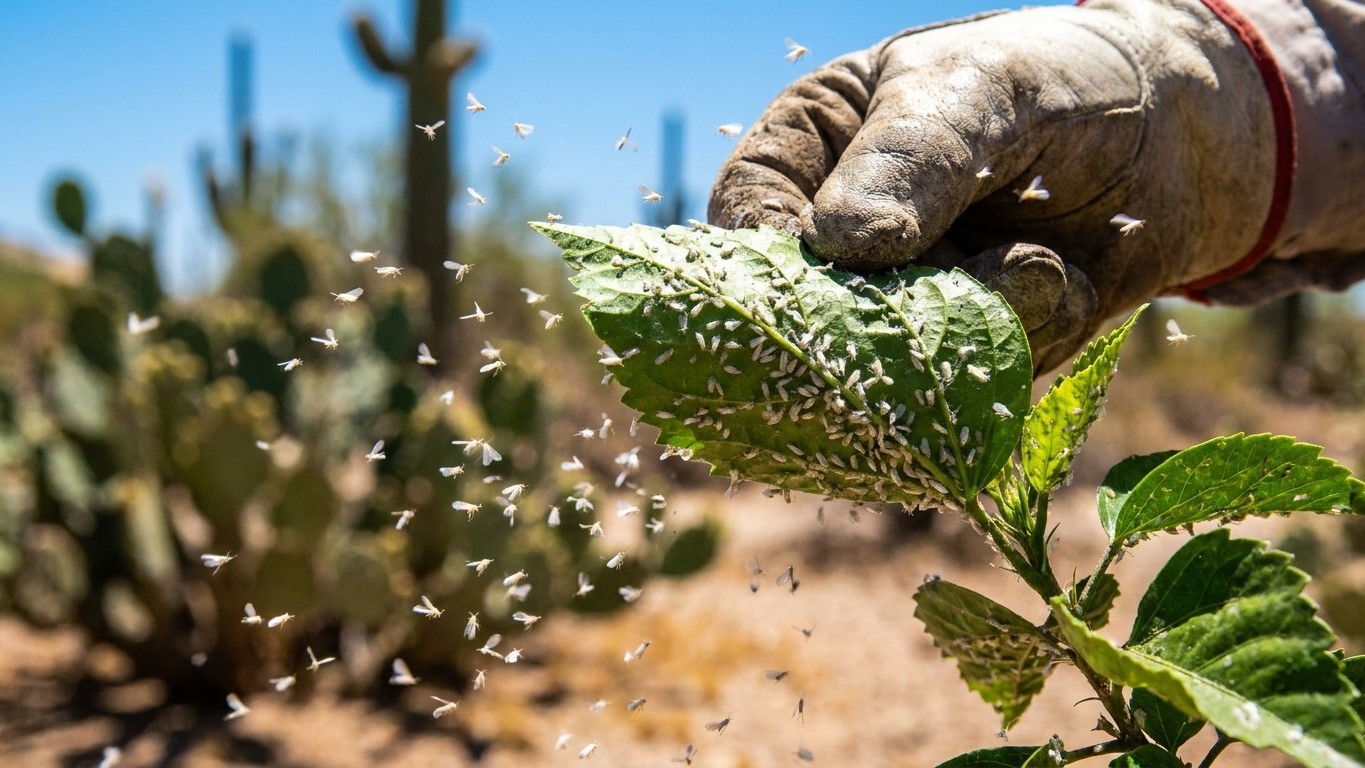

Whiteflies start turning up in Arizona’s low desert as early as March, but the population explosion that homeowners actually notice hits between June and September, when daytime highs sit above 100°F and the pest’s life cycle shrinks to barely two weeks. Stopping them means catching the nymphs before they mature, picking landscape plants that don’t invite an infestation, and layering physical controls with targeted treatments rather than reaching for one spray and hoping.
When Whiteflies Show Up in Arizona

The species behind almost every Arizona whitefly complaint is Bemisia tabaci, known locally as the sweetpotato whitefly or silverleaf whitefly. It’s a tiny insect, barely 1/16 inch long, with a dusty white wing coating that makes clouds of them lift off a shaken hibiscus bush like snow falling in reverse. Greenhouse whitefly shows up occasionally in shaded nurseries and cooler microclimates, but in yards and fields across the state, it’s the sweetpotato whitefly doing the damage.
Warm weather is the trigger. Eggs hatch faster, nymphs mature faster, and adults reproduce faster once temperatures climb into the 80s and 90s. At those temperatures, a whitefly can go from egg to breeding adult in 16 to 18 days. Compare that to a six-week cycle in cooler spring conditions and it’s easy to see why a manageable handful of whiteflies in April becomes an unmanageable swarm by July. Populations typically peak from June through September, taper off as nights cool in October and November, and shrink to low, hard-to-notice numbers through December and January, though they rarely disappear entirely in the low desert.
That’s a key difference from many other regions of the country. In much of the eastern United States, a hard freeze wipes out outdoor whitefly populations every winter, forcing a restart each spring. Arizona’s low desert cities don’t get that reset often enough to matter.
Where They’re Worst: Low Desert vs. High Country
Elevation decides a lot here. Phoenix sits around 1,100 feet, Yuma closer to 140 feet, and Tucson around 2,600 feet. All three see winter lows that dip near freezing on occasion but rarely stay there long enough to kill an entire whitefly population sheltering on winter vegetables, citrus, or ornamental shrubs. That means the pest can limp through winter at low numbers and rebuild fast once spring arrives, rather than starting from zero.
Higher-elevation communities tell a different story. Flagstaff sits above 6,900 feet and Prescott above 5,300 feet, and both get hard, sustained freezes most winters. Outdoor whitefly populations in those areas get knocked out almost completely, so infestations there are mostly confined to greenhouses, indoor plants, or plants brought in from lower elevations. If you garden in Flagstaff or the White Mountains, whiteflies are a minor nuisance. If you garden in Phoenix, Tucson, Yuma, or the surrounding desert valleys, they’re a season-long management project.
There’s agricultural history behind how seriously Arizona takes this pest. In the early 1990s, an outbreak of the sweetpotato whitefly swept across Arizona and California’s desert farmland, driving crop losses into the hundreds of millions of dollars across cotton, melons, and vegetable fields. That crisis reshaped how the region approaches whitefly control, pushing growers and extension researchers toward integrated strategies that combine monitoring, biological control, and careful insecticide rotation instead of relying on a single chemical fix. Those same principles now guide backyard advice, too.
What Actually Stops Whiteflies
No single tactic clears out an established whitefly population on its own. The pest reproduces too fast and hides on the undersides of leaves, where sprays and predators alike have a harder time reaching it. Effective control in Arizona combines three layers: physical and cultural changes, biological allies, and selective chemical treatments used at the right moment.
Cultural and Physical Controls
Start with monitoring. Yellow sticky traps hung near vulnerable plants catch adult whiteflies and give an early warning before numbers spike, which matters because by the time leaves are visibly yellowing, the nymph population underneath is already well established. A strong jet of water aimed at the underside of leaves knocks nymphs loose and reduces their numbers without any chemical input, a method that works especially well on smaller ornamentals and vegetable transplants.
Reflective mulch, the kind wrapped in aluminum foil or metallic plastic sheeting, disrupts the way adult whiteflies navigate toward host plants and has a solid track record in Arizona vegetable gardens, particularly around melons, squash, and tomatoes. Avoid heavy nitrogen fertilizer on plants prone to whitefly problems; the soft, lush new growth that nitrogen produces is exactly what whiteflies prefer to feed on. And when a plant or section of a plant is heavily infested, remove and bag it rather than composting it, since eggs and nymphs can survive in a compost pile long enough to reinfest the yard.
Biological Controls
Parasitic wasps do a lot of the heavy lifting in Arizona’s whitefly management, both in commercial agriculture and in home landscapes that avoid broad-spectrum insecticides. Two species in particular, Encarsia formosa and Eretmocerus eremicus, lay their eggs inside whitefly nymphs and are available commercially for release in gardens and greenhouses. Lady beetles, lacewing larvae, and minute pirate bugs also feed on whitefly nymphs and eggs when given the chance.
The catch is that broad-spectrum insecticides, the kind that kill on contact and don’t discriminate between pests and beneficial insects, wipe out these natural predators right along with the whiteflies. That often triggers a rebound infestation within a few weeks, since the whiteflies reproduce faster than their predators can recover. Choosing more selective treatments protects the biological control that’s already working in the yard.
Chemical Controls, Used Selectively
For light to moderate infestations, insecticidal soap and horticultural oil remain the go-to options in Arizona extension guidance. Both work on contact, meaning they only kill what they actually touch, so thorough coverage of leaf undersides is non-negotiable and repeat applications every 5 to 7 days are usually necessary until numbers drop.
Systemic insecticides containing imidacloprid, applied as a soil drench around ornamental shrubs and trees, offer longer-lasting control because the plant absorbs the chemical and it moves through the tissue whiteflies feed on. The tradeoff is pollinator risk: these products should never be applied to plants in bloom, since the same systemic action that kills whiteflies also shows up in nectar and pollen. Insect growth regulators, which interrupt the nymph stage specifically rather than killing adults outright, are common in commercial production and available in some retail formulations for home use.
One more point worth knowing before reaching for any spray: Bemisia tabaci has a well-documented history of developing resistance to multiple insecticide classes, a pattern that emerged clearly during the 1990s outbreak and hasn’t gone away. Rotating between different modes of action, rather than using the same product repeatedly, helps slow that resistance and keeps treatments working longer.
Signs of Infestation and When to Act
The first clue is usually sticky. Honeydew, the sugary waste whiteflies excrete while feeding, coats leaves, patio furniture, and cars parked under infested trees. Left alone, that honeydew grows a black sooty mold that blocks sunlight from reaching the leaf surface, compounding the plant stress. Ants show up in unusual numbers too, drawn to the same honeydew.
Leaves that yellow, curl, or drop from a plant that otherwise looks healthy are another red flag, especially on hibiscus, citrus, lantana, and vegetable crops like tomatoes and melons, which rank among the sweetpotato whitefly’s preferred hosts in Arizona landscapes. Shake a suspect branch and watch what lifts off. A small cloud of tiny white insects taking flight is about as clear a diagnosis as this pest offers.
Late March, once desert daytime temperatures start settling into the 80s, is the practical window to hang the season’s first sticky traps and start checking leaf undersides on hibiscus and citrus. Catching the first generation before the summer heat accelerates their reproduction is the single most useful timing decision an Arizona gardener can make all year.