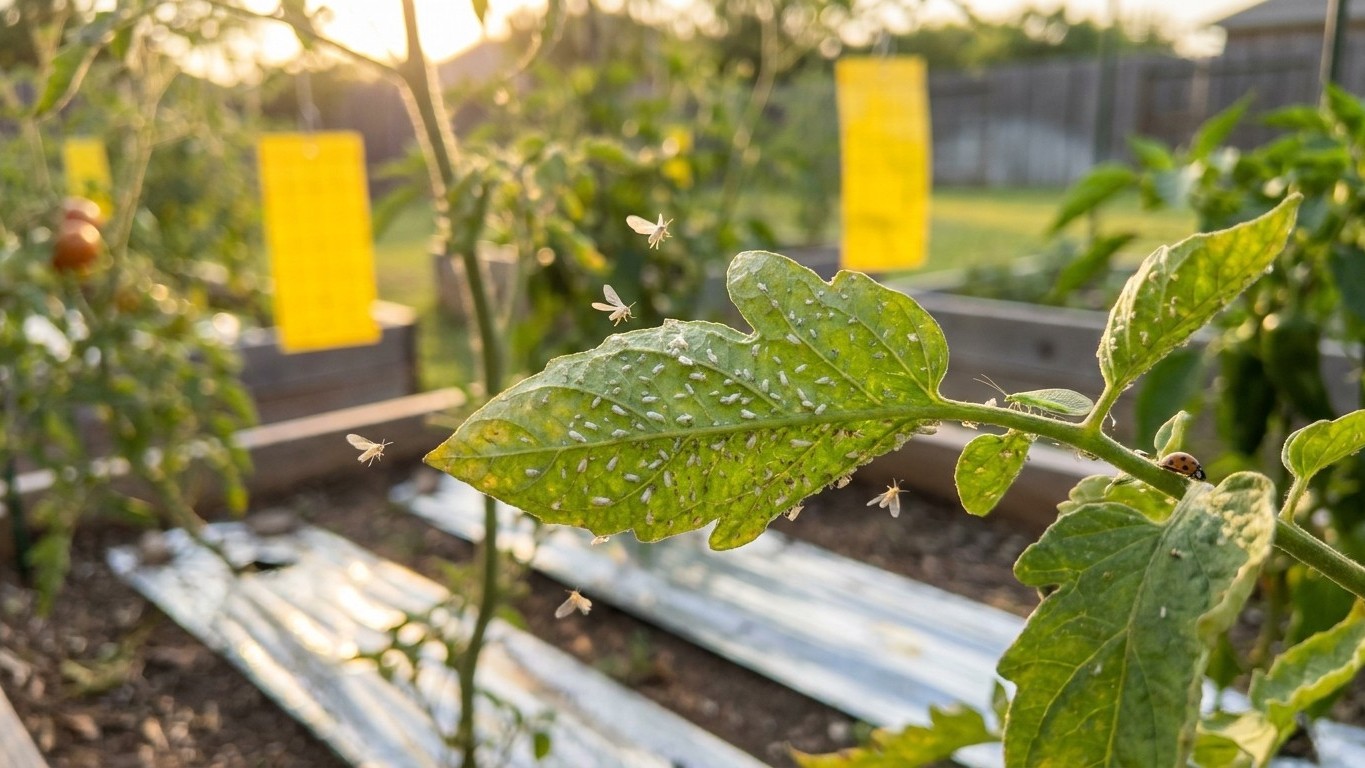

Whiteflies show up across Texas from early spring through late fall, with the heaviest pressure in the Rio Grande Valley, the Gulf Coast, and Central Texas between April and October. In the southern tip of the state, where winters rarely dip below freezing for long, populations never fully disappear. Stopping them means combining reflective mulch, yellow sticky traps, insecticidal soap or neem oil applied directly to the insects, and a healthy population of natural predators like lacewings and ladybugs. Broad-spectrum sprays tend to backfire because whiteflies build resistance fast and those chemicals also wipe out the bugs that would otherwise keep them in check.
When Whiteflies Actually Show Up in Texas

The species causing most of the trouble in Texas is Bemisia tabaci, commonly called the sweetpotato whitefly or silverleaf whitefly. Its timeline depends heavily on where you are in the state.
In the Rio Grande Valley and South Texas, mild winters let whiteflies overwinter on weeds, ornamentals, and volunteer crop plants. That means two peak windows each year: one from March through June, tied to cotton and vegetable planting, and a second from September through November as populations rebuild after the summer heat slows reproduction. Central Texas and the Hill Country see a similar pattern but compressed into April through October, with the worst outbreaks during the humid stretches of late summer.
Along the Gulf Coast, including the Houston and Beaumont areas, high humidity and a long growing season keep whiteflies active from spring into fall, often lingering on hibiscus and other ornamentals well into November. West Texas and the Panhandle get a shorter, drier season, generally June through September, concentrated on cotton and irrigated vegetable fields. A hard freeze below 28°F for several consecutive hours will knock populations back sharply in North Texas and the Panhandle, which is one reason those regions see less carryover damage from year to year than the Valley does.
Why Texas Is Prime Whitefly Territory
Warm temperatures speed up the whitefly life cycle. Eggs can hatch in under a week when conditions are right, and a full generation can complete in roughly three weeks during peak summer heat. That turnaround lets populations explode fast once a few adults find a favorable host plant.
Texas also offers an unusually wide menu of host plants. Cotton, tomatoes, squash, melons, citrus, and hibiscus all attract whiteflies, and the state grows plenty of each. The Rio Grande Valley learned this the hard way in the early 1990s, when a severe whitefly outbreak devastated cotton and vegetable crops, leading to significant economic losses and prompting the development of coordinated regional management programs that are still referenced by entomologists today. That history is part of why Texas A&M AgriLife Extension maintains active whitefly monitoring and research programs in South Texas.
Irrigation adds another layer. Well-watered lawns, greenhouse operations, and nursery stock create the kind of soft, nitrogen-rich plant growth whiteflies prefer, since sap-feeding insects thrive on tender new leaves. Greenhouses and nurseries can also act as year-round refuges, letting whiteflies survive winters that would otherwise kill them off outdoors.
Spotting an Infestation Before It Spreads
Whiteflies feed on the undersides of leaves, so the first sign homeowners notice is often not the insect itself but its aftermath. Leaves turn yellow, curl, or drop early. A sticky residue called honeydew coats the foliage, and that residue often grows a black fungus known as sooty mold, which can cover leaves in a thin dark film.
Shake or brush against an infested plant and you’ll often see a small cloud of tiny white or pale yellow insects lift off before settling back down. Flip a leaf over and look closely: adults are about 1/16 inch long, and the nymphs beneath them appear as tiny flat, oval, translucent scales that don’t move.
Squash, tomatoes, hibiscus, and citrus tend to show symptoms first in home landscapes, while cotton and melons are the crops most watched by growers in agricultural counties. Checking the undersides of leaves every week or two during peak season catches infestations before they spiral.
What Actually Stops Whiteflies in Texas Yards and Gardens
No single tactic handles whiteflies on its own. Extension entomologists generally recommend layering several methods, since the insect reproduces too fast for a one-time fix to hold.
Cultural and Physical Controls
Reflective mulch, silver-colored plastic sheeting laid around the base of plants, confuses whiteflies navigating by light and measurably reduces landing rates in vegetable gardens. Removing weeds and volunteer plants around the yard eliminates the overwintering sites that let populations rebuild each spring. Spacing plants further apart improves airflow, which whiteflies dislike, and makes it harder for them to move plant to plant undetected.
Yellow sticky traps, hung just above the plant canopy, work both as an early-warning tool and a modest control method, since whiteflies are strongly attracted to yellow. Checking traps weekly gives a rough sense of whether populations are climbing before damage becomes visible.
Biological Controls
Lady beetles, lacewing larvae, and tiny parasitic wasps such as Encarsia formosa all prey on whiteflies at different life stages. Encouraging these predators means avoiding broad-spectrum insecticides, which kill beneficial insects along with the pest and often make outbreaks worse in the following weeks. Planting flowering herbs like dill, fennel, or yarrow nearby can help draw in and sustain these predator populations.
Direct Treatments That Work
Insecticidal soap and horticultural oil (including neem oil) kill whiteflies on contact but have no residual effect, which means thorough coverage of leaf undersides is what matters, not just spraying the top of the plant. These products need to be reapplied every five to seven days during an active infestation, and they’re gentler on beneficial insects than synthetic chemicals.
Systemic insecticides exist for severe cases, but resistance is a documented problem with Bemisia tabaci in Texas cotton and vegetable regions, largely from repeated use of the same chemical class. Rotating between different modes of action, and reserving stronger products for genuine outbreaks rather than routine prevention, slows the development of resistant populations.
What Doesn’t Work Well
- Spraying only the top surface of leaves, since whiteflies feed and lay eggs underneath
- One-time treatments without follow-up, given the insect’s fast reproduction cycle
- Broad-spectrum insecticides used repeatedly, which accelerate resistance and kill natural predators
- Ignoring nearby weeds or ornamentals that serve as a reservoir population
Texas cotton growers in the Rio Grande Valley have leaned on regional coordination for decades, timing planting and harvest to reduce the overlap between crop cycles and peak whitefly emergence. Home gardeners can borrow the same logic on a smaller scale: staggering plantings, clearing old crop debris promptly after harvest, and watching the calendar for the regional peak windows described above go a long way toward keeping whiteflies from ever reaching outbreak numbers in the first place.