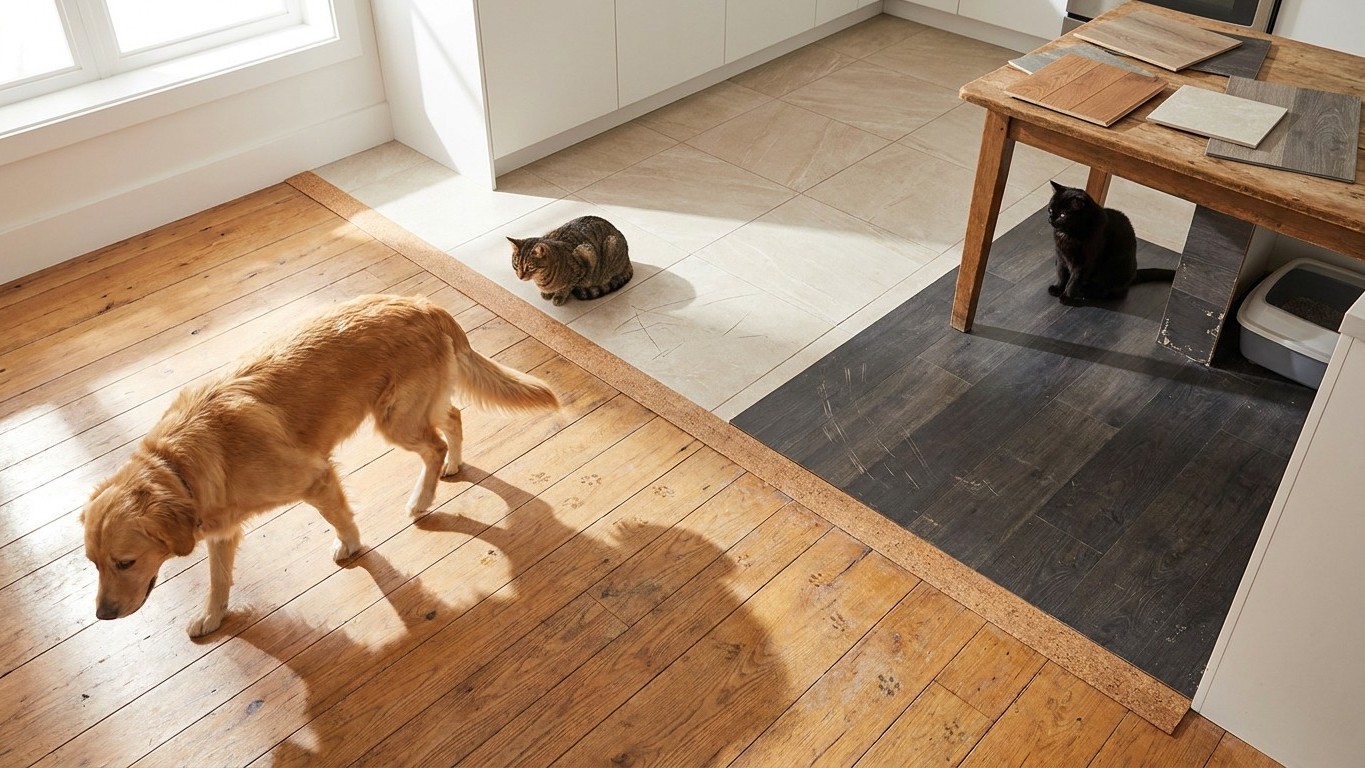

The honest answer: no flooring material handles claws, accidents and traction equally well, so the right choice depends on which of those three risks worries you most. A household with an aging dog that slips needs different traction than a house with two cats and a litter box near the back door. Matching the covering to the actual risk, not to a generic “pet-friendly” label, is what makes the difference.
What is actually happening

The thing to understand here is that scratch resistance is a surface property, stain resistance is a material property, and grip is neither. Three different mechanisms, three different failure points, and most advice collapses them into one vague recommendation.
Scratch resistance lives entirely in the finish or wear layer, the thin skin on top of the plank, tile or slab. A dog’s nails, especially on a large breed that isn’t kept trimmed, drag across that skin every time the animal turns a corner at speed. On some surfaces the finish absorbs the abrasion and shows fine scuffing that buffs out. On others the scratch cuts through the finish into the material underneath, and at that point the damage is permanent, because you’re no longer scratching a coating, you’re scratching the floor itself.
Stain resistance is a different animal. It depends on how porous the material is below the surface, not how hard the top layer is. A urine accident that sits for twenty minutes behaves very differently on a sealed, non-porous surface than on a material with any grain, seam or grout line for liquid to travel through. Once liquid gets past the surface, you’re no longer dealing with a stain you can wipe off. You’re dealing with something the material has absorbed, and it doesn’t always show up right away.
Traction is the one nobody plans for until an animal is sliding across the kitchen on a hardwood floor. It has almost nothing to do with scratch resistance or stain resistance. A glass-smooth, high-gloss finish can be extremely scratch resistant and still be dangerous for a fifteen-year-old dog with weak hips, because grip comes from texture, not hardness. This matters more than most owners realize: older pets and large breeds develop joint problems that make repeated slipping on smooth floors a real physical risk, not just an inconvenience.
When an accident does soak past the surface and reach the subfloor, the question of how much moisture got in and how deep isn’t something you answer by eye. That’s the job of a moisture meter, a tool a flooring inspector or contractor runs against the subfloor material itself, not the finish. It tells them whether what looks like a surface stain has become a subfloor problem, which changes everything about what happens next.
The covering, or what is under it
No single flooring type wins on all three fronts. Ranking them honestly means admitting that the material best at resisting scratches is often mediocre at traction, and the material best at hiding stains is sometimes the easiest to gouge. Here’s how the common options actually compare when claws, accidents and traction are judged separately.
| Covering | Scratch resistance | Stain/moisture resistance | Traction for pets |
|---|---|---|---|
| Solid hardwood | Weak, finish scratches show quickly with active dogs | Poor once finish is breached; seams let moisture reach the wood | Moderate, worse with high-gloss finishes |
| Engineered wood | Similar to solid hardwood at the surface | Better core stability, but face veneer still stains if soaked | Moderate |
| Laminate | Good on the wear layer, but edges swell if liquid sits in seams | Weak at joints. The core swells rather than staining | Poor to moderate, smooth finishes can be slick |
| Vinyl (sheet or plank) | Good, resists surface scratching well | Very good, largely non-porous | Good, especially with textured finishes |
| Tile | Excellent on the tile itself, grout is the weak point | Excellent on glazed tile, grout lines absorb and stain | Poor when glazed and wet, better with textured or matte tile |
| Carpet | Not applicable in the same way, fibers snag rather than scratch | Poor, padding underneath absorbs everything | Best for traction, worst for accidents |
That table is where the family rule this site keeps repeating actually matters: separate the covering from what’s under it. A scratched hardwood plank is a covering problem, you can screen and refinish the surface without touching anything below. A cupped or buckled plank near a spot where a dog has repeatedly had accidents is not a covering problem anymore, it’s the subfloor reacting to moisture it absorbed through the seams over time. Sanding that cupped board flat without addressing the moisture source underneath just gives you a flat board that cups again in a few months.
The same split applies to grout. A stained grout line is a surface condition you clean or reseal. A soft, spongy spot in the subfloor beneath a tile that’s been near a litter box for years is a different problem entirely, one that starts with the substrate, not the tile on top of it.
What to check, in order
Work through these from least invasive to most, and stop at the point where the next step requires lifting flooring. Each check tells you something specific, and just as importantly, rules something out.
- Look at the wear pattern along the pet’s regular path. Check the route from the pet’s bed to the door, or to the water bowl. Fine surface scuffing that catches the light but doesn’t catch a fingernail is finish wear, purely cosmetic. Grooves you can feel with a fingernail mean the scratch has gone past the finish into the material, which rules out a simple polish fix.
- Check baseboards and corners for dark spots or a faint ammonia smell. This finds accidents that were cleaned on the surface but never fully addressed underneath. A visible ring or discoloration at a baseboard joint suggests liquid traveled sideways under the flooring, which a surface cleaning would never catch.
- Do a simple water bead test on seams and grout lines. Drop a small amount of water on a seam, a grout line, or a plank joint and watch whether it beads up or gets absorbed within a minute or two. Beading rules out a failed seal at that spot. Absorption tells you the protective layer there is gone, which is exactly where future accidents will do damage.
- Press gently on the floor near known accident zones. A firm, unyielding feel rules out subfloor softening. Any give, bounce, or slightly spongy feel under your palm or foot suggests the subfloor has taken on moisture over time, and this is the point where a visual check stops being enough.
- Bring in someone with a moisture meter for the subfloor itself. This is the step that requires lifting a section of flooring or drilling a small test point, and it’s where a homeowner’s inspection ends and a professional’s begins. The meter tells the inspector whether the subfloor moisture is isolated to one spot or has spread, which determines whether the fix is a patch or a larger tear-out.
Stop at step four if everything feels solid. There’s no reason to open up a floor that passes the water bead test and doesn’t give under pressure.
When this stops being a flooring job
Three things end this page and hand the problem to someone else. The first is anything Structural, meaning joists, beams or support posts that have softened or sagged under a subfloor that’s been wet for a long time. That’s a structural engineer’s call, not a flooring contractor’s, because the fix involves load-bearing repair, not surface replacement. The second is active water, a leak that’s still happening rather than a stain from something that happened once. That’s a plumber’s job to trace and stop before any flooring work makes sense, since replacing a floor over an active leak just means doing it again in a year. The third is a wet smell that’s persisted long enough to suggest mold or rot in the subfloor material itself. At that point a flooring fitter can’t just sand or refinish over it, the affected material needs to come out and the moisture source needs to be found first.
A flooring fitter handles the covering: the boards, tiles, planks or finish you can see and touch. A plumber handles where water is getting in from a pipe, appliance line or fixture. A structural engineer handles what happens when water has been sitting long enough to compromise the framing underneath. Those are three different phone calls, and confusing them is how homeowners end up paying for a new floor over a problem that reappears within a season.
If the moisture is arriving from above rather than rising from below, the source is usually a roof or plumbing issue rather than the floor itself. Check the site’s roofing guides for signs of a roof leak tracking down through walls, and the plumbing guides for how to trace a leak back to its fixture before any flooring decision gets made.