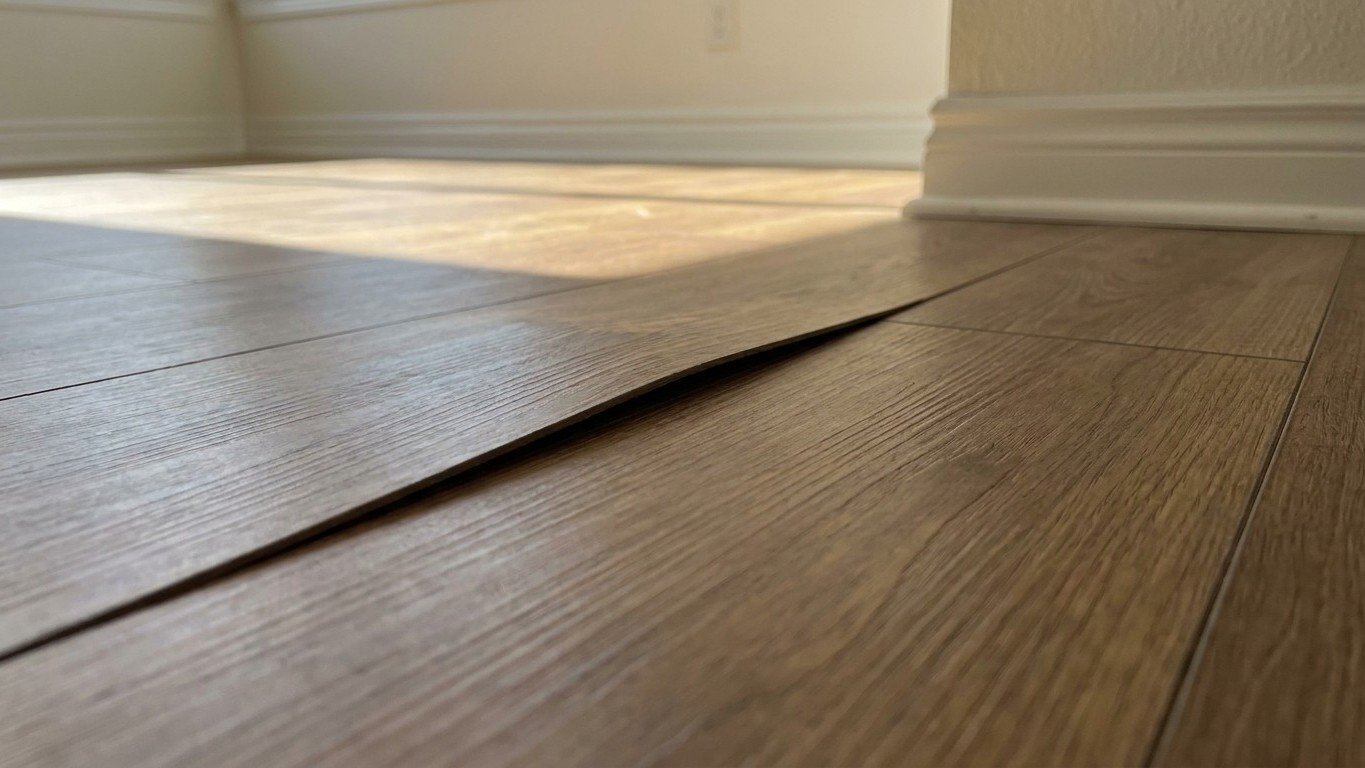

A ridge or hump running along a seam in laminate flooring means the planks have run out of room to expand and are pushing against each other, a wall, or some other fixed point. It’s almost never a flaw in the laminate itself. The fix starts with finding where the floor is trapped, not with sanding, gluing, or replacing the boards that happen to show the damage.
What is actually happening
The thing to understand here is expansion. A laminate floor isn’t fastened to the subfloor at all. It floats, held together only by the locking mechanism between planks, which means the whole room of flooring behaves as one connected sheet rather than a collection of individual boards. That sheet grows and shrinks slightly as temperature and humidity shift through the year, and it needs a gap at every edge, along every wall, doorway, and fixed object, to move into. Installers leave that gap on purpose. Trim or baseboard usually hides it, which is why most homeowners never know it’s there until something goes wrong.
A peak forms when that gap disappears somewhere along the perimeter. If the sheet can’t push outward at the wall, it has nowhere left to go but up, and the weakest point along the run, usually a seam between two planks, is where it buckles first. That’s why the ridge often shows up several feet from the actual obstruction. The floor isn’t lifting where the problem is; it’s lifting where it’s structurally easiest to lift.
Several things close that gap over time. Trim installed too tight, or nailed down through the flooring instead of into the wall, pins the edge in place. Cabinetry, a stair nosing, or a threshold set flush against the boards does the same thing. Debris, adhesive, or shims left in the gap during installation act like a wedge once the floor tries to expand. Even furniture pushed hard against a wall can transfer enough resistance to a floor that’s already tight.
Seasonal swings make the problem visible on a schedule. A floor that was installed with a slightly undersized gap might sit flat all winter and then peak the first humid stretch of summer, when the boards swell and finally meet resistance they didn’t have room for. That’s also why a peak that appears suddenly, rather than gradually, points more toward a blocked edge than toward a slow Structural issue underneath.
The covering, or what is under it
Not every peak has the same cause, and the layer responsible changes what fixes it. The table below separates what you’re likely seeing at the surface from where the actual fault sits, because sanding or refastening a plank does nothing if the real obstruction is at the wall, or if the subfloor underneath is the one moving.
| What you observe | Likely cause | Which layer it belongs to |
|---|---|---|
| Ridge running parallel to a wall, close to the trim line | Missing or closed expansion gap at the perimeter | Covering (installation/trim) |
| Peak right at a doorway or transition strip | Transition installed too tight, no room to expand into the next room | Covering (transition detail) |
| Bump in the middle of a room, away from any wall | Boards pressed by furniture, or debris trapped in the seam during install | Covering |
| Localized peaking with a spongy or soft feel underfoot | Subfloor swelling from moisture, pushing the floating floor up from below | Subfloor |
| Bowing across whole panels, not just at a seam | Sustained dampness under the floor, not a one-time spill | Subfloor / moisture source |
| Peaking plus a squeak or a soft give when walked on | Movement in the subfloor itself, possibly the framing below it | Subfloor / joists |
The first three rows are covering problems. They involve the flooring and its trim, and they’re within reach of a homeowner with a pry bar and some patience. The last three point somewhere else entirely, toward water or movement that has nothing to do with how the laminate was clicked together. A board that’s peaking because the subfloor beneath it is swollen will keep peaking after you replace it, because the new board floats on the same wet surface the old one did. That distinction, covering versus what’s under it, is the one thing worth confirming before touching a single plank.
What to check, in order
Work from the least invasive check to the most, and stop as soon as one of them gives you a clear answer.
- Look at the perimeter first. Pull the baseboard or quarter round in the section closest to the peak. This rules in or out the most common cause instantly: if the flooring is touching the wall or the trim was nailed through the plank instead of above it, you’ve found the fault without needing any tools beyond a pry bar.
- Check every transition and fixed object. Door casings, closet openings, stair nosings, and cabinet toe kicks are common places where an installer left too little room. If the boards butt directly against any of these with no visible gap, that’s very likely your answer, and it rules out anything happening further under the floor.
- Look for debris in the gap. Where the trim is off, check for leftover shims, dried adhesive, or construction debris wedged into the expansion space. Its presence confirms an installation issue. Its absence pushes the likely cause toward moisture or furniture load instead.
- Note what’s happening in the room itself. A vent blowing directly on that section of floor, strong afternoon sun through a window, or a space heater used nearby can all explain why one area swells more than the rest of the room. This doesn’t rule out other causes, but it narrows the pattern.
- Check underneath if you can get there. A basement ceiling or crawlspace below the affected area may show staining, sagging, or dampness that points straight to a subfloor problem. This is the last check you can do without disturbing the floor, and a clear sign here is usually enough to justify pulling boards.
- Bring in a moisture test if the above turn up nothing. A flooring contractor or inspector can run a proper moisture test on the subfloor, which exists to tell whether the wood or concrete underneath is holding more moisture than the flooring can tolerate over time. That test requires lifting a section of flooring to reach the subfloor directly, which is where a homeowner’s own checklist ends and a professional’s begins.
When this stops being a flooring job
Three things mark the line between something you fix with a pry bar and something that needs a different specialist entirely.
The first is anything structural. If the peaking comes with a soft, springy feel underfoot, or if the joists or beams under that section show sagging, rot, or visible damage, no amount of trim adjustment or replaced planks will hold. That’s a call for a structural engineer or a foundation contractor, not a flooring installer, because the floor covering is only reacting to a frame that’s no longer flat or solid.
The second is active water. A subfloor that’s damp because of a running leak, a failed appliance connection, or water intruding from outside will keep swelling no matter how many times the laminate is reinstalled with a wider gap. That’s a plumber’s job if the source is a supply line, drain, or fixture, and it needs to be found and stopped before any flooring work makes sense. If the water is tracking down from above, through a roof, a flashing detail, or a window, that’s a different trade again, and worth checking against a roofing-focused guide rather than treating as a floor issue at all.
The third is anything that’s been wet long enough to smell. A musty or sour odor coming from under the flooring usually means the moisture has been there for a while, not a one-time event, and it raises the likelihood of mold or wood decay that a visual check from above won’t reveal. At that point the right call is a professional who can open the floor, assess what’s underneath, and say plainly whether the subfloor itself needs replacing before anything new goes down.
A flooring fitter can widen a gap, cut back a tight transition, or replace a run of damaged planks. A plumber traces and stops a leak. A structural engineer evaluates framing. Knowing which one you need, before you call anyone, is what keeps a straightforward repair from turning into a guessing game paid for by the hour.