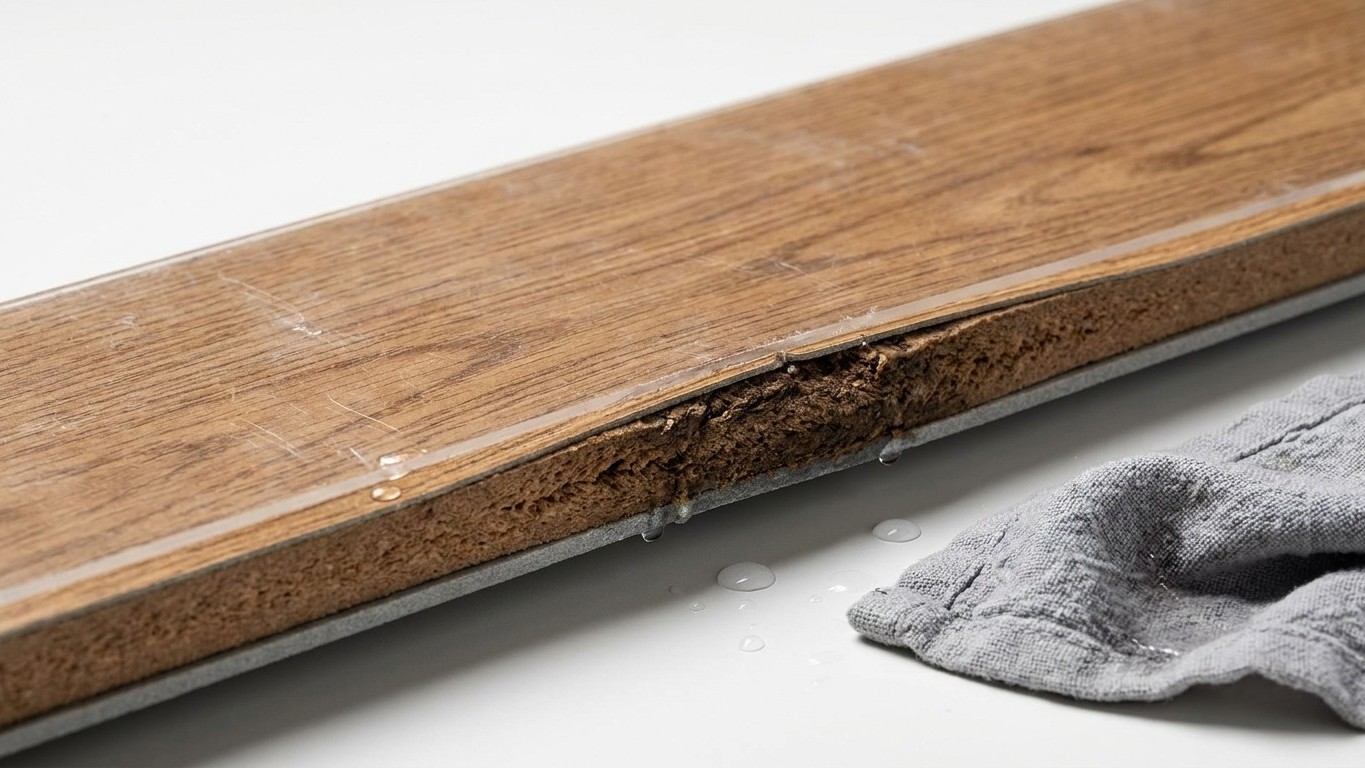

A laminate floor isn’t wood or stone. It’s a photograph of wood or stone, printed on paper, sealed under a clear plastic layer, and glued to a compressed wood-fiber board. That sandwich construction explains why laminate looks convincing from three feet away and why it reacts so badly to something as ordinary as a wet dish towel left on the floor overnight.
What is actually happening

Peel back what you’re standing on and you’ll find four layers doing four different jobs. On top is a clear wear layer, usually melamine resin, whose only purpose is to take the scuffing, the dropped keys, the dog’s claws. Underneath that sits the decor layer, the actual photograph, a high-resolution image of oak grain or slate texture printed onto paper. Below that is the core, almost always high-density fiberboard (HDF), a compressed block of wood fibers and resin that gives the plank its rigidity and its click-lock edges. A thin balancing layer on the bottom keeps the whole plank from warping under normal humidity swings.
The core is where the entire story changes. HDF is wood fiber, and wood fiber drinks water. Solid hardwood can sometimes be sanded, dried out, and saved after a spill. Laminate can’t, because the image you’re looking at isn’t in the material, it’s printed on paper sitting a fraction of an inch above a sponge. Once water gets past the seams and into that fiberboard core, the fibers swell, the plank distorts, and the printed layer on top cracks or lifts because the shape underneath it has changed. There’s no Refinishing that fixes a swollen core. The plank is done, and often its neighbors are too, since water spreads sideways through a floor faster than most people expect.
This is also why flooring contractors run a moisture check on the subfloor before they’ll install laminate in the first place, and why some will re-check a room years later if a homeowner reports cupping or a musty smell. The test itself isn’t about a number the homeowner needs to memorize. It exists to answer one question: is the material underneath this floor dry enough, and staying dry enough, for a moisture-sensitive core to sit on top of it. A contractor or inspector runs it with a handheld meter pressed against the subfloor or the plank itself, and the reading tells them whether to proceed, wait, or go looking for a leak. For a homeowner, the useful takeaway isn’t the reading, it’s knowing that test exists and what triggers someone to call for it: standing water, a musty smell, or boards that have started to cup at the edges.
The covering, or what is under it
Almost Everything that goes wrong with laminate falls into one of two buckets: damage to the printed surface, which is cosmetic and often lives with a plank that still functions fine, or damage that started underneath, in the core or the subfloor, which no amount of surface cleaning will touch. Telling these apart before calling anyone in saves a lot of wasted effort.
| What you observe | What it usually means | Which layer is involved |
|---|---|---|
| Scratches, dulling, or light scuffing | Wear layer abrasion from foot traffic or furniture legs | Covering only |
| Peeling or bubbling right at a seam | Moisture worked into the joint from spills or mopping | Covering failing, core beginning to absorb |
| Boards cupping or lifting at the edges | The HDF core has taken on moisture and swollen | Core, and likely the subfloor beneath it |
| Dark staining or a musty smell near baseboards | Standing or recurring moisture under the floor | Subfloor, sometimes Structural framing |
| A soft, springy feel underfoot in one spot | Subfloor material has softened or delaminated | Subfloor, not the laminate itself |
| Uniform fading in a sunlit room | UV exposure breaking down the printed layer’s pigment | Covering only |
Notice the pattern: scratches and fading are annoyances you live with or replace a plank for, and that’s a covering problem, contained to what you can see. Cupping, staining, and a soft feel underfoot are the floor telling you something is happening below it, and no amount of cleaning, resealing, or replacing the visible plank changes what’s happening in the subfloor. A homeowner who sands down a cupped laminate edge, or swaps a discolored plank for a new one without finding Where the Water came from, will be doing the same job again within a season, because the source was never addressed.
This is the single most useful distinction on this page: a scuffed wear layer is a cosmetic fix, replace the plank or live with it. Anything involving swelling, softness, or smell means the problem started under the floor, and the floor is just the messenger.
What to check, in order
Work from least invasive to most, and stop as soon as one step gives you an answer. None of these require pulling up flooring.
- Scan the pattern of damage. Is it one plank near a window, or does it follow a wall, or is it the whole room? Isolated damage near a heat source or window points to UV or dry-air wear, which is cosmetic. Damage following a wall or spreading from one corner points toward a plumbing or roof source, not general wear. This step rules out “the whole floor is failing” when really it’s one bad seam.
- Check the baseboards and transitions. Pull back a floor vent cover or look where the laminate meets tile or carpet. Staining, gaps, or a musty smell concentrated at one wall usually rules out humidity as the cause and points to a specific leak behind that wall or under that section of subfloor.
- Press and walk the suspect area. A firm, even feel underfoot rules out subfloor softening; a spongy or springy give suggests the subfloor material itself has absorbed water and lost integrity. This is the point where a cosmetic fix stops being enough.
- Look at what’s directly above or below. A bathroom, laundry connection, or kitchen appliance sitting above or adjacent to the affected room is often the actual source, even if the visible damage shows up in the room below or beside it. This step tells you.
- Bring in a flooring contractor for a moisture reading. If the first four checks point to ongoing moisture rather than a one-time spill, this is the point where a professional meter reading on the subfloor tells you whether the material is still actively wet or has already dried. That reading decides whether flooring work can start now or needs to wait.
Steps one through four are things any homeowner can do with a flashlight and a few minutes. Step five is where it becomes worth paying someone, because a moisture meter reading only means something in the hands of someone who installs and diagnoses these floors regularly.
When this stops being a flooring job
Three signs mean you’re no longer dealing with a flooring question, even though a flooring problem is what you noticed first.
Anything structural, meaning joists, beams, or support posts that feel soft, sagging, or visibly damaged when you check underneath, is a call to a structural engineer, not a flooring installer. A flooring contractor can tell you the surface is failing. They generally aren’t licensed or equipped to assess whether the framing holding up your floor is still sound. That’s a different trade, with different tools and different liability.
Active water, meaning you can trace an ongoing source rather than a one-time spill that’s since dried, is a plumber’s call, not a flooring one. Replacing laminate over a leak that’s still running just means doing the replacement again in a few months. If the water is coming from above, a roof leak working its way down through a wall or ceiling, that’s a roofing question first, and this site’s guides on tracing roof and plumbing leaks cover how to find those sources before any flooring decision gets made.
And if a floor has been wet long enough to smell musty, that smell is often a sign of mold growth in the subfloor or framing, which shifts the job again, this time toward a remediation specialist or a general contractor experienced in water damage repair rather than a standard flooring crew. A flooring installer’s job is the surface and what sits directly under it. Once the problem reaches the framing, the plumbing, or the air quality of the room, it needs someone whose job is that specific problem, not someone whose job is laying planks.