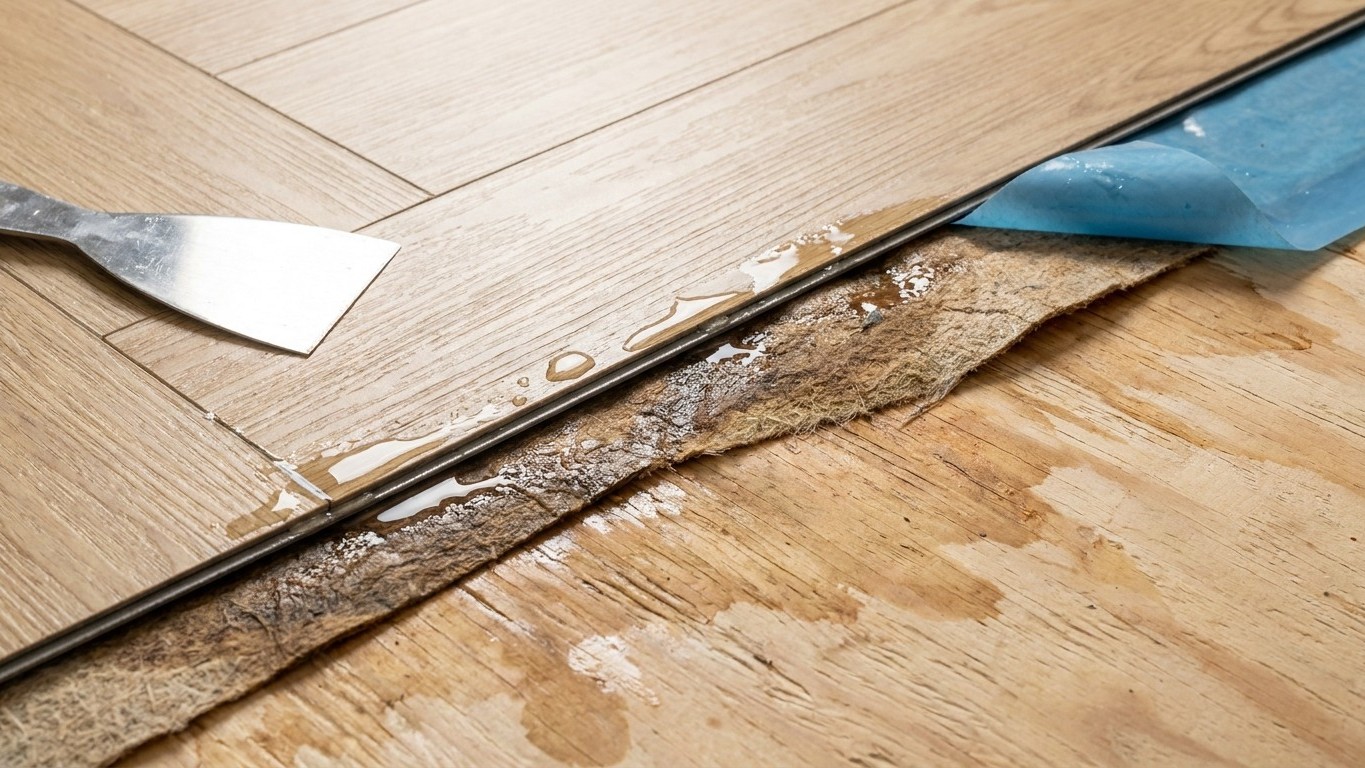

Vinyl plank floors handle water, foot traffic, and daily wear better than almost anything else on the market. What they can’t do is fix a wet subfloor, hide a Structural problem, or stay flat over joists that are already moving. The plank is only as good as what’s underneath it.
What is actually happening

Vinyl plank got popular for a reason that has nothing to do with looks. The plank itself, the visible layer you walk on, is essentially waterproof. Spill a glass of water on it and nothing happens to the plank. That’s the selling point, and it’s true. What isn’t true is that the floor system as a whole is waterproof, because the plank is only one part of an assembly that includes seams, edges, and whatever is directly below it.
Here’s the mechanism that matters: water doesn’t need to get through the plank to cause a problem. It travels along the joints between planks, at the transitions near doorways, tubs, and exterior walls, and along the perimeter where the floor meets baseboard. Once it’s past that edge, it’s sitting on top of the subfloor, or on top of the underlayment, in a space that doesn’t dry the way an exposed surface does. The plank keeps water out of your living room. It also, ironically, keeps water in once it’s underneath.
This is why a floor can look completely fine, dry to the touch, with no staining, and still have water sitting under it for weeks. The visible layer isn’t reporting what’s happening below. A flooring contractor or inspector dealing with a suspected moisture issue will typically run a subfloor moisture test, not to get a dramatic number to quote you, but to answer one narrow question: is the material under this floor holding more water than it should be able to release on its own. That test exists specifically because the surface lies. A vinyl plank floor can pass every visual check and still be sitting over a subfloor that’s been damp long enough to start breaking down.
The other thing that changes the answer to “does vinyl plank work here” is what’s under the subfloor itself. A slab-on-grade in a dry climate behaves nothing like a crawlspace in a humid one, and a bathroom with a poorly sealed tub surround behaves nothing like a hallway. Vinyl plank isn’t one product performing one way everywhere. It’s a surface layer whose real-world performance depends almost entirely on what’s happening one layer down, and that’s the part most buying guides skip past.
The covering, or what is under it
The plank you see and the structure you don’t are two separate problems, and mixing them up is how small issues turn into expensive ones. The table below separates what you’d actually observe from which layer is responsible.
| What you observe | What it usually means | Which layer |
|---|---|---|
| A single board is slightly raised or “peaking” at the seam | Expansion with nowhere to go, often from a tight installation or temperature swing | The covering (installation issue) |
| Boards are cupping or bowing across several feet, not just at one seam | Moisture is being absorbed unevenly from below | What’s under it (subfloor or moisture source) |
| A soft, spongy feel underfoot in one specific spot | The subfloor material itself is degrading in that area | What’s under it (subfloor) |
| A musty smell with no visible staining on the plank | Moisture or mold activity trapped beneath a waterproof surface | What’s under it (subfloor or framing) |
| Gaps opening up between boards in dry winter months | Normal seasonal shrinkage, common and usually cosmetic | The covering (expected behavior) |
| A floor that feels uneven or bouncy over a wider area, not just one board | Movement in the joists or framing, unrelated to the plank | What’s under it (structure) |
Notice the pattern: anything localized to a seam or a single board is usually the covering doing exactly what vinyl plank does, expanding, contracting, occasionally telegraphing a slightly uneven subfloor spot. Anything that spreads across an area, comes with a smell, or feels structural rather than cosmetic almost always belongs to the layer underneath. This is the single most useful distinction in flooring diagnosis, and it’s also the one people skip because it’s faster to just replace the plank and hope. Replacing a cupped board without addressing what made it cup means installing a new plank on top of the same unresolved problem. It will do the same thing again, usually faster the second time.
What to check, in order
Before assuming the worst, work through these checks from least invasive to most. Each one either narrows down the cause or rules something out entirely.
- Look at where the problem sits. Is it isolated to one board, one room, or spread across the whole floor? A single affected board points toward an installation quirk. A pattern that follows an exterior wall or a plumbing wall points toward a water source, not a flooring defect. This step rules out a random manufacturing issue if the pattern is consistent and traceable.
- Check the room’s history. Has there been a recent appliance leak, a slow drip under a sink, a roof issue, or a flood in that area, even a minor one? This rules out mystery causes when there’s an obvious, already-known event behind it.
- Press and listen. Walk the affected area slowly and note where it feels soft, springy, or different from the rest of the floor. This narrows the location without opening anything, and it separates a cosmetic seam issue (feels solid, just visually raised) from a structural or moisture issue (feels different underfoot).
- Check the perimeter and transitions. Look closely at baseboards, door thresholds, and any spot where the floor meets tile or stone, since these are the most common entry points for water working its way under a waterproof surface. Staining or swelling at baseboard specifically suggests water entering from the edge, not from below.
- Call in a moisture test if the pattern points to water. This is where a professional uses a moisture meter or probe on the subfloor itself, not the plank, to determine whether the material below is holding water it shouldn’t be. This is the last check that doesn’t require lifting anything, and it’s the one that turns a guess into a fact.
If the moisture test comes back elevated, or if the soft spot under your foot doesn’t correspond to anything cosmetic, that’s the point where the next step involves opening the floor. Everything up to here can be done by eye, by hand, and with a rented or borrowed meter. What comes after requires pulling planks and looking at the subfloor directly, and that’s a different job.
When this stops being a flooring job
Three things move a project out of flooring territory entirely, and recognizing them early saves both time and money. The first is anything structural: joists that flex, sag, or show visible damage, beams, or support posts that have shifted. That’s not a flooring contractor’s call to make. It’s a structural engineer’s, and no amount of new plank fixes a frame that’s moving.
The second is active water. If a moisture test shows an elevated subfloor and there’s no known past event to explain it, water is likely still coming from somewhere, and finding that source is a plumbing question, not a flooring one. A leaking supply line, a failed drain connection, or a slow leak around a fixture will keep re-wetting a subfloor no matter how many times the floor above it gets replaced. That’s a call to a licensed plumber, and the site’s plumbing and water damage guide walks through how those leaks typically show up before they’re obvious.
The third is smell. A musty odor coming from under a floor that’s been damp long enough to develop it usually means organic material, subfloor, framing, insulation, has been wet for an extended stretch. At that point the concern isn’t just structural integrity, it’s air quality and potential mold growth, and that’s worth a specialist’s assessment before any new flooring goes down. Covering a smell with a new waterproof plank doesn’t solve it. It seals it in.
If the water’s origin traces upward rather than from a pipe, a roof leak or flashing failure can travel surprisingly far from where it enters before it ever shows up as a stain on a ceiling or a damp patch on a floor below. That’s covered in the site’s roofing leak guide, which is worth a look if the affected room sits under an exterior wall, a valley, or a chimney. A flooring fitter can install a beautiful, durable plank floor. What they generally can’t do, and shouldn’t be asked to do, is diagnose a leaking roof three floors up or a shifted foundation footing underneath. Knowing which trade to call, before the new floor goes down, is what actually protects the investment.